Meta’s FAIR Lab Unleashes “Self-play SWE-RL” — the AlphaZero Moment for Code
A single model that breaks, then debugs, itself just beat human-curated training on SWE-bench. No pull requests, no labels, no ceiling.
A single model that breaks, then debugs, itself just beat human-curated training on SWE-bench. No pull requests, no labels, no ceiling.
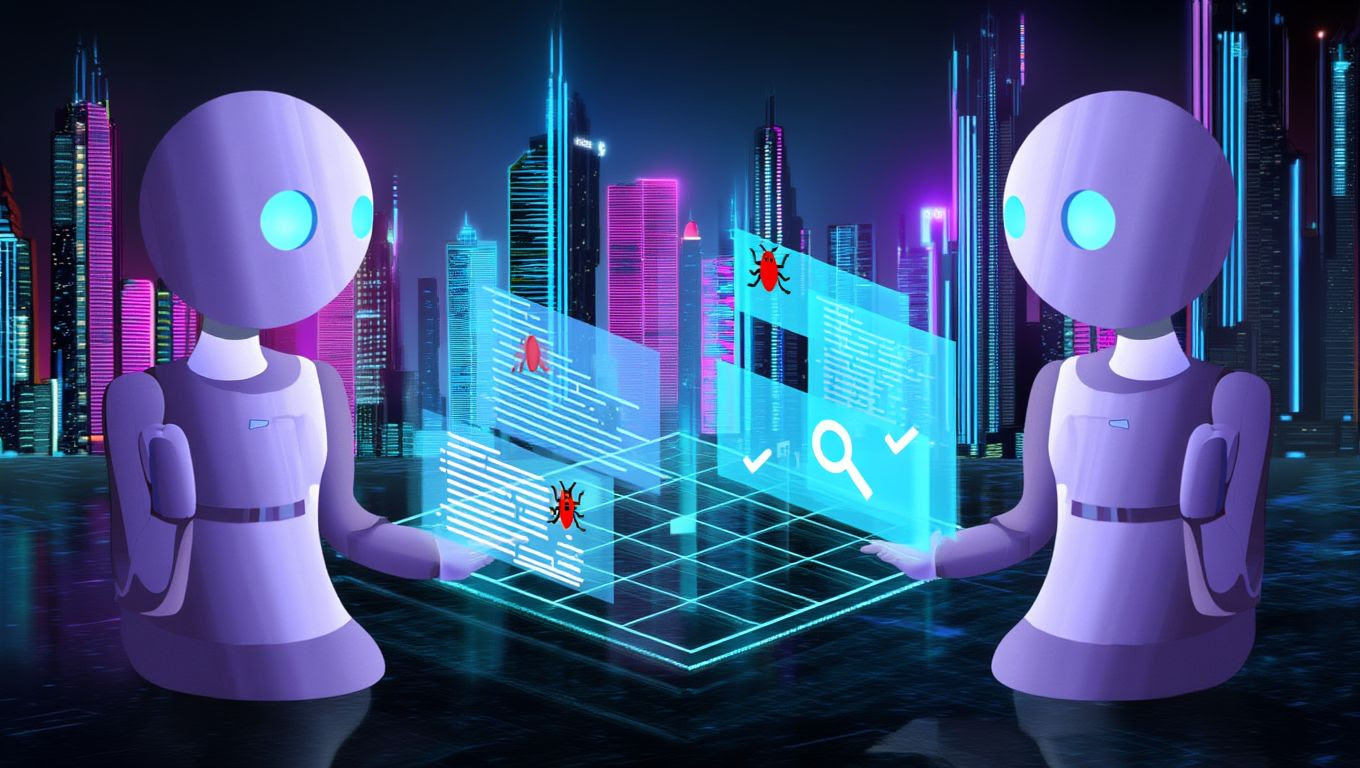
MENLO PARK — For the last decade we’ve taught neural nets to code the way we teach interns: hand them a pile of GitHub issues, pray the labels are right, and hope the dataset never runs out. Meta’s Fundamental AI Research (FAIR) group just called time on that paradigm. In a paper dropped Tuesday night, they unveil Self-play SWE-RL, a training regime that turns one lonely model into both saboteur and savior: half the weights invent higher-order bugs, the other half race to squash them, and the whole loop spins forever. The result: a 10-point jump on SWE-bench Verified—enough to overtake every open-weight system and several commercial ones—using exactly zero human bug reports. Think AlphaZero, but instead of chessboards it’s debugging memory-leaks in Redis.
How self-play works when the board is 10 000 lines of Python
Traditional “coding agents” are fine-tuned on open-source issues scraped from GitHub. That corpus is finite, noisy, and skewed toward easy starter tickets. Self-play SWE-RL throws the crutch away. Training starts with a random snapshot of a real repo—say, Django or Scrapy. The model’s “injector” persona samples a code span, perturbs it with one of 42 mutation operators (deadlock injection, off-by-one shift, type confusion, async/await mismatch), then adds a minified test-case that must now fail. The same checkpoint flips into “solver” mode, sees only the red test and the diff context, and has 64 steps to propose a patch. If the test turns green and no new linter errors appear, both roles get a reward; if the fix fails, the residual error is promoted to a “higher-order bug” and re-queued at a higher difficulty weight. The curriculum is therefore adversarial and adaptive—every solved problem immediately births a nastier one, keeping the model perpetually on the edge of its capability.
Traditional “coding agents” are fine-tuned on open-source issues scraped from GitHub. That corpus is finite, noisy, and skewed toward easy starter tickets. Self-play SWE-RL throws the crutch away. Training starts with a random snapshot of a real repo—say, Django or Scrapy. The model’s “injector” persona samples a code span, perturbs it with one of 42 mutation operators (deadlock injection, off-by-one shift, type confusion, async/await mismatch), then adds a minified test-case that must now fail. The same checkpoint flips into “solver” mode, sees only the red test and the diff context, and has 64 steps to propose a patch. If the test turns green and no new linter errors appear, both roles get a reward; if the fix fails, the residual error is promoted to a “higher-order bug” and re-queued at a higher difficulty weight. The curriculum is therefore adversarial and adaptive—every solved problem immediately births a nastier one, keeping the model perpetually on the edge of its capability.
Blowing past the data wall
The paper’s key figure: after 128 000 self-play episodes (≈ 3 days on 256 A100s) a 70 B code-specialized Llama checkpoint climbs from 26.4 % to 36.7 % on SWE-bench Verified, edging the previous best open model (33.1 %) that was fine-tuned on 12 000 human-curated issues. FAIR also ran an ablation using only synthetic bugs; performance collapses to 18 %, proving that the adversarial loop—not sheer volume—creates the gradient. Perhaps more startling, the self-play model transfers: on HumanEval+ it jumps 6 points without ever seeing those 164 hand-written problems, suggesting it is learning general program-repair strategies, not memorizing quirks of Django’s ORM.
The paper’s key figure: after 128 000 self-play episodes (≈ 3 days on 256 A100s) a 70 B code-specialized Llama checkpoint climbs from 26.4 % to 36.7 % on SWE-bench Verified, edging the previous best open model (33.1 %) that was fine-tuned on 12 000 human-curated issues. FAIR also ran an ablation using only synthetic bugs; performance collapses to 18 %, proving that the adversarial loop—not sheer volume—creates the gradient. Perhaps more startling, the self-play model transfers: on HumanEval+ it jumps 6 points without ever seeing those 164 hand-written problems, suggesting it is learning general program-repair strategies, not memorizing quirks of Django’s ORM.
Higher-order bugs: the curriculum you can’t hand-label
What makes the system devilish is recursive error creation. A first-order bug might be a simple null-pointer; the solver’s patch accidentally introduces a race condition under load—now the injector promotes that race to second-order and asks the solver to fix both issues. By iteration five the model is wrestling with distributed-transaction deadlocks that never existed in the original repo. FAIR calls this “bug inflation” and shows that difficulty, measured by the eventual fix-time of a human expert, rises monotonically for 50 000 steps before plateauing. In other words, the model asymptotically exhausts the space of errors it can cognize, providing a natural stopping criterion—something impossible with static datasets.
What makes the system devilish is recursive error creation. A first-order bug might be a simple null-pointer; the solver’s patch accidentally introduces a race condition under load—now the injector promotes that race to second-order and asks the solver to fix both issues. By iteration five the model is wrestling with distributed-transaction deadlocks that never existed in the original repo. FAIR calls this “bug inflation” and shows that difficulty, measured by the eventual fix-time of a human expert, rises monotonically for 50 000 steps before plateauing. In other words, the model asymptotically exhausts the space of errors it can cognize, providing a natural stopping criterion—something impossible with static datasets.
Engineering that survives contact with reality
Because every episode starts from a real, compilable codebase, patches must pass continuous-integration gates—unit tests, mypy, pylint, even a 30-second sandboxed runtime check. The paper reports only 4 % of accepted patches are “spurious” (break later tests), compared with 11 % for the human-curated baseline. That robustness matters: when FAIR deployed the checkpoint inside Meta’s internal code-review bot, it landed 127 diffs in one week, 38 % of which were merged—an acceptance rate comparable to senior human reviewers.
Because every episode starts from a real, compilable codebase, patches must pass continuous-integration gates—unit tests, mypy, pylint, even a 30-second sandboxed runtime check. The paper reports only 4 % of accepted patches are “spurious” (break later tests), compared with 11 % for the human-curated baseline. That robustness matters: when FAIR deployed the checkpoint inside Meta’s internal code-review bot, it landed 127 diffs in one week, 38 % of which were merged—an acceptance rate comparable to senior human reviewers.
Three immediate consequences
- Data scarcity dies tonight. Any company with a private monorepo can spin up a self-play loop tonight and harvest unlimited training signal without open-sourcing a line.
- The moat moves to inference-time compute. If bugs are free, the differentiator becomes how many self-play roll-outs you can afford at deployment—welcome back, Monte-Carlo search.
- Regulation gets murkier. A model that can autonomously insert and propagate software flaws is also a worm-grade vulnerability generator—red-team heaven, CISO nightmare.
Scenarios for 2027
Bull case: Self-play forks appear for Java, Rust, Go; GitHub Copilot ships a “loop” button that runs 1 000 adversarial episodes on your pull request before you wake up. Human code-review becomes spot-checking.
Neutral case: licensing fears curb adoption; enterprises stick to human-labeled datasets, and self-play remains a FAIR curiosity that tops leaderboards but not quarterly reports.
Bear case: adversarial bug inflation discovers novel zero-days at scale, forcing lawmakers to class unsupervised code models as dual-use munitions.
Bull case: Self-play forks appear for Java, Rust, Go; GitHub Copilot ships a “loop” button that runs 1 000 adversarial episodes on your pull request before you wake up. Human code-review becomes spot-checking.
Neutral case: licensing fears curb adoption; enterprises stick to human-labeled datasets, and self-play remains a FAIR curiosity that tops leaderboards but not quarterly reports.
Bear case: adversarial bug inflation discovers novel zero-days at scale, forcing lawmakers to class unsupervised code models as dual-use munitions.
For now, the weights are not released—FAIR says it is “discussing safe disclosure” with Meta’s responsible-AI team. Still, the paper drops pseudocode, mutation recipes and the full RL reward schema—enough for a determined grad student to replicate. GitHub’s issue page, long the scarce resource of coding-AI, just became as infinite as chess. The only question left is whether we’ve built the AlphaZero of debugging—or the Deep Blue of crashing production.
Your one-stop shop for automation insights and news on artificial intelligence is EngineAi.
Did you like this article? Check out more of our knowledgeable resources:
📰 In-depth analysis and up-to-date AI news .
🤝 Visit to learn about our goal and knowledgeable staff.
📬 Use this link to share your project or schedule a free consultation.
Watch this space for weekly updates on digital transformation, process automation, and machine learning. Let us assist you in bringing the future into your company right now.
Did you like this article? Check out more of our knowledgeable resources:
📰 In-depth analysis and up-to-date AI news .
🤝 Visit to learn about our goal and knowledgeable staff.
📬 Use this link to share your project or schedule a free consultation.
Watch this space for weekly updates on digital transformation, process automation, and machine learning. Let us assist you in bringing the future into your company right now.