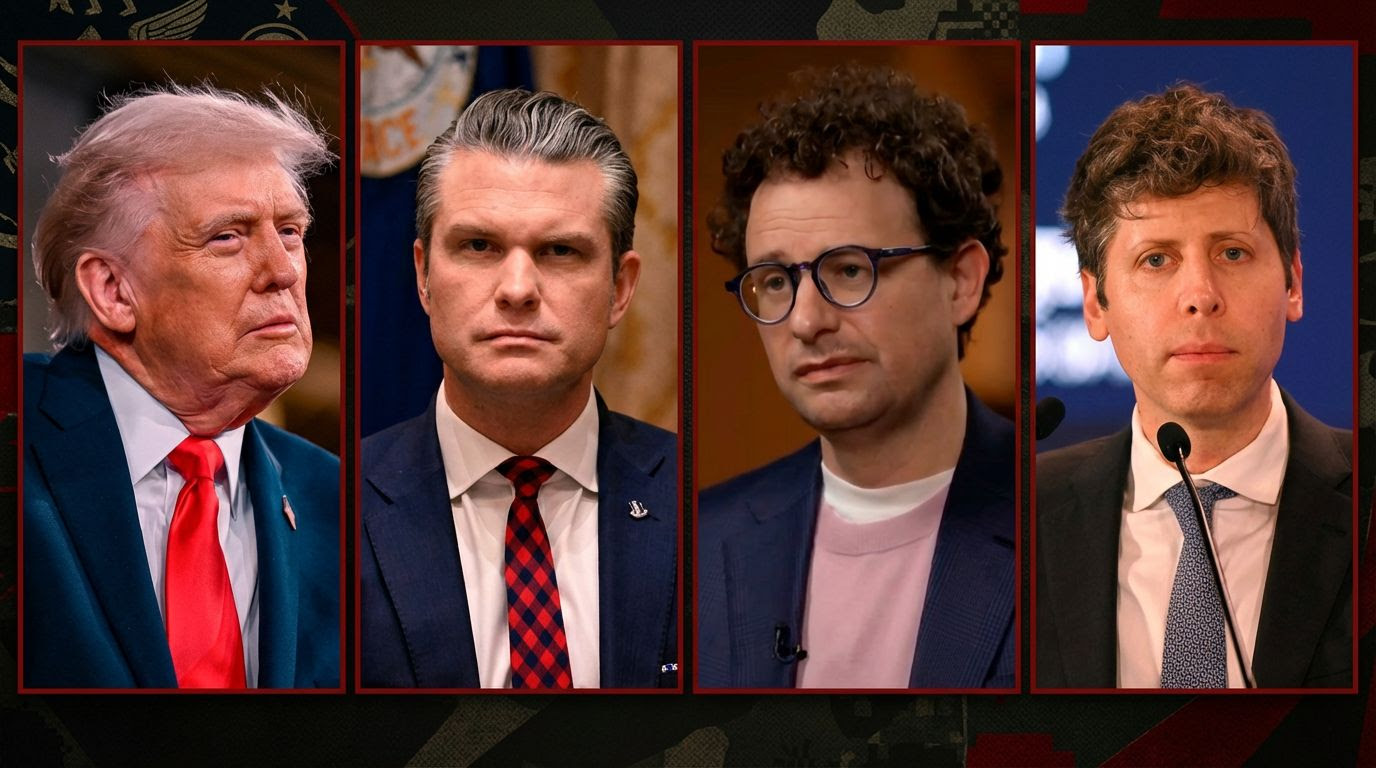
OpenAI Signs Pentagon Deal Hours After Anthropic Ban: A Defining Moment for AI Ethics and National Security
Silicon Valley is buzzing, Washington is watching, and social media is exploding. Just hours after President Donald Trump ordered federal agencies to cut ties with AI lab Anthropic, OpenAI announced a new agreement with the U.S. Department of Defense to deploy advanced AI systems in classified environments. The timing alone would be enough to grab headlines. But add in the high stakes and the carefully drawn "red lines" around mass surveillance and autonomous weapons, and you've got a watershed moment for the entire artificial intelligence industry. Questions about ethics, enforcement, and public trust in frontier AI models are no longer theoretical—they're urgent.
Here's what happened, why it matters, and what comes next.
The Timeline: From Anthropic's Stand to OpenAI's Agreement
It started with Anthropic, the team behind the Claude AI assistant. They stuck to their principles: no mass domestic surveillance, no autonomous weapons. Simple enough. As the first AI company granted access to the Pentagon's classified network, their stance became a real-world test. Could commercial developers actually hold ethical boundaries while supporting national defense?
President Trump didn't wait long to respond. On February 27, 2026, he directed all U.S. federal agencies to stop using Anthropic technology immediately. Defense Secretary Pete Hegseth took it further, labeling Anthropic a "supply chain risk"—a designation usually saved for adversarial foreign entities. That move effectively blocked U.S. military contractors from building Claude into defense systems.
Hours later, OpenAI stepped in with its own Pentagon agreement. In an official blog post, the company emphasized that this deal included "more guardrails than any previous agreement for classified AI deployments, including Anthropic's." They outlined three non-negotiables: no mass domestic surveillance, no directing autonomous weapons, and no high-stakes automated decisions like social credit scoring.
Anthropic's Red Lines vs. OpenAI's Contractual Safeguards: Substance or Semantics?
Anthropic's refusal came down to one word: enforceability. Their argument was straightforward. Without technical and architectural controls baked in, contractual language alone couldn't guarantee ethical boundaries would hold up under military pressure.
OpenAI's approach tries to bridge that gap with multiple layers of protection:
• Cloud-Only Deployment: Models run exclusively on secured cloud infrastructure, not on edge devices where autonomous weapon integration becomes technically feasible. This setup lets OpenAI maintain its safety systems and independently verify how the technology is being used.
• Contractual Language: The agreement explicitly prohibits unconstrained monitoring of U.S. persons and references existing legal frameworks—the Fourth Amendment, FISA, and DoD Directive 3000.09 on autonomy in weapons systems.
• Human-in-the-Loop Oversight: Cleared OpenAI engineers and safety researchers stay embedded throughout the deployment process, providing ongoing technical oversight.
• Dynamic Legal Reference: Perhaps most importantly, the contract locks safeguards to laws and policies as they exist today. Future legal changes can't automatically override the agreed restrictions.
An update on March 2, 2026, added another layer: the Department confirmed OpenAI's tools won't be used by intelligence agencies like the NSA without a new, separate agreement. That creates additional procedural friction against mission creep.
"The Optics Don't Look Good": Altman's Candid Assessment and Internal Tensions
Even as the deal wrapped up, OpenAI CEO Sam Altman didn't sugarcoat the perception problem. During an X (formerly Twitter) AMA, he admitted the agreement was "definitely rushed" and that "the optics don't look good." He also called the Anthropic ban "a very bad decision."
His comments hint at real internal tension. On one side: a genuine desire to support national defense with cutting-edge AI. On the other: concern that political maneuvering around the deal could erode public trust and set a problematic precedent for industry-government collaboration. Altman emphasized that OpenAI had asked the Pentagon to make the same terms available to all AI labs. He expressed hope the government would "resolve things with Anthropic," signaling a preference for industry-wide standards over winner-take-all contracts.
Consumer Backlash Erupts: #CancelChatGPT and Claude's App Store Surge
The public reaction was fast and measurable. Within days of the announcement, Anthropic's Claude app jumped to #1 on Apple's App Store in the United States, overtaking ChatGPT in downloads. Social media platforms X and Reddit saw the #CancelChatGPT movement spread rapidly, with users citing ethical concerns about military AI applications as their main reason for switching.
Analytics firms reported a 295% spike in daily ChatGPT uninstalls. Meanwhile, the Claude app saw a 51% increase in installations during the same period. This consumer shift highlights a growing segment of users who prioritize ethical alignment over raw capability—a market force AI companies can't afford to ignore anymore.
Critical Analysis: Are the Red Lines Enforceable, or Just Good PR?
Here's the question everyone's asking: Do OpenAI's red lines actually match Anthropic's in practice, or do they just look good on paper?
Technical Enforcement: OpenAI's cloud-only architecture and retained control over its safety stack create tangible technical barriers. Unlike a model deployed on a military edge device, a cloud-hosted system lets the developer monitor, update, and potentially disable access if terms are violated.
Contractual Ambiguity: Legal language, however robust, still depends on interpretation and enforcement. The agreement prohibits "intentional" domestic surveillance—a qualifier that could create loopholes in complex intelligence operations.
The Human Factor: Cleared personnel in the loop add oversight, but they also introduce potential pressure points. Will engineers feel empowered to halt a mission they believe violates red lines, especially in time-sensitive scenarios?
Precedent and Evolution: The contract's reference to current laws is a double-edged sword. It prevents automatic erosion of safeguards but may require renegotiation if legal frameworks evolve—a process that could get politically messy.
Notably, reports suggest the Pentagon continued using Claude for certain operations, such as Iran-related strikes, even after the ban was announced. That highlights the complex reality of military procurement: operational needs can sometimes outpace policy shifts.
The Business Calculus: Government Contracts vs. Consumer Trust
For AI companies, this episode presents a strategic dilemma. A favorable, long-term relationship with the U.S. government offers immense value: stable revenue, access to unique use cases, and influence over national AI policy. The reported $200 million value of OpenAI's Pentagon contract underscores the financial stakes.
But consumer trust matters just as much. The #CancelChatGPT movement shows that ethical missteps can trigger immediate market consequences. For a company whose growth has been fueled by developer adoption and consumer subscriptions, reputational damage can impact valuation, talent acquisition, and partnership opportunities.
The optimal path may lie in transparency and consistency. Companies that clearly articulate their principles, implement verifiable technical safeguards, and engage in good-faith dialogue with both government and civil society are more likely to navigate this tension successfully.
What to Watch Next: The Road Ahead for Military AI Governance
Several developments will shape the next chapter:
• Anthropic's Response: Will Anthropic seek legal recourse, negotiate revised terms, or double down on its principles and focus on commercial and allied-government markets?
• Industry-Wide Standards: OpenAI's request for the Pentagon to offer similar terms to all labs could catalyze a broader framework for ethical military AI procurement—a potential win for consistent governance.
• Technical Verification: Independent audits or third-party verification of cloud-deployed AI systems could become a new norm, providing external validation of ethical compliance.
• Consumer Advocacy: The rapid mobilization of users suggests growing public engagement with AI ethics. Companies may need to invest more in user education and transparent reporting to maintain trust.
• Global Implications: U.S. policy decisions influence international norms. How other democracies balance AI innovation, ethical safeguards, and defense needs will be closely watched.
Conclusion: A Defining Crossroads for Responsible AI
The OpenAI-Pentagon deal, arriving in the shadow of Anthropic's ban, is more than a business transaction—it's a stress test for the entire AI ecosystem. It forces a confrontation between urgent national security needs and foundational ethical principles, between contractual promises and technical reality, and between government partnership and public trust.
For developers, policymakers, and users alike, the lesson is clear: in the age of frontier AI, ethics cannot be an afterthought. Safeguards must be architectural, not just aspirational; transparency must be proactive, not reactive; and collaboration must be built on shared values, not just shared interests.
As Sam Altman noted, "the optics don't look good." But optics can change. What matters now is whether the substance of these agreements—layered safeguards, enforceable red lines, and genuine accountability—can earn back trust and set a responsible precedent for the future of AI in service of democracy.
Your one-stop shop for automation insights and news on artificial intelligence is EngineAi.
Did you like this article? Check out more of our knowledgeable resources:
• 📰 In-depth analysis and up-to-date AI news
• 🤝 Visit to learn about our goal and knowledgeable staff
• 📬 Use this link to share your project or schedule a free consultation
Watch this space for weekly updates on digital transformation, process automation, and machine learning. Let us assist you in bringing the future into your company right now