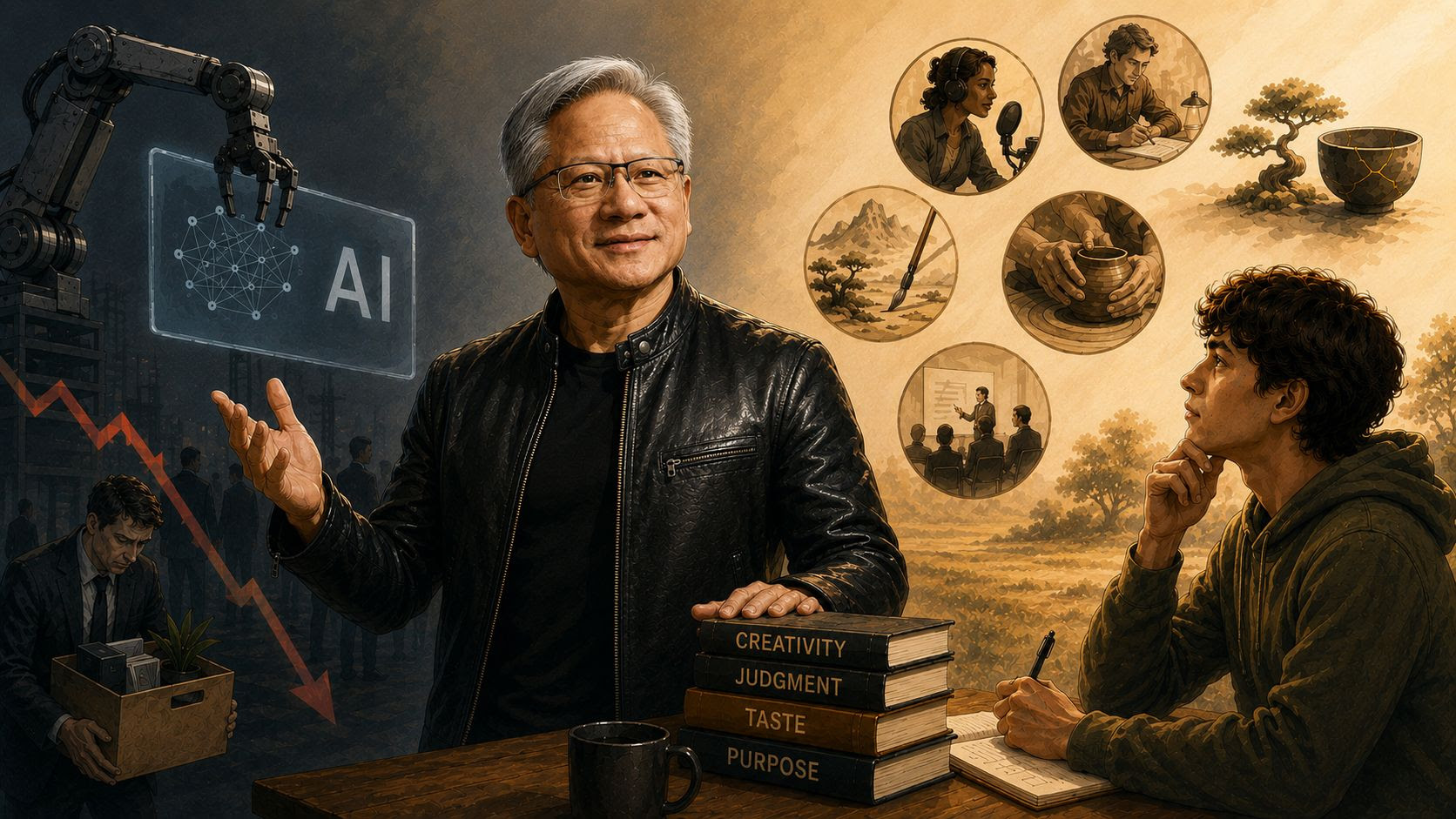
Jensen Huang to Parents: Stop Obsessing Over What Your Kids Study
The scene is familiar. A parent sits at the kitchen table, scrolling through headlines. “AI will replace 300 million jobs.” “Goldman Sachs says 60% of workers are in roles that didn’t exist in 1940.” “Your kid’s dream career? Probably automated by the time they graduate.”
Panic sets in. Should they push their child toward computer science? Away from computer science? Toward prompt engineering? Away from anything a chatbot can do?
Jensen Huang, the CEO of Nvidia, has a message for that parent. And it’s probably not what they expect.
Speaking with CNA in a recent interview, Huang told parents to stop obsessing over what their kids study. Not because it doesn’t matter. But because the skills that mattered before AI will still matter after AI. The difference is that AI becomes a tool—a powerful one—not a replacement for the human at the center.
“The best thing you can do is ask: how can AI help elevate my learning, my craft, my purpose?” Huang said. “Not: what subject is AI-proof?”
It’s a striking piece of advice from a man whose company makes the hardware that powers the AI revolution. Nvidia’s chips are in every major AI lab. Huang has more reason than almost anyone to believe in AI’s capabilities. And yet he’s telling parents not to overcorrect. Not to panic. Not to treat AI as an existential threat to their children’s futures.
The interview is worth reading in full. But the core argument breaks down into three parts: the case for timeless skills, the beauty of imperfection, and why the “AI is stealing jobs” narrative might be lazier than we think.
The Journalism Test
Huang used journalism as an example, which is interesting because journalism is one of the industries that people have been predicting will be hollowed out by AI for years.
If you believe the hype, AI can already write articles. It can summarize earnings reports. It can generate listicles. It can do a passable imitation of a breaking news alert. So why would anyone need human journalists?
Huang’s answer: because the best journalists do things that AI cannot do, and those things are not mysterious.
“They not only prepare questions,” he said. “They listen. They think about the audience. They respond dynamically.”
That’s four distinct skills. Preparation is mechanical—AI can help there. But listening? That’s attention. Thinking about the audience? That’s empathy and judgment. Responding dynamically? That’s improvisation, context-switching, and real-time decision-making.
None of those are easy to automate. Not because they’re technically impossible, but because they are fundamentally social. They are about reading a room, sensing tension, knowing when to push and when to pause. A journalist who just recites prepared questions is replaceable. A journalist who listens and adapts is not.
Huang’s point applies beyond journalism. A doctor who just follows a checklist is replaceable. A doctor who reads the patient’s face, who notices the hesitation, who asks the right follow-up question—that doctor is practicing medicine, not just applying protocols. A teacher who just delivers a script is replaceable. A teacher who sees confusion in a student’s eyes and changes tack mid-lesson—that teacher is teaching.
The pattern is the same. Mechanical competence is getting cheaper. Human judgment, emotional intelligence, and adaptive creativity are getting more valuable.
Wabi-Sabi and the Beauty of Imperfection
The most unexpected part of Huang’s interview was his invocation of wabi-sabi.
For those who don’t know, wabi-sabi is a Japanese aesthetic concept. It finds beauty in imperfection, transience, and incompleteness. A cracked ceramic bowl repaired with gold. A moss-covered stone. A flower arrangement that’s slightly asymmetrical. The idea is that flaws are not errors to be eliminated. They are features that make something real.
Huang suggested that as AI becomes more capable of producing perfect, polished, error-free outputs, humans will start to value the opposite. Not sloppiness. But the marks of humanity—the quirks, the idiosyncrasies, the choices that no algorithm would make.
Think about it this way. AI can generate a thousand logos in a minute. They will be well-composed, color-balanced, and on-trend. But a human designer brings something else: a history, a point of view, a willingness to break a rule because it feels right. That’s not a bug. That’s the whole point.
“Uniquely human qualities will become more prized across domains,” Huang said.
This is not a fringe opinion. You hear variations of it from artists, writers, and musicians who have watched AI produce technically competent but emotionally flat work. The stuff that feels alive is the stuff that has a human behind it, taking risks, making mistakes, leaving traces.
The paradox is that as AI gets better at perfection, imperfection becomes a signal of authenticity. And authenticity, in a world of infinite synthetic content, is scarce.
The “Lazy” Narrative
Huang also took a swing at the doom-and-gloom narrative about AI and jobs. He called it “lazy.”
“AI has just arrived,” he said. “How is it possible they’re already losing jobs?”
This is the most controversial part of his interview. Because the fact is, people are losing jobs. According to the article, more than 80,000 jobs have already been cut this year in favor of AI. CEOs are announcing layoffs and citing automation. The numbers are real. The anxiety is real.
Huang is not denying that jobs will change. He’s questioning the causal story. Is AI actually replacing those workers, or are companies using AI as an excuse for layoffs they wanted to do anyway? Are the jobs gone because AI does them better, or because the narrative gives cover for cost-cutting?
He has a point. The timeline is suspicious. AI didn’t suddenly become capable last week. The technology has been improving steadily for years. But the layoffs—the big, headline-grabbing ones—coincide with a post-pandemic correction, rising interest rates, and a broader tech downturn. AI is the story executives tell because it sounds futuristic and inevitable. It shifts blame from management decisions to technological forces.
None of this means AI won’t displace jobs. It will. Some categories of work will shrink. But the lazy narrative is the one that says “AI is coming for your job” as if that’s the end of the story. The real story is more complicated, more interesting, and more contingent on human choices.
What Huang Isn’t Saying
To be fair to the skeptics, Huang’s advice is easier to give when you run a company valued at over $2 trillion. His children, if he has them, will never worry about rent. The luxury of “study what you love” is not evenly distributed.
There’s also an implicit assumption that the economy will continue to reward human creativity and judgment at a premium. That’s likely true for the top quartile of performers in any field. But what about the middle? What about the competent but not exceptional? Those are the workers most at risk from automation, and Huang’s advice—“focus on your unique human qualities”—might feel abstract to a bookkeeper or a customer service representative whose job is being automated away.
Huang would probably respond that those roles are changing, not disappearing. The bookkeeper who learns to use AI to reconcile accounts faster is more valuable, not less. The customer service rep who uses AI to handle routine queries and focuses on the emotionally complex calls is more valuable, not less.
That’s the optimistic case. The pessimistic case is that the middle hollows out anyway, and only the high-creativity, high-judgment roles survive. Huang clearly believes in the optimistic case. But he’s not presenting evidence for it. He’s stating a belief.
The Broader Expert Consensus
Huang’s advice actually puts him in pretty good company.
Over the past year, a surprising number of experts have converged on similar recommendations. Don’t chase “AI-proof” careers. Don’t major in prompt engineering—it’s a temporary skill, not a discipline. Instead, focus on things that are durable: critical thinking, communication, collaboration, creativity.
The World Economic Forum’s future of jobs report consistently ranks these “human skills” as increasing in importance, even as technical skills become more specialized. A study from MIT and Stanford found that AI tools boost productivity most for lower-skilled workers, suggesting that the technology is more of an equalizer than a replacement. And surveys of executives consistently show that they value judgment, ethics, and emotional intelligence more than raw technical ability when hiring for roles that will interact with AI.
The consensus is not that AI is harmless. It’s that the response to AI should not be to hide in a “safe” major that probably isn’t safe anyway. The response should be to learn how to use AI as a lever for whatever you already care about.
What This Means for Parents (and Students)
If you’re a parent reading this, Huang’s advice translates into a few concrete actions.
First, stop vetoing your kid’s interests because you think they’re not “AI-proof.” There is no such thing. History is littered with careers that were supposed to be safe and weren’t, and careers that were supposed to be doomed and weren’t.
Second, encourage your kids to learn how to use AI tools. Not as a substitute for thinking, but as a way to think faster, research deeper, and iterate quicker. The kid who can write an essay and the kid who can use AI to outline, draft, and revise that essay in half the time—the second kid has a superpower.
Third, invest in the stuff that doesn’t change. Reading comprehension. Clear writing. Basic numeracy. The ability to hold a conversation. The willingness to be wrong and learn from it. These are not sexy. They are also not going away.
Finally, model the behavior. If you’re a parent who panics about AI, your kids will panic too. If you treat AI as a tool—interesting, powerful, but not magical—they will too.
The Deeper Question
Underneath all of this is a question that Huang didn’t directly answer, but that lingers over the whole interview.
What happens if the optimistic case is wrong? What if AI does replace significant numbers of workers, not just tasks? What if the jobs that remain require levels of creativity and judgment that most people don’t have or can’t develop?
Huang’s answer, implicit but clear, is that we cross that bridge when we come to it. Panicking now doesn’t help. Preparing now does. And the best preparation is not to flee from AI but to learn to work with it.
It’s a very engineer’s answer. Identify the problem. Build the tools. Adapt. Iterate.
Whether that works for an entire society, at scale, under political pressure, with all the messiness of real human lives—that remains to be seen. But Huang is not a sociologist. He’s a technologist. He’s giving the advice he knows how to give.
And for a lot of parents, it might be exactly what they need to hear: stop panicking, start learning, and trust that human beings have adapted to every technological revolution before this one. This time is different—every time is different. And yet, here we still are.
The Takeaway
Jensen Huang is not a parenting expert. He’s not a labor economist. He’s a CEO who builds chips. But he’s also a remarkably clear thinker about the relationship between humans and machines. And his advice to parents is refreshingly simple in a moment of overwhelming complexity.
Don’t obsess over what your kids study. Obsess over whether they know how to listen, adapt, and bring their full humanity to whatever they do. Those skills were valuable before AI. They’ll be valuable after.
The rest is just details. Important details, yes. But details nonetheless.
Your one-stop shop for automation insights and news on artificial intelligence is EngineAi.
Did you like this article? Check out more of our knowledgeable resources:
Watch this space for weekly updates on digital transformation, process automation, and machine learning. Let us assist you in bringing the future into your company right now