This Startup Wants to Give AI Something It Has Never Had: A Memory That Lasts
Here’s a quirk of modern AI that almost no one talks about outside of research labs.
The models that power your chatbot, your code assistant, and your customer support system are frozen. They are statues. They were trained on data from months or years ago, and they do not learn a single thing from your interactions with them.
You correct the AI. It apologizes. And then it makes the exact same mistake five minutes later. Because the correction went nowhere. It was a temporary course correction, not a permanent update. The model doesn’t remember you. It doesn’t remember being wrong. It doesn’t get better.
This is not a bug. It’s the design. Current AI systems are trained once, evaluated, and then deployed in a fixed state. If you want them to improve, you have to collect new data, retrain from scratch or fine-tune on a batch, and redeploy. That takes weeks or months. In the meantime, the model is as smart as it was last quarter.
A new startup called Trajectory thinks this is insane. And they’ve raised $15 million to fix it.
The Founding Team and the Vision
Trajectory comes out of stealth today with a $15 million seed round led by Conviction and Bessemer. The founding team reads like a who’s-who of serious AI engineering: ex-DeepMind, ex-Apple, ex-OpenAI, ex-Meta SuperIntelligence Lab, ex-Scale AI. These are not people who build wrappers around ChatGPT. These are people who have built frontier models and know exactly where the limitations are.
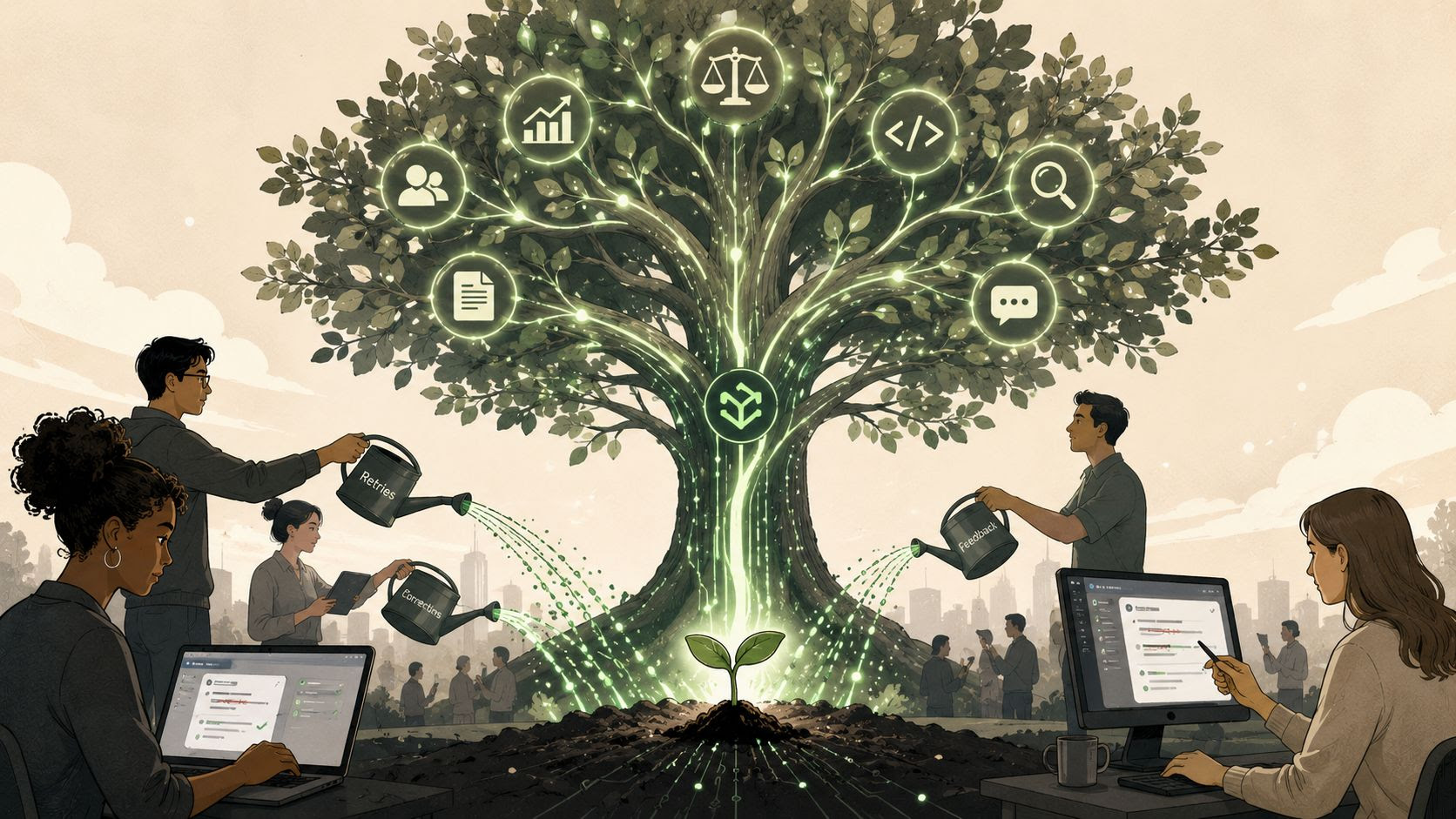
Their insight is simple. The most valuable data for improving an AI system is not the training data from the internet. It’s the interaction data from real users using the system in production. Every time a user corrects a model, retries a prompt, or edits an output, they are providing a free training signal. Today, that signal is thrown away. Tomorrow, Trajectory wants to capture it and use it to improve the model continuously.
The company’s name is not accidental. Trajectory is about the path a model takes through time—getting smarter, fixing its mistakes, adapting to new situations. Not a frozen snapshot. A learning system.
What They Actually Built
Trajectory is a platform that sits between your application and your AI model. It captures three things:
Corrections. When a user says “no, that’s wrong” and provides the right answer, Trajectory logs the pair (wrong output, correct output).
Retries. When a user re-prompts because the first answer was bad, the platform captures both attempts.
Edits. When a user manually fixes an AI-generated output, that edit becomes training data.
These signals are then used to post-train the model—not from scratch, but as a lightweight continuous update. The model doesn’t forget what it learned pre-training. It just adds new knowledge from the corrections.
The technical challenge is doing this without catastrophic forgetting (where the model learns the new thing but forgets the old thing) and without overfitting to a single user’s quirks. Trajectory says they’ve solved both problems through a combination of selective sampling, regularization, and careful data filtering.
Early results are promising. Trajectory claims its post-trained models outperform frontier AI on crucial narrow tasks for its early customers. That’s a strong claim. The proof will be in the production deployments.
The Early Customers
Trajectory launched with a handful of design partners, and they’re not small names.
Clay is a creative AI platform for musicians and producers. Their users interact with generative models constantly, tweaking outputs, regenerating, editing. Every one of those interactions is a signal about what the user actually wanted.
Harvey is a legal AI assistant. Lawyers correct it constantly—this citation is wrong, this argument misses a precedent, this clause is poorly worded. Today, those corrections just make the current session better. Tomorrow, they would make Harvey better for every user.
Decagon builds AI for customer support. Their models handle millions of conversations. Every time a human agent overrides the AI’s answer, that’s gold.
Rogo is an AI for investment research. Analysts are picky. They want precise data, correct calculations, proper sourcing. Corrections are frequent and high-value.
These are not toy use cases. They are real businesses with real users, real mistakes, and a real need for models that improve over time. If Trajectory can deliver, these customers will see compounding quality gains.
Weekly Updates, Then Hourly, Then Continuous
Today, Trajectory’s models are post-trained every week. That’s already faster than the industry norm (which is months, if at all). But it’s not the final target.
The company says it’s working toward hourly updates. And the real moonshot: an update at every interaction. A model that learns from a correction and applies that learning immediately, for all users, without a batch process.
That’s technically brutal. Real-time learning at scale requires solving problems that have stumped researchers for years. Stability (the model shouldn’t oscillate). Privacy (you can’t leak user data across sessions). Compute efficiency (retraining every minute is expensive). And evaluation (how do you know the model is actually getting better?).
Trajectory is not claiming to have solved all of these yet. But they’re building toward it. The weekly updates are the first step. Hourly is the next. Continuous is the vision.
Why This Matters for Businesses
If you run a business that uses AI, you have a problem you might not even recognize.
Your AI model was trained on general data from the internet. It doesn’t know your specific product, your specific customers, your specific edge cases. You can fine-tune it on your data, but that’s a batch process. You do it once. Then the model is frozen again.
Meanwhile, your users are correcting the model constantly. Those corrections are the most valuable data you will ever get. They tell you exactly where the model is failing for your actual use cases. Today, that data is just making the current session slightly less frustrating. Tomorrow, it could make the model permanently better.
That’s the value proposition of continual learning. Your AI gets smarter every day because your users are teaching it. Not in a lab. Not with synthetic data. In production, on real tasks, with real feedback.
For businesses, this is the holy grail. Not a model that is good enough at launch. A model that compounds in quality over time, getting better every week, every day, every interaction.
The Comparison to Human Learning
The Trajectory team uses an analogy that I find helpful.
Humans don’t learn by being trained once on a static dataset. We learn by doing. We try something. We fail. We get feedback. We adjust. We try again. That loop—action, feedback, adjustment—is the engine of human skill acquisition.
Current AI skips the feedback and adjustment steps. It acts. It fails. And then it forgets that it failed. The next time, it fails in exactly the same way.
Trajectory is trying to close the loop. Act, get feedback, adjust, remember the adjustment, act better next time. That’s not just better AI. That’s a different kind of AI. An AI that lives in time. An AI that has something like a memory of its own mistakes.
The company is careful not to overclaim. They’re not building AGI. They’re not claiming their models are conscious or self-aware. But they are claiming something almost as radical: that AI can learn continuously from real-world experience, just like humans do, without forgetting what it already knew.
That is not a small claim.
The Technical Hurdles Ahead
Let me be honest about the challenges.
Catastrophic forgetting is real. When you train a model on new data, it tends to overwrite old knowledge. The most common solution is to replay old data during training, which is expensive and complicated. Trajectory claims to have mitigations, but in production at scale, this problem is not fully solved.
Data quality. User corrections are noisy. Sometimes the user is wrong. Sometimes the correction is a matter of taste, not truth. Trajectory needs to filter out bad signals without throwing away good ones. That’s hard.
Privacy. If you’re learning from user interactions across multiple customers, you cannot leak data from one customer to another. Trajectory says they keep each customer’s data separate. But that limits the learning signal. The ideal case would be learning across customers without sharing sensitive data—a hard privacy-utility trade-off.
Evaluation. How do you know the model is getting better? Standard benchmarks are static. Trajectory needs dynamic evaluation that measures improvement on real user tasks over time. That’s an open research problem.
Latency and cost. Real-time learning is expensive. Every update requires compute. If you’re updating every hour, that’s 24 times more compute than a daily update. The economics have to work.
None of these are dealbreakers. But they’re real. Trajectory’s success depends on how well they navigate these trade-offs.
The Competitive Landscape
Trajectory is not the only company thinking about continual learning. But they are the most focused.
OpenAI and Anthropic have research directions in this area, but it’s not their core product. Google has studied continual learning for years, mostly in research. Several smaller startups have tried and failed.
What’s different about Trajectory is the team’s depth and the focus on product, not just research. They’re not publishing papers. They’re shipping code. They’re working with real customers who have real pain.
The seed round from Conviction and Bessemer is also notable. Conviction is the firm run by Sarah Guo, a well-known AI investor. Bessemer is a blue-chip venture firm with deep enterprise SaaS experience. The combination signals that Trajectory is being taken seriously by both AI specialists and business builders.
What Trajectory Needs to Prove
Over the next 12–18 months, Trajectory needs to show a few things.
First, that continual learning works at scale. Weekly updates on a handful of customers is good. Hourly updates on dozens of customers is better. The company needs to ship.
Second, that the quality gains are meaningful. “Outperforms frontier AI” is a claim. Trajectory needs to publish numbers—on customer-specific tasks, on standard benchmarks, on A/B tests in production.
Third, that the economics work. If continual learning costs 10x more than batch fine-tuning, customers might not pay. Trajectory needs to show that the value of the quality gains exceeds the cost of the compute.
Fourth, that they can handle the hard edge cases. What happens when a user maliciously provides bad corrections? What happens when the model starts to drift toward a specific user’s idiosyncratic preferences? What happens when two users provide contradictory corrections? These are not theoretical. They will happen in production.
The Bigger Picture
Trajectory is a startup. Startups fail. Most of them. That’s the deal.
But even if Trajectory fails, the idea will not. Continual learning is the obvious next step for AI in production. The frozen model era is a historical anomaly. It exists because we didn’t have the infrastructure or the algorithms to do better. We are starting to have both.
When I look at Trajectory, I see a bet on a future that I genuinely believe is coming. A future where every interaction with an AI system makes that system slightly better for everyone. A future where the AI you use today is the dumbest version you will ever use.
That future is not guaranteed. It requires solving hard problems. It requires customers willing to pay for quality that compounds over time. It requires a team that can execute.
But the direction is clear. Frozen models are a phase. Learning models are the destination. And Trajectory is trying to build the on-ramp.
The Bottom Line
Trajectory has raised $15 million to build the platform for continual learning. The team is stacked. The early customers are real. The problem is urgent.
The company is not claiming to have solved AGI. They’re not claiming to have built a model that learns instantly without any trade-offs. They’re claiming something more concrete: that they can take the corrections, retries, and edits that users already provide, and use them to make models better over time. Weekly updates today. Hourly updates soon. Continuous updates as the goal.
For businesses running AI in production, that is not a nice-to-have. It’s a competitive necessity. Because if your model isn’t learning from every interaction, your competitor’s model might be.
Trajectory is still early. The seed round is just the beginning. But the direction is clear. And for once, the direction actually makes sense.
Your one-stop shop for automation insights and news on artificial intelligence is EngineAi.
Did you like this article? Check out more of our knowledgeable resources:
Watch this space for weekly updates on digital transformation, process automation, and machine learning. Let us assist you in bringing the future into your company right now