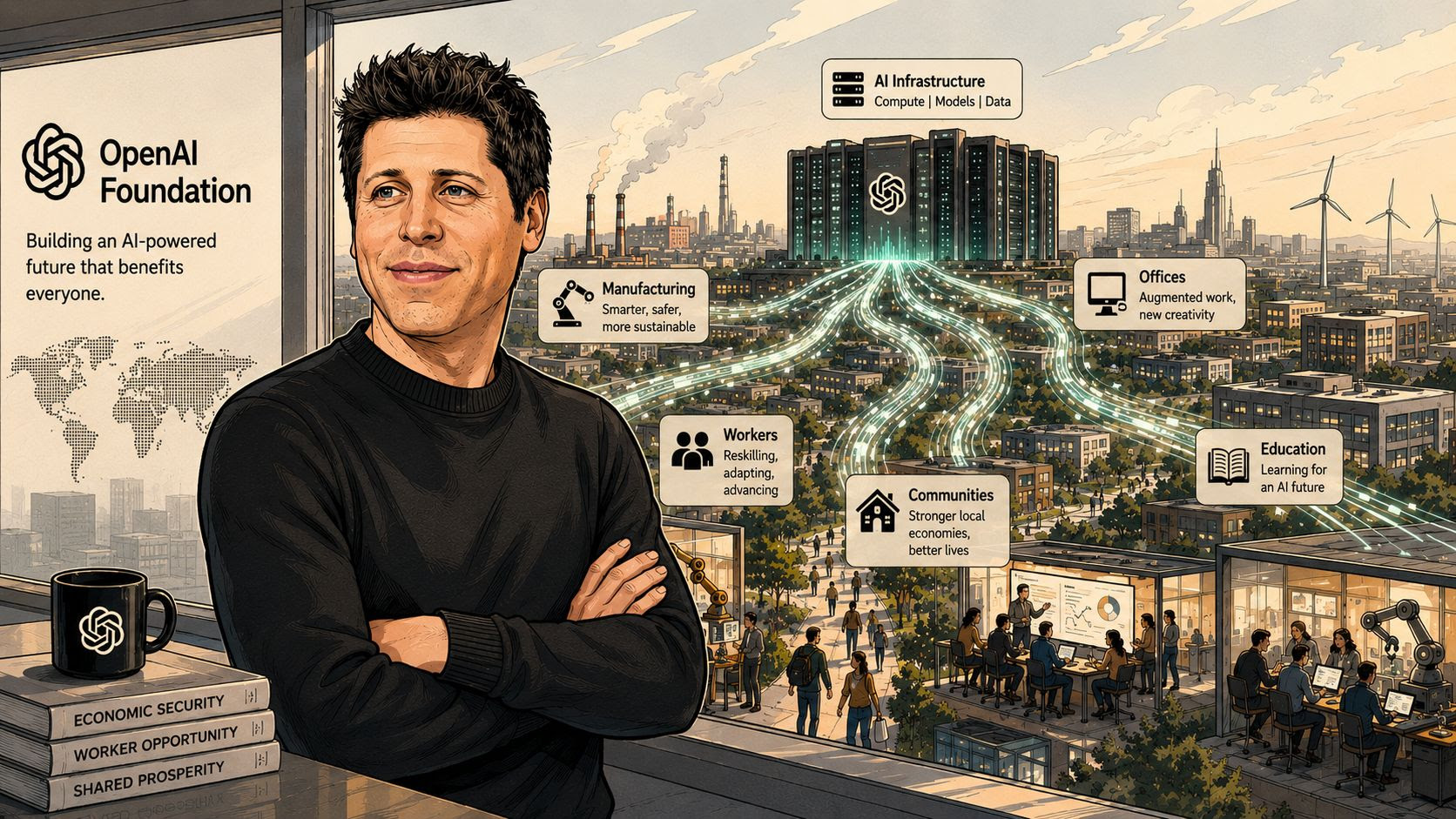
OpenAI’s Nonprofit Just Pledged $250M to Help Workers. The First Checks Can’t Come Fast Enough.
Here’s a sentence that should make you pause: the OpenAI Foundation, the nonprofit arm that owns 26% of OpenAI’s for-profit business, just committed $250 million to help workers and communities navigate AI-driven disruption.
That’s real money. Not a rounding error. Not a marketing budget disguised as charity. Two hundred and fifty million dollars to fund grants, partnerships, and direct work aimed at one question: what happens to people when AI starts taking jobs at scale?
The announcement is significant for two reasons. First, because it’s coming from OpenAI itself—the company that, more than any other, has been associated with both the promise and the peril of generative AI. Second, because the money is not symbolic. The Foundation intends to spend it. On retraining. On job transitions. On research into tax shifts, sovereign wealth funds, and other mechanisms for sharing the value that AI creates.
The first initiatives are supposed to be announced later this year. That’s the good news.
The bad news is that layoffs are already spreading. More than 80,000 jobs have been cut this year in the tech sector alone, with CEOs openly citing AI as a reason. Customer service reps, content writers, translators, paralegals, entry-level programmers—the list grows every week. And worker anxiety is running higher than I’ve seen in two decades of covering technology.
The Foundation’s $250 million is a start. But a start is not a solution. And later this year is not now.
What the Foundation Actually Plans to Do
The announcement is light on specifics and heavy on categories. That’s typical for a first commitment. The real test will be the grant announcements later in 2025. But the categories themselves are worth unpacking.
Economic impact research. The Foundation wants to build systems that track how AI value flows—not just what people earn, but what they can actually do and access. That’s a subtle but important shift. Most economic metrics focus on income. But a worker whose wage stays flat while their job becomes monotonous and meaningless has lost something that doesn’t show up in GDP numbers. The Foundation is signaling that they want to measure well-being, not just dollars.
Worker retraining and transition. This is the most obvious category, and the one where philanthropy has a spotty track record. Retraining programs often fail because they train for jobs that don’t exist, or because they don’t account for the real barriers workers face (childcare, transportation, the sheer exhaustion of working full time while learning something new). The Foundation says it wants to ensure workers have “agency over AI use” and that work provides “meaning, purpose, and satisfaction.” That’s a high bar. We’ll see if the grants match the rhetoric.
Long-term economic security. This is the most interesting category, and the one where the Foundation is wading into genuinely new territory. They’re exploring tax shifts from labor to capital—the idea that as labor becomes less valuable relative to capital, we should tax capital more and labor less. They’re looking at sovereign wealth funds, where a portion of AI-driven profits is set aside for a public trust. And they’re considering “durable stakes for people in AI-made value”—which is a wonky way of saying some form of universal profit sharing.
These are not small ideas. They’re the kinds of structural reforms that economists have been debating for years but that have never been politically feasible. The Foundation is not going to implement them alone. But by funding research and advocacy, they can move the Overton window.
The 26% Ownership Question
The Foundation owns 26% of OpenAI’s for-profit business. That’s a critical detail.
When OpenAI restructured a few years ago, it created a capped-profit company controlled by a nonprofit board. The nonprofit owns a significant chunk of the equity. As OpenAI generates profits—which it is now doing, to the tune of billions in revenue—the Foundation gets a share.
That means the Foundation’s $250 million commitment is not coming from Sam Altman’s pocket or from Microsoft’s investment. It’s coming from OpenAI’s own success. The more successful the for-profit becomes, the more money the Foundation has to spend on its mission.
This is a virtuous cycle in theory. In practice, it creates a tension. The Foundation’s ability to help workers depends on OpenAI’s ability to keep growing. But OpenAI’s growth is driven by the very automation that is displacing workers in the first place. The Foundation is essentially betting that the company causing the disruption can also fund the solution.
That’s not a contradiction. It’s a hedge. But it’s worth naming.
Too Little, Too Late? Or Just in Time?
The criticism writes itself. $250 million sounds like a lot. In the context of global labor markets, it’s a rounding error. There are 160 million workers in the US alone. If AI disrupts even 10% of those jobs, that’s 16 million people. $250 million divided by 16 million is $15.63 per person.
That’s obviously not how the money will be spent. The Foundation isn’t writing checks to individuals. It’s funding research, pilot programs, and advocacy. The hope is that successful pilots will be scaled by governments and other funders. The Foundation sees itself as a catalyst, not a piggy bank.
But the catalyst argument only works if the pilots happen fast. And “later this year” is not fast. Workers being laid off today need help today. A retraining program that launches in 2026 does nothing for someone who lost their job in 2024.
This is the gap that critics will hammer. OpenAI has been developing AI for years. They knew the disruption was coming. The Foundation could have been ramping up years ago. Instead, they’re announcing a commitment now, with no concrete programs yet, and a timeline that stretches into next year.
From the outside, it looks like reaction, not proaction. Whether that perception is fair depends on what gets announced in the coming months.
How This Compares to Other Efforts
OpenAI is not the only player in this space. The philanthropic world has been waking up to AI-driven labor disruption for a while.
The Ford Foundation has funded research on AI and inequality. The Rockefeller Foundation has a whole program on the future of work. Google.org has given millions to digital skills training. Microsoft’s philanthropic arm has focused on AI for nonprofits, not directly on worker displacement.
What’s different about the OpenAI Foundation is the scale of the funding relative to the size of the organization—and the direct connection to the company driving the disruption. This is not a tech company writing a check to distance itself from negative consequences. This is a tech company using its ownership structure to embed worker support into its business model.
That’s novel. Whether it’s effective remains to be seen.
The Tax Shift and Sovereign Wealth Ideas
The most forward-looking part of the announcement is the exploration of tax shifts and sovereign wealth funds. These are structural interventions, not Band-Aids.
The labor-to-capital tax shift is simple in concept: as automation replaces workers, tax the owners of capital (robots, algorithms, data centers) more and tax human labor less. This could take the form of a higher corporate tax rate, a tax on AI inference, or a robot tax. Each has problems. A robot tax is hard to define (what counts as a robot?). A tax on AI inference could slow innovation. But the direction of travel is clear: if capital becomes more productive and labor becomes less scarce, the tax base should shift accordingly.
Sovereign wealth funds are a different idea. Take a portion of the profits from AI and put them into a public fund. The fund invests in a diversified portfolio. The returns are distributed to citizens as a dividend or used to fund public services. Alaska has a sovereign wealth fund from oil revenues. Norway has one from natural gas. The idea is to treat AI as a natural resource owned collectively, not just by the companies that build it.
Both ideas face steep political hurdles. Neither will happen without sustained advocacy and experimentation. The Foundation can’t implement them alone. But by funding research and pilot programs, they can help build the intellectual and political infrastructure for a future where AI’s gains are broadly shared.
That’s not as immediately satisfying as writing a check to a laid-off worker. But it might be more important in the long run.
The Timing Problem
Let me be blunt. The Foundation’s announcement is welcome. But the timing is off.
Layoffs are happening now. Worker anxiety is high now. The first wave of AI-driven disruption is not a future hypothetical. It’s a present reality. And yet the Foundation’s first initiatives won’t be announced until later this year, with grants likely disbursed even later.
There is no good reason for this delay. The Foundation has had money. The need has been visible for years. The fact that they’re announcing a commitment before announcing any actual programs suggests that the organization is still being built, still figuring out its strategy, still hiring staff.
That’s fine for a new foundation. But OpenAI is not a new company. They’ve had years to plan for this moment. The fact that they’re only now ramping up their worker-focused philanthropy feels like a missed opportunity.
I say this not to be harsh, but to name the gap between rhetoric and reality. The Foundation says it wants to help workers navigate disruption. The best way to do that is to start helping now. Not later this year. Not after a strategic planning process. Now.
What Comes Next
The Foundation says it will announce the first initiatives later this year. Here’s what I’ll be watching for.
First, speed. Are the grants announced in October and disbursed in November, or are they announced in December with a rollout in 2026? The difference matters.
Second, scale. $250 million over multiple years is not nothing. But relative to the scale of the problem, it’s small. Is the Foundation planning to raise more money from other donors? Is OpenAI planning to increase its for-profit contribution as the company grows? The announcement doesn’t say. It should.
Third, experimentation. The best philanthropy takes risks. The Foundation should fund things that might fail. Pilot programs that try novel approaches to retraining. Research that challenges conventional wisdom. Advocacy that makes people uncomfortable. Safe grants are easy. Useful grants are hard.
Fourth, humility. The Foundation should not pretend to have all the answers. Worker dislocation is a complex problem with a long history. AI is making it harder, but it’s not brand new. The Foundation should fund people who have been working on this for years—labor economists, workforce development experts, community organizers—not just tech people who discovered the problem last week.
The Bottom Line
The OpenAI Foundation’s $250 million commitment is a significant step. It’s real money. It’s aimed at a real problem. And it’s coming from a nonprofit that has a real financial stake in the future of AI.
But a step is not a journey. And the journey has barely begun.
Workers being displaced by AI today cannot wait for grants that will be announced next year. Retraining programs that launch in 2026 do nothing for someone who lost their job in 2024. And structural reforms like tax shifts and sovereign wealth funds are decade-long projects, not quick fixes.
The Foundation deserves credit for making the commitment. Now it needs to deliver. Fast.
Because the disruption is not waiting. And neither are the workers.
Your one-stop shop for automation insights and news on artificial intelligence is EngineAi.
Did you like this article? Check out more of our knowledgeable resources:
Watch this space for weekly updates on digital transformation, process automation, and machine learning. Let us assist you in bringing the future into your company right now