The Prompt-Powered Holiday: How Triple Whale's AI Guide is Turning BFCM Data into Profit
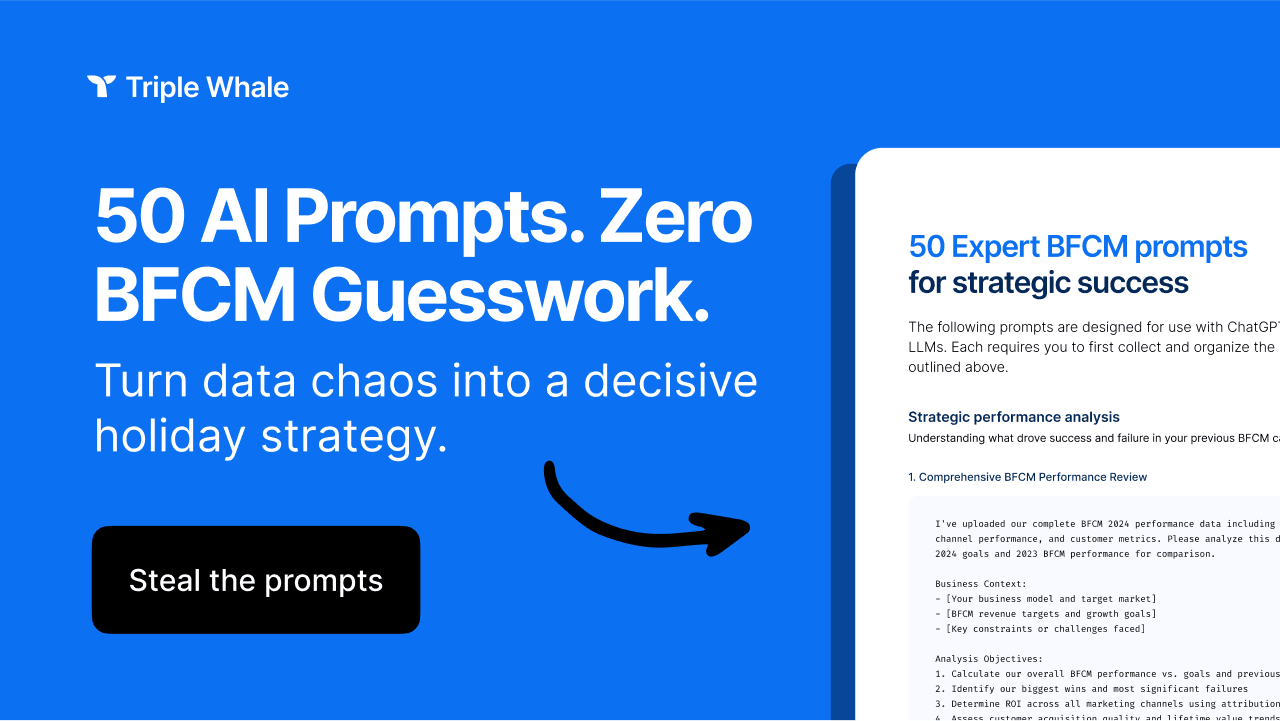
In the high-stakes theater of Black Friday Cyber Monday (BFCM), data is both the greatest asset and the heaviest burden. E-commerce brands generate terabytes of information during the holiday rush—click streams, cart abandonments, conversion funnels, customer segments, ad performance metrics—yet most struggle to transform this deluge into decisive action. The result is a paradox of plenty: more data than ever, but less clarity about what to do next. Enter Triple Whale with a strategic intervention: a new guide featuring 50 AI prompts designed to transform massive BFCM datasets into understandable, useful insights. This isn't just a cheat sheet for better prompts; it is a playbook for turning information overload into profit optimization. For brands navigating the most critical sales window of the year, the ability to ask the right questions of their data may be the difference between record revenue and missed opportunity.
The core challenge Triple Whale addresses is not data collection—it is data interpretation. Traditional analytics dashboards excel at showing what happened: traffic spiked at 2 PM, conversion rate dropped on mobile, cart abandonment increased among first-time visitors. But they rarely explain why, or prescribe what to do about it. This is where large language models (LLMs) promise to help: by allowing marketers to query their data in natural language, uncovering patterns and insights that might escape manual analysis. Yet generic LLMs, trained on broad internet text, often struggle with the nuances of e-commerce metrics, attribution models, and seasonal shopping behavior. The result can be plausible-sounding but ultimately misleading recommendations. Triple Whale's guide solves this by providing e-commerce-specific prompts—carefully crafted queries that align AI reasoning with the realities of holiday retail.
The guide's structure reflects a deep understanding of the BFCM workflow. It begins with foundational principles: the dos and don'ts of BFCM LLM prompting. Do provide clear temporal context ("Compare this year's BFCM weekend to last year's, excluding pre-sale days"). Do specify metric definitions ("Calculate ROAS using attributed revenue, not last-click"). Don't ask vague questions ("Why did sales drop?"); instead, ask targeted ones ("Which traffic source had the highest cart abandonment rate on Cyber Monday, and what was the average order value for completed purchases from that source?"). These guidelines transform the AI from a generic chatbot into a specialized analyst, capable of delivering insights that are both accurate and actionable.
Data preparation emerges as a critical, often overlooked, component of effective prompting. The guide emphasizes that AI outputs are only as good as the inputs they receive. Before querying, brands should ensure their data is clean, normalized, and structured for analysis: consistent UTM parameters, unified customer IDs across channels, and properly attributed revenue across touchpoints. Triple Whale provides detailed procedures for this groundwork, recognizing that the most sophisticated prompt cannot compensate for fragmented or inconsistent data. This emphasis on preparation reflects a mature understanding of AI analytics: the magic is not in the model alone, but in the marriage of quality data and intelligent querying.
The 50 prompts themselves cover the full spectrum of BFCM decision-making. Some focus on real-time optimization: "Identify the top 3 products with the highest add-to-cart rate but lowest conversion rate during the first 4 hours of Black Friday, and suggest potential friction points." Others address post-campaign analysis: "Segment customers who purchased during BFCM by acquisition channel, lifetime value, and product category, then recommend personalized retention strategies for each group." Still others tackle strategic planning: "Based on this year's BFCM performance, forecast inventory needs for next year's holiday season, accounting for lead times and supplier constraints." Each prompt is designed to extract maximum value from holiday data, turning retrospective analysis into forward-looking strategy.
Perhaps the most significant insight in the guide is why leading companies choose e-commerce-trained AI over simple, generic LLMs. The difference lies in domain expertise. A model fine-tuned on e-commerce data understands the semantics of "blended ROAS," the implications of "attribution windows," and the seasonal patterns that distinguish BFCM from ordinary shopping days. It can distinguish between a genuine trend and a statistical anomaly, between correlation and causation in complex multi-touch journeys. Generic LLMs, by contrast, may apply general reasoning that misses the nuances of retail economics. For brands operating on thin margins and tight timelines, this distinction is not academic—it is existential. E-commerce-trained AI doesn't just answer questions; it asks better ones.
The strategic implications extend beyond the holiday season. The prompts and principles in Triple Whale's guide establish a framework for year-round data intelligence. The ability to rapidly interrogate performance data, identify emerging trends, and test hypotheses in natural language transforms analytics from a periodic report into a continuous conversation. This agility is increasingly valuable in a market where consumer behavior shifts rapidly and competitive advantages are fleeting. Brands that can learn faster from their data can adapt faster to changing conditions—a capability that compounds over time.
Moreover, the guide democratizes advanced analytics. Traditionally, extracting deep insights from BFCM data required a team of data scientists, SQL expertise, and specialized visualization tools. Triple Whale's prompt-based approach lowers that barrier, empowering marketers, merchandisers, and founders to ask sophisticated questions without writing code. This does not replace data professionals; it amplifies their impact by freeing them from routine queries to focus on strategic modeling and infrastructure. The result is a more agile, more insightful organization where data literacy is distributed, not siloed.
Yet, the power of AI prompting demands responsible use. The guide implicitly acknowledges that prompts can be gamed, misinterpreted, or over-relied upon. A poorly framed question can yield misleading answers; an over-automated decision can overlook contextual nuance. Triple Whale emphasizes human oversight: AI insights should inform judgment, not replace it. The most effective workflows combine AI speed with human wisdom—using prompts to surface possibilities, then applying experience to evaluate and act. This balanced approach ensures that technology serves strategy, not the other way around.
Looking ahead, the convergence of e-commerce data and AI prompting hints at a broader shift in how brands operate. The future may belong not to those with the most data, but to those who can ask the best questions of it. Prompt engineering could become a core competency for marketing teams, alongside copywriting and media buying. Tools that make this skill accessible—through templates, guidance, and domain-specific training—will become essential infrastructure. Triple Whale's guide is an early example of this trend: not just a resource, but a catalyst for a new way of working.
For brands preparing for the next BFCM cycle, the message is clear: data alone is not enough. The competitive advantage lies in the ability to extract insight from noise, to turn metrics into decisions, and to learn faster than the competition. Triple Whale's 50-prompt guide offers a practical path to that advantage. It transforms the overwhelming complexity of holiday data into a structured dialogue with intelligence—where every click, cart, and client interaction becomes a signal, not just a statistic.
The holiday rush will always be chaotic. But chaos, properly analyzed, reveals patterns. And patterns, properly understood, reveal opportunity. Triple Whale's guide doesn't promise to eliminate the stress of BFCM; it promises to make that stress productive. By giving brands the tools to ask better questions of their data, it turns the post-mortem into a pre-strategy, the retrospective into a roadmap.
The prompt-powered holiday is here. The questions are ready. The only thing left is to ask.
Your one-stop shop for automation insights and news on artificial intelligence is EngineAi.
Did you like this article? Check out more of our knowledgeable resources:
Watch this space for weekly updates on digital transformation, process automation, and machine learning. Let us assist you in bringing the future into your company right now