For the past eighteen months, OpenAI has been a company at war with itself. On one side, the relentless drive toward artificial general intelligence – the mission that animated the nonprofit’s founding and still burns in the research wing. On the other, the cold demands of building a sustainable business, serving enterprise customers, and fending off competition from Anthropic, Google, and a resurgent open-source ecosystem. The result has been a proliferation of “side quests” – ambitious, exploratory projects that seemed important at the time but that, in aggregate, diluted the company’s focus and stretched its talent thin.
Last month, Sam Altman declared that the side quests were over. In a blog post titled simply with a family photo and a series of reflections following a Molotov cocktail attack on his home, he wrote: “OpenAI is now a major platform, not a scrappy startup, and we need to operate in a more predictable way now.” The subtext was clear: the era of experimentation was ending. The era of disciplined execution was beginning.
Today, the human cost of that pivot became visible.
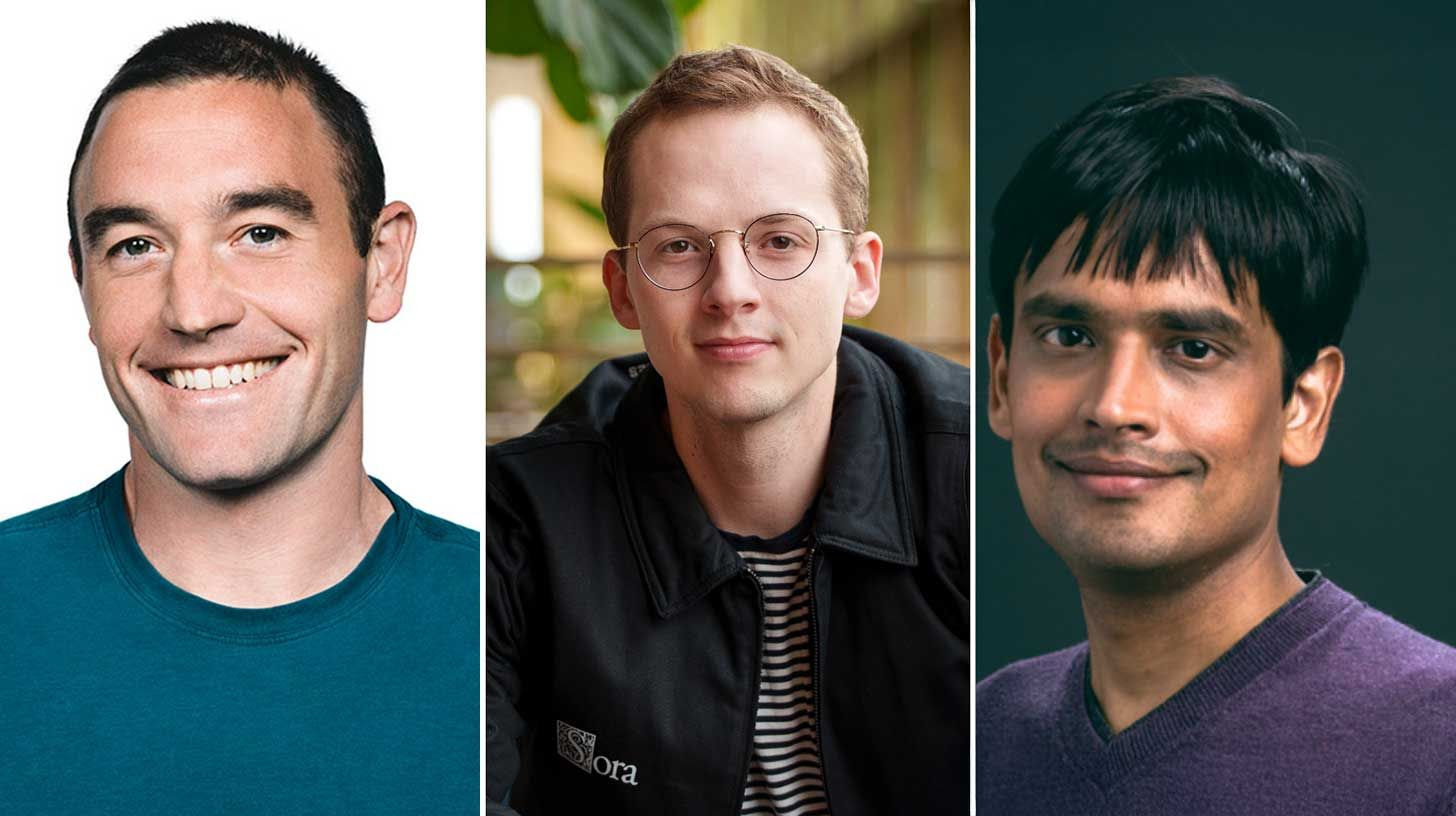
Kevin Weil, the former Chief Product Officer who led OpenAI for Science, departed. Bill Peebles, who led the Sora video generation team until the company shuttered the app last month over cost concerns, also left. And Srinivas Narayanan, the enterprise apps chief who had spent three years at OpenAI after thirteen at Facebook, announced he was heading to India to care for aging parents.
Three senior executives. One day. And a month of leadership changes that have left employees and industry observers asking the same question: Is OpenAI streamlining for focus, or is something deeper breaking?
The answer, as with most things at OpenAI, is complicated. The departures are simultaneous but not necessarily coordinated. Weil’s exit is directly tied to the “decentralization” of OpenAI for Science – a side quest that is being folded back into core product teams. Peebles’s departure was arguably sealed the moment OpenAI killed Sora, a project he had led with evident passion. Narayanan’s move appears genuinely personal – a family decision made more palatable by the uncertainty of the current moment.
But taken together, they paint a picture of a company in transition. A company that, after years of saying “yes” to every interesting idea, is now learning to say “no.” And a company that is discovering, as every organization does when it pivots from growth to focus, that some of its most talented people are attached to the very projects being cut.
“The no-side-quests strategy is exactly what OpenAI needs,” said Dr. Elena Vasquez, a former tech executive turned strategist. “But it’s also brutally painful. Every side quest had a champion. Every champion had a team. When you kill the quest, you lose the champion. That’s not a bug. It’s a feature. But that doesn’t make it less sad.”
Part I: Kevin Weil and the Decentralization of OpenAI for Science
Of the three departures, Kevin Weil’s is the most significant – and the most directly tied to Altman’s new strategic direction.
Weil joined OpenAI in 2023 after a distinguished career at Instagram, Facebook, and Twitter (where he served as VP of Product). He was initially brought on as Chief Product Officer, but his role evolved over time. By late 2025, he was leading OpenAI for Science – an ambitious initiative to build specialized AI tools for researchers in biology, chemistry, physics, and other scientific disciplines.
The flagship product of OpenAI for Science was Prism , an application designed to help scientists analyze experimental data, generate hypotheses, and write research papers. Prism was built on top of Codex – OpenAI’s coding and reasoning engine – but was tailored to scientific workflows: handling lab notebooks, integrating with electronic lab systems, and understanding domain-specific terminology.
Prism had its internal champions. Early beta testers at academic labs and pharmaceutical companies reported significant productivity gains. But the product was expensive to maintain, required specialized fine-tuning, and served a relatively small market compared to OpenAI’s core ChatGPT business.
In the post-side-quests reorganization, OpenAI for Science is being decentralized . The team is being broken up and folded into other groups. Prism’s capabilities will be woven into Codex directly – meaning scientists will access scientific AI features through the same interface as everyone else, rather than through a dedicated app. Weil, who had been the public face of the science initiative, chose to depart rather than take on a different role.
“Kevin believed deeply in the science mission,” said one former OpenAI employee, speaking on condition of anonymity. “He thought OpenAI had a responsibility to build tools specifically for researchers, not just general-purpose chat. When the company decided that was a side quest, he had a choice: stay and work on something else, or leave. He left.”
Altman’s blog post, written days before Weil’s departure, hinted at this tension. “We are now a major platform, not a scrappy startup,” he wrote. “We need to operate in a more predictable way.” The science initiative, however noble, was not predictable. It was exploratory. And in the new OpenAI, exploration is a luxury.
“The irony is that the science work was exactly the kind of thing OpenAI was founded to do,” added Vasquez. “Benefiting all of humanity. Accelerating scientific discovery. That’s the mission statement. But the mission statement has to coexist with the P&L statement. And right now, the P&L is winning.”
Weil has not announced his next move. Industry speculation ranges from joining a rival AI lab (Anthropic would be a natural fit) to launching his own scientific AI startup. Whatever he does, his departure is a loss – not just of his product leadership, but of the signal it sends about OpenAI’s priorities.
Part II: Bill Peebles and the Ghost of Sora
Bill Peebles’s departure is the most wistful of the three. Peebles led the team that built Sora , OpenAI’s ambitious text-to-video generation model. Sora was not a side quest in the traditional sense – it was a major product launch, backed by significant compute and marketing spend. But last month, OpenAI made the difficult decision to kill the Sora app , citing unsustainable costs and disappointing usage metrics.
In a statement at the time, Peebles called the work “the honor and adventure of a lifetime.” It was gracious – and final. The video generation features that survived are being folded into other products, but the standalone Sora app, and the team that built it, are gone.
Peebles’s departure is not a surprise. When a company kills your product, you do not usually stick around to build the next thing. But the timing – leaving on the same day as Weil and Narayanan – suggests a broader dissatisfaction with the new direction.
“Bill was a true believer in generative video,” said one colleague. “He thought it was the next frontier. He recruited people to that vision. When OpenAI pulled the plug, it wasn’t just a product decision. It was a statement about what the company values. Bill heard that statement loud and clear.”
Sora’s demise was a classic example of the side-quest problem. The technology was impressive – capable of generating minutes of coherent, high-resolution video from text prompts. But the use cases were unclear. Consumers generated a few videos, got bored, and moved on. Enterprise customers were interested but unwilling to pay the high inference costs. The unit economics never worked.
“Sora was a research project dressed up as a product,” said Marcus Wei, an AI industry analyst. “OpenAI should have kept it in the lab, not launched it as an app. The launch created expectations that the team couldn’t meet. The shutdown created bitterness. It was a lose-lose.”
Peebles has not announced his next role, but his expertise in generative video is rare and valuable. He could join a startup (Runway or Pika would be obvious suitors), start his own company, or move into academia. Whatever he does, his departure is a reminder that even the most talented leaders cannot outrun strategy.
Part III: Srinivas Narayanan – The Personal Departure
Srinivas Narayanan’s exit is the most difficult to parse. On its face, it is not about strategy at all. Narayanan announced on X that he is moving to India to care for aging parents – a genuinely personal reason that no amount of corporate loyalty can override.
“After 13 years at Facebook and 3 years at OpenAI, I’m heading back to India to be with family,” he wrote. “It’s been an incredible journey, but family comes first.”
Narayanan ran OpenAI’s enterprise apps – the suite of tools (ChatGPT Enterprise, Team, and the associated admin controls) that generate a significant portion of OpenAI’s revenue. He was not a glamorous figure like Weil or Peebles, but he was essential. Enterprise customers trust OpenAI not just because of the model quality, but because of the governance, security, and compliance features that Narayanan’s team built.
His departure, even for personal reasons, creates a gap. And the timing – the same day as two other high-profile exits – amplifies the sense of instability.
“Srinivas was the quiet backbone of our enterprise business,” said one OpenAI employee. “He didn’t seek the spotlight. He just got things done. Losing him, for any reason, is a blow. Losing him on a day when we’re also losing Kevin and Bill… it feels like a lot.”
OpenAI has not announced a replacement for Narayanan. The enterprise apps group will report to someone else – likely a product leader with less specialized experience. That transition will need to be managed carefully, especially as competition from Anthropic (Claude Enterprise) and Google (Gemini Enterprise) intensifies.
“The enterprise market does not forgive disruption,” said Sarah Jenkins, a software procurement consultant. “If OpenAI’s enterprise team goes through a messy transition, customers will notice. And they will get calls from Anthropic and Google. That is not a risk you want to take right now.”
Part IV: Sam Altman’s Blog – The Cultural Context
To understand the departures, one must read Sam Altman’s April 11 blog post – the one that began with a family photo and a description of a Molotov cocktail attack on his home. The post was ostensibly about violence, rhetoric, and the perils of being a public figure. But it was also a strategic document.
“OpenAI is now a major platform, not a scrappy startup,” Altman wrote. “We need to operate in a more predictable way now. It has been an extremely intense, chaotic, and high-pressure few years.”
That line – “more predictable” – is the key. OpenAI has been chaotic by design. It was a research lab that accidentally became a product company. It was a nonprofit that mutated into a capped-profit hybrid. It was a company that said “yes” to everything: science tools, video generation, enterprise apps, consumer chatbots, API services, robotics research, and more.
The chaos attracted brilliant people. It also exhausted them.
“The side-quests strategy was fun when we were small,” said a former OpenAI manager. “Everyone had an idea. Everyone got to build their passion project. But as we scaled, the cost of saying ‘yes’ became visible. We had too many products. Too many codebases. Too many meetings. We were spread thin. Anthropic was focused. They were beating us with half the headcount because they weren’t distracted.”
Altman’s post was a public acknowledgment of that reality. The Molotov cocktail was the symbol – a literal explosion that forced him to reflect on the damage that words and narratives can do. But the strategic message was aimed internally: the free-for-all is over. We are focusing. Get on board or get out.
Some employees are getting out.
“The timing of the departures – exactly one month after that blog – is not a coincidence,” said Chen. “Altman drew a line. Weil, Peebles, and Narayanan found themselves on the other side of it. For different reasons, they chose to leave. That’s how focus works.”
Part V: The Side-Quests Legacy – What OpenAI Is Losing (and Gaining)
The side-quests era at OpenAI was not a waste. It produced real innovations that would not have emerged from a more disciplined, focused process.
OpenAI for Science generated novel approaches to scientific reasoning that are now being integrated into Codex. Even if Prism the product dies, the underlying research will survive. Sora advanced the state of text-to-video generation, even if the app was not commercially viable. The models and techniques will be repurposed. Enterprise apps were never a side quest – they were core to the business – but Narayanan’s work on governance and security will outlast his tenure.
The question is whether the benefits of focus will outweigh the costs of losing the people who built the side quests.
“Focus means saying no to good ideas so you can say yes to great ones,” said Vasquez. “OpenAI is saying no to science tools and video apps. That frees up compute, talent, and management attention for the core mission: building AGI. That is a rational trade-off. But the people who believed in the good ideas are leaving. That is also rational. The challenge is whether OpenAI can retain enough of the talent that matters while shedding the projects that don’t.”
The early signs are mixed. OpenAI’s core model teams – the ones working on GPT-5 and beyond – remain intact and motivated. The engineering teams supporting ChatGPT and the API are stable. But the loss of three senior leaders in one day creates a perception of instability that competitors will exploit.
“Anthropic is already reaching out to OpenAI employees,” said one recruiter who works with both companies. “They’re saying, ‘Come to a place where you can focus without chaos.’ That message is landing. OpenAI is bleeding talent, not just from side quests but from the core. Altman’s focus pivot may be necessary, but it’s also painful. And in the short term, it’s making the chaos worse, not better.”
Part VI: What Comes Next – The Focused OpenAI
The post-side-quests OpenAI will look different. Here is what we can expect:
Fewer products, deeper integration: Instead of standalone apps for science, video, or other domains, OpenAI will embed specialized capabilities into Codex and ChatGPT. Scientists will use Codex with scientific reasoning. Video generation will be a feature of Sora (the model, not the app) accessible via API. The number of surfaces will shrink; the depth of each surface will grow.
More enterprise focus: Despite Narayanan’s departure, OpenAI is doubling down on enterprise. The governance and security features he built are now table stakes. The company will compete aggressively with Anthropic for large corporate customers, using its scale and brand recognition as advantages.
Discipline on compute: The most expensive side quests – like Sora – are being shut down because they consumed inference compute that could have been used for something more valuable. Going forward, every product will need to justify its compute budget. No more “cool but unprofitable” projects.
A narrower research agenda: OpenAI’s research wing will focus more tightly on the core path to AGI: reasoning, planning, and alignment. Exploratory research – the kind that might lead to a breakthrough in a completely new direction – will be reduced. The company is betting that the path to AGI is now clear enough to follow without branching.
“This is the maturation of OpenAI,” said Wei. “They are transitioning from a research lab with products to a product company with research. That is a fundamental shift. It will take years to fully execute. And it will cost them people who joined for the research culture.”
The question is whether the new, focused OpenAI can still attract the kind of talent it needs. The researchers who want to work on speculative, blue-sky projects will go elsewhere – to Anthropic’s research division, to Google DeepMind, to academic labs, or to startups. OpenAI will need to attract a different kind of talent: builders, product-minded engineers, and enterprise salespeople.
“That is the risk,” added Vasquez. “OpenAI is trading the magic of the side quests for the predictability of a platform. That may be the right move for the business. But it’s not obviously the right move for the mission. The mission – benefiting all of humanity – might require side quests. It might require exploring the weird, the impractical, the unprofitable. Altman is betting that it doesn’t. We’ll see if he’s right.”
Conclusion: The Cost of Growing Up
The departure of Kevin Weil, Bill Peebles, and Srinivas Narayanan in a single day is not a sign that OpenAI is collapsing. It is a sign that OpenAI is changing. The company is shedding the projects and people that belong to its scrappy, exploratory past. It is consolidating around a narrower, more predictable, more commercial future.
That is painful. It is also necessary.
Every company that grows from startup to platform goes through this transition. The leaders who thrived in chaos often struggle in structure. The projects that were exciting experiments become expensive distractions. The people who loved the “anything is possible” energy find themselves frustrated by the “what is the ROI?” meetings.
Altman’s blog post, with its photo of his family and its reflection on violence and rhetoric, was a reminder that he is not a dispassionate CEO. He is a man under pressure, running a company that is trying to change the world while also staying solvent. The side quests were a luxury. The luxury is over.
Whether the focused OpenAI will be more effective than the chaotic one is an open question. But the experiment is now underway. The side quests are dead. The leaders who championed them are gone. And the company is left with a simpler, harder task: building AGI, and nothing else.
No more science experiments. No more video apps. No more distractions. Just the long, difficult, focused march toward the future.
For the people leaving, the future will be elsewhere. For the people staying, the work continues. And for the rest of us, watching from the outside, the question is not whether OpenAI can focus. It is whether focus is enough.
Your one-stop shop for automation insights and news on artificial intelligence is EngineAi.
Did you like this article? Check out more of our knowledgeable resources:
Watch this space for weekly updates on digital transformation, process automation, and machine learning. Let us assist you in bringing the future into your company right now