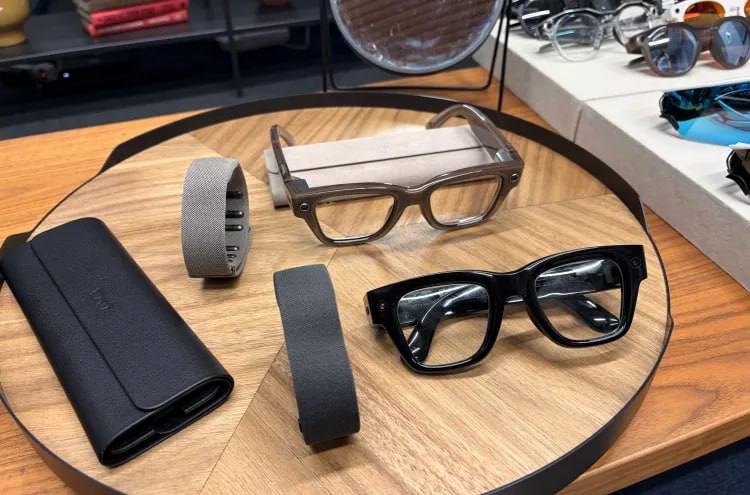
The Invisible Interface: How Meta's Ray-Ban Display and Neural Band Are Redefining Wearable Computing
For years, the promise of augmented reality has been tantalizingly out of reach. Smart glasses were either too bulky, too limited, or too conspicuous to become everyday tools. The dream was always the same: seamless digital information overlaid on the real world, accessible without pulling out a phone or drawing unwanted attention. Now, Meta is taking its most significant step yet toward that vision. The company has unveiled a major upgrade to its Ray-Ban smart glasses: a 600×600 pixel micro-display hidden in the right lens, activated by a finger snap and bright enough to see in direct sunlight at 5,000 nits. Paired with the Neural Band—a bracelet that reads tiny muscle signals for gesture control—this isn't just an incremental product update. It is a declaration that the future of computing is not in your pocket, but on your face, controlled by the subtlest movements of your hand.
The engineering achievement here is remarkable. Packing a high-resolution, high-brightness display into a lens that looks indistinguishable from standard eyewear required breakthroughs in micro-LED technology, waveguide optics, and thermal management. The result is a screen that only you can see, projecting crisp text, icons, and interfaces directly into your field of view. A quick finger snap wakes the display; a tap of your fingers selects an option; a rotation of your fist scrolls through content. The Neural Band, worn on the wrist, detects the electrical signals from your muscles before movement even occurs, enabling near-instantaneous, intuitive control. This is not voice commands that draw attention in quiet spaces, nor is it touchpads on temple arms that require awkward gestures. It is interaction that feels almost telepathic—private, precise, and profoundly natural.
The feature set transforms these glasses from a novelty into a genuine productivity and lifestyle tool. Turn-by-turn navigation appears as floating arrows in your peripheral vision, so you never miss a turn while walking or cycling. Instagram feeds scroll hands-free as you wait in line. WhatsApp calls connect with a whisper, with speech-to-text transcription and real-time translation appearing as subtitles in your lens—breaking language barriers in real-time conversations. The new 12MP camera with 3x optical zoom captures high-quality photos and video without raising a phone, preserving the spontaneity of moments. For professionals, the implications are significant: instant access to notes during meetings, real-time translation in international calls, or hands-free documentation in field work. This is not about replacing your smartphone; it is about augmenting your presence in the world with contextual intelligence that arrives exactly when and where you need it.
The design philosophy prioritizes discretion and social acceptability. At 69 grams, the glasses are lightweight enough for all-day wear. The display is visible only to the wearer, eliminating the "glasshole" effect that plagued earlier AR attempts. Battery life is rated at 6 hours of active use, with an additional 30 hours provided by the charging case—a full day's power for most users. Priced at $800 and launching in the US on September 30, these glasses position themselves as a premium but accessible entry point into augmented reality. This is not a developer kit or a luxury concept; it is a consumer product designed for mainstream adoption. Meta is betting that once people experience the utility of an invisible interface, they will not want to go back to pulling out a phone for every query.
The strategic implications extend beyond hardware. By integrating deeply with Meta's ecosystem—Instagram, WhatsApp, Facebook, and future AI agents—these glasses become a new touchpoint for engagement. Every interaction, every glance, every gesture generates data that can refine personalization, improve AI models, and create new advertising opportunities. The Neural Band's muscle-signal technology, developed through Meta's Reality Labs research, represents a bet on a post-touch, post-voice interface paradigm. If successful, this could establish a new standard for human-computer interaction, one that is more intuitive, more accessible, and more integrated with human physiology than any previous input method.
Yet, the introduction of such intimate technology raises important questions about privacy, etiquette, and social norms. A camera that can record without obvious indication, a display that lets you check messages during conversations, a microphone that transcribes speech in real-time—these capabilities demand thoughtful governance. Meta has emphasized privacy controls, including LED indicators for recording and granular permissions for data usage. But societal acceptance will depend not just on technical safeguards, but on cultural adaptation. When does augmented reality enhance human connection, and when does it distract from it? How do we establish norms for when it is appropriate to "check your glasses" in social settings? These are not questions Meta can answer alone; they require ongoing dialogue with users, regulators, and communities.
The broader industry context makes this launch particularly significant. While competitors like Apple Vision Pro have pursued high-fidelity, immersive AR/VR experiences, Meta is doubling down on lightweight, always-available augmented reality. This is a different vision of the future: not occasional immersion in virtual worlds, but continuous augmentation of the physical one. By focusing on glasses that look and feel like conventional eyewear, Meta is targeting a much larger addressable market—the billions of people who already wear glasses or sunglasses. If this approach resonates, it could accelerate the timeline for AR adoption by years, making contextual computing as ubiquitous as smartphones are today.
For developers, the platform opportunity is compelling. Meta has historically fostered robust developer ecosystems for its social platforms; extending that to AR glasses could unlock a new wave of innovation. Imagine apps that overlay historical information on landmarks, translate restaurant menus in real-time, or provide interactive tutorials for complex tasks. The combination of visual display, voice interaction, gesture control, and AI integration creates a rich canvas for experiential software. Early developer support will be critical to building the content library that drives consumer adoption.
Looking ahead, the roadmap hints at even more advanced capabilities. The ability to "write letters in the air" using gesture recognition suggests future expansions in input modalities. Integration with Meta's AI agents could enable proactive assistance: your glasses reminding you of a contact's name as they approach, or summarizing a document you are about to discuss. As the technology matures, the boundary between "using a device" and "having an intelligent companion" will blur. The glasses become not just a display, but a context-aware partner that understands your environment, your intentions, and your needs.
The $800 price point positions these glasses as an aspirational but attainable product. For early adopters, tech enthusiasts, and professionals who value hands-free information access, the value proposition is clear. For the broader market, the success of this launch will depend on demonstrating tangible utility beyond novelty. Meta's challenge is not just to sell glasses, but to cultivate a new habit: reaching for your face, not your pocket, when you need information.
The age of the smartphone as the primary computing interface is not ending, but it is evolving. Meta's Ray-Ban upgrade represents a compelling vision of what comes next: wearable, invisible, intuitive. The technology is ready. The design is refined. The ecosystem is building. The only question remaining is whether users are ready to look up—and see the future, right before their eyes.
September 30 cannot come soon enough for those eager to try. For everyone else, it is a reminder: the next computing revolution will not be held in your hand. It will be worn on your face, controlled by a thought, and invisible to everyone but you. The invisible interface is here. The question is: what will you do with it?
Your one-stop shop for automation insights and news on artificial intelligence is EngineAi.
Did you like this article? Check out more of our knowledgeable resources:
Watch this space for weekly updates on digital transformation, process automation, and machine learning. Let us assist you in bringing the future into your company right now