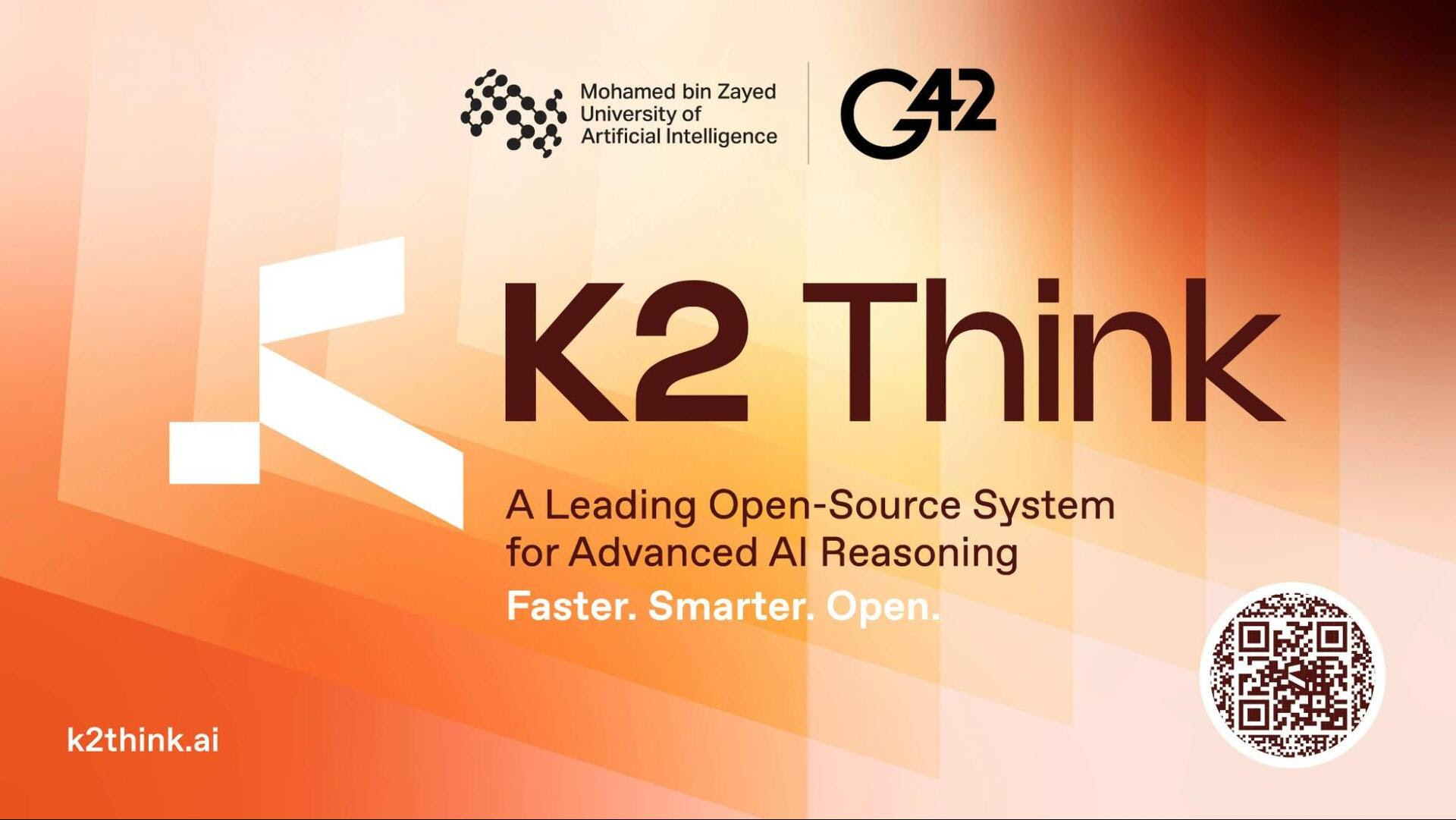
The Open Reasoning Revolution: How K2 Think is Redefining Transparency, Efficiency, and Global Collaboration in AI
In an era where artificial intelligence development is increasingly defined by closed models, proprietary weights, and guarded training data, a counter-movement is gaining momentum: the belief that the most powerful AI should also be the most accessible.
Enter K2 Think, a new release that is more than just another model—it is a statement of principle. With training data, parameter weights, and deployment code all publicly available, K2 Think is completely open source, guaranteeing reproducibility and promoting international cooperation. This isn't just a technical achievement; it is a philosophical commitment to the idea that transparency and performance are not mutually exclusive. For AI developers in labs, startups, or enterprises, K2 Think offers something rare: a high-performance reasoning engine that can be trusted, audited, and extended—without black-box dependencies or licensing restrictions.
The technical specifications are striking. K2 Think delivers performance comparable to 600B+ parameter reasoning LLMs while operating at only 32B parameters. This efficiency gain is not incremental; it is transformative. In a field where compute cost has been a primary barrier to entry, a model that achieves frontier-level reasoning at a fraction of the size democratizes access to advanced capabilities. Startups can deploy sophisticated reasoning without massive infrastructure budgets. Researchers can experiment with state-of-the-art architectures without waiting for API quotas.
Enterprises can fine-tune and adapt the model to domain-specific tasks without vendor lock-in. This is not just about saving money; it is about accelerating innovation by lowering the barrier to experimentation.
The mechanisms behind this efficiency are equally noteworthy. K2 Think leverages test-time scaling and enhanced chain-of-thought reasoning to achieve depth without breadth. Rather than relying on brute-force parameter count, the model employs dynamic computation: allocating more reasoning steps to complex problems while remaining lightweight on simpler tasks. This adaptive approach mirrors human cognition—spending more mental effort on difficult questions, less on routine ones. The result is a model that is not just smaller, but smarter: capable of nuanced, multi-step reasoning without the overhead of a monolithic architecture. For developers building agentic workflows, scientific reasoning tools, or complex decision-support systems, this capability is invaluable.
The optimization for wafer-scale inference on Cerebras hardware represents another strategic differentiator. Cerebras systems, with their massive on-chip memory and high-bandwidth interconnects, are designed for exactly the kind of large-model inference that K2 Think enables. By tailoring the model architecture to this hardware, the developers have unlocked performance that would be impractical on conventional GPU clusters. This is not just a technical detail; it is a signal that the future of AI deployment may be defined by co-design—where models and hardware are developed in tandem to maximize efficiency. For organizations investing in specialized infrastructure, K2 Think offers a blueprint: open models optimized for specific platforms can deliver superior performance without sacrificing flexibility.
But perhaps the most significant aspect of K2 Think is its commitment to openness. In a landscape where many "open" releases omit critical components—training data, fine-tuning scripts, or evaluation protocols—K2 Think provides the full stack. This completeness enables true reproducibility: researchers can verify claims, auditors can assess safety properties, and developers can build upon a known foundation.
Reproducibility is not just a scientific virtue; it is a practical necessity for building trustworthy AI. When models are used in high-stakes domains—healthcare, finance, governance—the ability to inspect, test, and validate every component is essential. K2 Think's transparency turns AI from a black box into a glass box, where decisions can be traced, biases can be identified, and improvements can be collaboratively developed.
The international cooperation dimension is equally profound. AI development has become increasingly fragmented along geopolitical lines, with competing ecosystems emerging in the US, China, Europe, and beyond. Open-source projects like K2 Think offer a bridge: a shared foundation that researchers worldwide can contribute to, learn from, and build upon. This collaboration accelerates progress by pooling expertise, avoiding duplication, and fostering cross-cultural perspectives on safety, ethics, and utility. In a field where the stakes are global—climate modeling, pandemic response, scientific discovery—such cooperation is not just desirable; it is essential. K2 Think demonstrates that openness can be a strategic advantage, not a vulnerability.
For enterprises evaluating AI investments, K2 Think offers a compelling alternative to proprietary APIs. The ability to self-host, fine-tune, and audit a model provides control over data privacy, compliance, and customization—critical considerations for regulated industries. Moreover, the efficiency gains translate directly to operational savings: lower inference costs, reduced latency, and simpler deployment architectures. This is not just about avoiding vendor fees; it is about building resilient, adaptable AI infrastructure that can evolve with business needs.
Yet, the open-source model also demands responsibility. With great accessibility comes the risk of misuse. K2 Think's transparency means that bad actors can study its capabilities as easily as good ones. The community must therefore invest in robust safety research, red-teaming initiatives, and governance frameworks that ensure the model is used ethically. This is not a reason to restrict openness; it is a reason to strengthen collaboration on safety. The same global network that contributes to K2 Think's development can also contribute to its responsible deployment.
Looking ahead, K2 Think hints at a broader shift in how AI is developed and deployed. The future may belong not to the largest models, but to the most efficient, transparent, and adaptable ones. As hardware evolves—from wafer-scale systems to edge devices—the ability to co-design models for specific platforms will become increasingly valuable. And as the demand for trustworthy AI grows, the commitment to reproducibility and auditability will differentiate serious projects from hype.
For the research community, K2 Think is an invitation. Its open weights and code provide a foundation for exploration: testing new training methods, probing reasoning capabilities, or adapting the architecture to novel domains. This collaborative potential is the essence of open science: progress accelerated by shared knowledge, not siloed competition.
The message to the industry is clear: openness and performance can coexist. K2 Think proves that a 32B parameter model can reason at the level of much larger systems, that transparency can enable rather than hinder innovation, and that global cooperation can accelerate rather than dilute progress. In a field often defined by zero-sum competition, this is a refreshing reminder that the rising tide of open collaboration can lift all boats.
The age of closed, monolithic AI is not ending, but it is being challenged. In its place rises a vision of open, efficient, and collaborative intelligence—where the best ideas win not because they are secret, but because they are shared. K2 Think is more than a model release; it is a manifesto for that future.
The weights are public. The code is available. The invitation is open. The only question remaining is: what will you build with it?
Your one-stop shop for automation insights and news on artificial intelligence is EngineAi.
Did you like this article? Check out more of our knowledgeable resources:
Watch this space for weekly updates on digital transformation, process automation, and machine learning. Let us assist you in bringing the future into your company right now