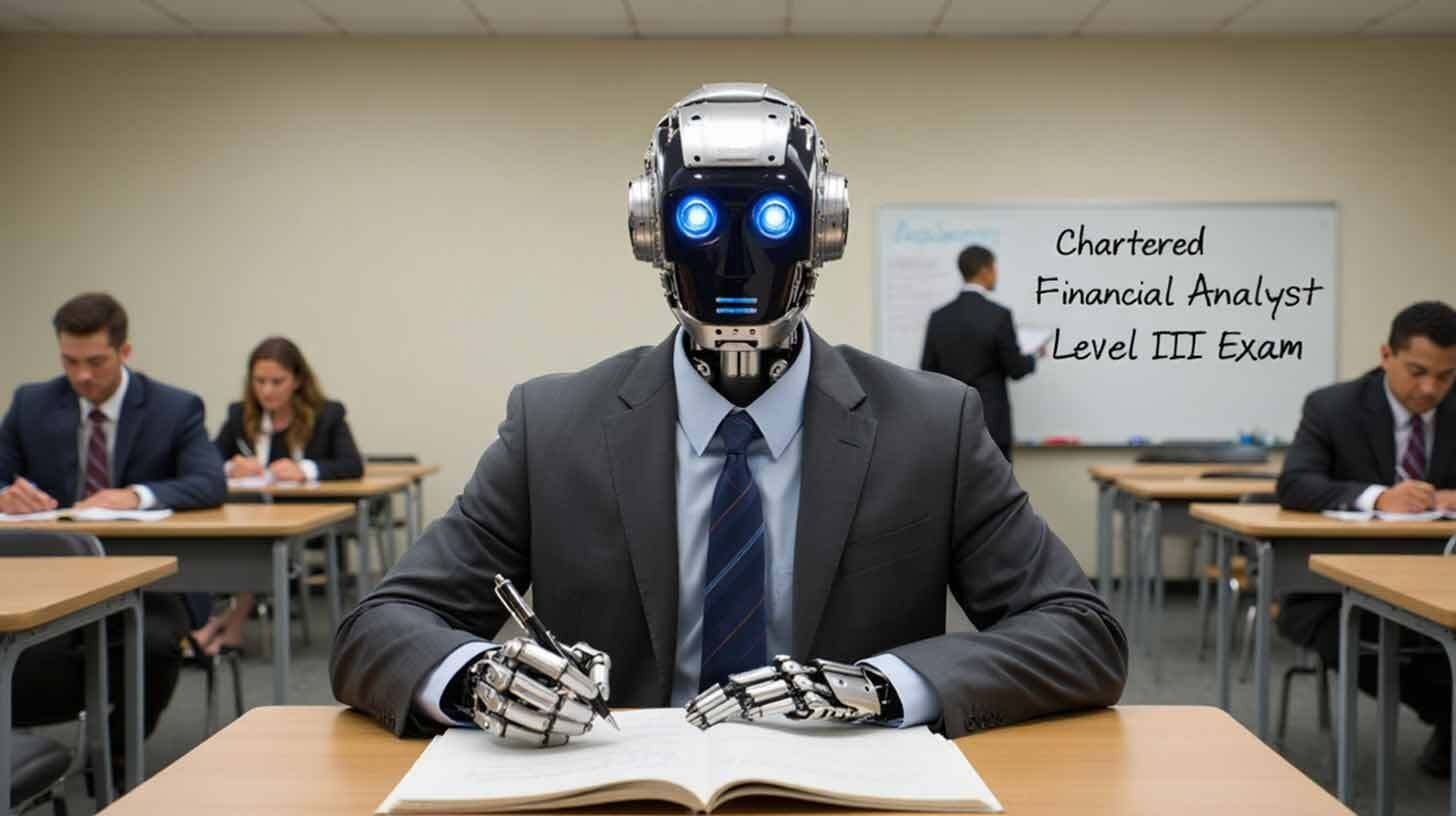
The Analyst, Automated: How AI's CFA Success Redefines the Future of Finance
For decades, the Chartered Financial Analyst (CFA) designation has stood as the gold standard of investment professionalism. Earning the charter is a rite of passage that demands immense sacrifice: typically over 1,000 hours of study spread across several years, culminating in three grueling exam levels that test everything from ethical standards to complex portfolio management. It is a barrier designed to ensure that only the most dedicated and knowledgeable individuals enter the field. Now, that barrier has been breached not by a human candidate, but by artificial intelligence. According to groundbreaking research from NYU Stern and GoodFin, frontier AI models from Google, Anthropic, and OpenAI can now successfully complete all three levels of the CFA exam, including the notoriously difficult Level III essay problems that stumped them just two years ago. This is not merely a technical benchmark; it is a watershed moment that signals a fundamental shift in the value of human expertise within the financial industry.
The specifics of the study are striking. Researchers examined 23 large language models on simulated CFA Level III exams and discovered that nine of them achieved passing scores higher than 63%. Leading the pack was OpenAI's o4-mini, which received the highest score of 79.1%, followed closely by Gemini 2.5 Pro at 75.9% and Claude 4 Opus at 74.9%. These numbers are significant not just for their magnitude, but for their velocity. While human candidates spend years preparing for these exams, often balancing study with full-time employment, these models completed the assessment in a matter of minutes. The contrast is stark: what represents a career-defining achievement for a human is now a trivial computational task for a machine. This efficiency gain suggests that the raw processing of financial knowledge—memorization, calculation, and standard analysis—is rapidly becoming commoditized.
Perhaps the most telling detail lies in the essay section of the Level III exam. Historically, this has been the graveyard for AI systems. Constructed response questions require nuanced reasoning, structured argumentation, and the ability to synthesize disparate pieces of information—tasks that earlier models struggled to perform coherently. Two years ago, frontier models consistently failed this portion. Today, with the advent of advanced reasoning models, they not only pass but excel. The study noted that AI essay replies were regularly rated 5.6 points higher by human graders than by automatic grading methods. This discrepancy suggests that AI-generated arguments are becoming increasingly persuasive to human readers, potentially even more so than rigid algorithmic scoring systems anticipate. It indicates that AI is not just crunching numbers; it is learning the language of finance, the tone of professionalism, and the structure of logical justification.
The implications for the financial workforce are profound. For generations, the value of a financial analyst was tied to their ability to gather information, perform analysis, and construct investment justifications. These were the skills the CFA certified. If AI can now perform these tasks faster, cheaper, and with comparable accuracy, the center of gravity for human value must shift. The research suggests that as AI advances, human elements such as client connections, contextual judgment, and ethical oversight will take precedence over research findings and investment justifications. The analyst of the future will not be valued for their ability to build a discounted cash flow model—that will be assumed capability of their software stack. Instead, they will be valued for their ability to understand a client's unique risk tolerance, navigate complex family dynamics in wealth management, or interpret geopolitical nuance that falls outside historical data patterns.
This transition mirrors earlier shifts in other professions. In medicine, diagnostic AI is becoming highly accurate, yet the value of the physician remains rooted in empathy, communication, and holistic care. In finance, the "human in the loop" will evolve from a processor of information to a curator of trust. Clients do not just want returns; they want confidence, reassurance, and a partner who understands their life goals beyond the spreadsheet. AI can optimize a portfolio; it cannot comfortably talk a client through a market crash or negotiate a sensitive family inheritance dispute. These soft skills, often dismissed as secondary to technical prowess, are becoming the primary differentiators in an AI-saturated market.
Moreover, the speed at which this capability emerged highlights the accelerating pace of AI development. The leap from failing essay portions two years ago to dominating them today demonstrates a significant shift in analytical capacities. It suggests that the window for adapting to this new reality is narrowing. Financial institutions that continue to hire and train based on traditional metrics of technical knowledge risk finding themselves obsolete. The curriculum of finance education may need to pivot from teaching students how to calculate beta to teaching them how to interrogate an AI's calculation of beta, how to identify bias in training data, and how to apply ethical judgment when algorithms suggest morally ambiguous strategies.
The NYU research also raises questions about the future of certification itself. If the knowledge barrier is lowered, what does the CFA charter signify? It may evolve from a test of knowledge retention to a test of judgment, ethics, and oversight. The charter could become less about proving you know the material and more about proving you can responsibly wield the tools that know the material for you. This would align with the broader trend in professional services where licensure increasingly focuses on accountability rather than just competency.
Ultimately, this breakthrough is not a signal that human analysts are obsolete, but that their role is being redefined. The machines have mastered the textbook; now humans must master the context. The future of finance will not be a competition between human and AI, but a collaboration where AI handles the complexity of data and humans handle the complexity of people. For those willing to adapt, this offers an opportunity to elevate the profession from number-crunching to true advisory. For those who cling to the past, the message is clear: the exam has changed, and the syllabus is being rewritten in real-time.
The CFA was once the proof of expertise. Now, it is the baseline. The real test begins where the data ends.
Your one-stop shop for automation insights and news on artificial intelligence is EngineAi.
Did you like this article? Check out more of our knowledgeable resources:
Watch this space for weekly updates on digital transformation, process automation, and machine learning. Let us assist you in bringing the future into your company right now