ChatGPT’s App Ecosystem: OpenAI’s Bold Bet on an “Everything Interface”
OpenAI has taken a pivotal step in transforming ChatGPT from a conversational AI assistant into a dynamic, interactive platform—unveiling a fully browsable app directory and opening the doors for third-party developers to build and submit their own integrations. This move signals OpenAI’s most concrete effort yet to position ChatGPT not just as a tool for answers, but as a central operating interface for digital life—a place where users can order food, design presentations, browse real estate, and stream music, all without leaving the chat window.
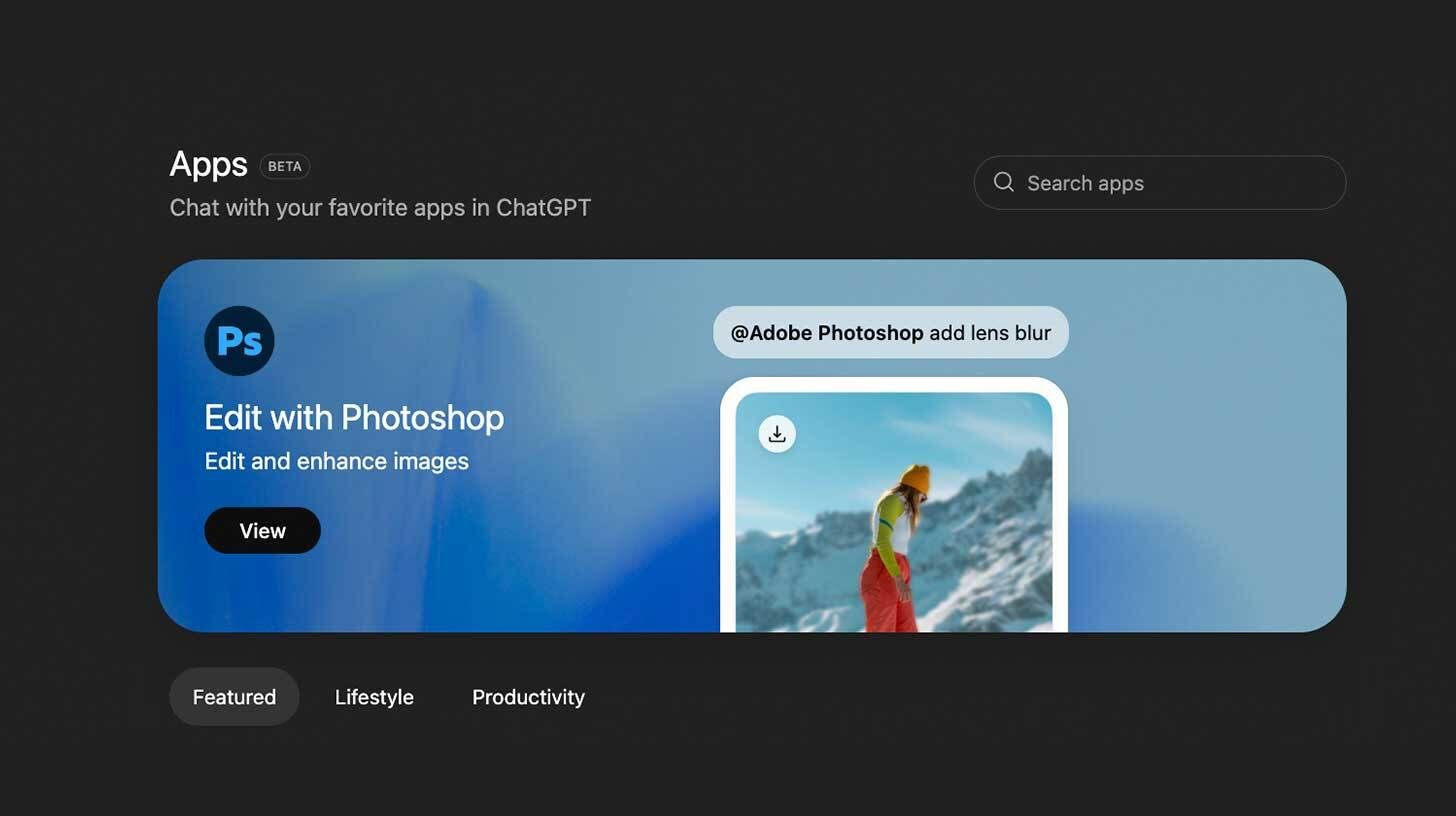
Announced as the next evolution of the “Apps in ChatGPT” feature first introduced at DevDay earlier this year, the new directory organizes third-party services into intuitive categories like Featured, Lifestyle, and Productivity. Users can access it directly from the tools menu or via chatgpt.com/apps, turning ChatGPT into a discovery hub akin to an app store—but one embedded seamlessly into conversation. Already live integrations include household names like Photoshop, Canva, DoorDash, Spotify, and Zillow, each allowing users to trigger real-world actions through natural language prompts.
For developers, OpenAI has released a beta SDK, comprehensive documentation, open-source UI libraries, and step-by-step submission guides—all designed to lower the barrier to entry and encourage high-quality, chat-native experiences. This is more than an API expansion; it’s an invitation to co-create the future of human-computer interaction.
From Assistant to Action Hub
At its core, OpenAI’s vision is clear: ChatGPT should be the starting point—not the endpoint—for digital tasks. Where traditional apps require users to switch contexts, open new tabs, or navigate complex menus, ChatGPT Apps aim to collapse that friction. Imagine sketching a rough idea in text—“turn this into a sleek pitch deck”—and having Canva automatically generate slides. Or saying, “Find me a two-bedroom apartment under $2,500 in Seattle,” and seeing Zillow listings appear instantly in the chat.
This “action layer” is what separates the new app ecosystem from earlier plugins or the underwhelming GPT Store. Rather than just customizing ChatGPT’s tone or knowledge base, these apps enable real functionality: booking, creating, purchasing, analyzing. The integration is deep—users can invoke apps by typing @Appname or selecting them from the tools menu, and OpenAI is even experimenting with context-aware suggestions, where relevant apps surface automatically based on conversation history, user behavior, and stated intent.
Critically, these aren’t just links or shortcuts. Apps built with OpenAI’s SDK can participate in the conversation, request specific inputs, display rich UI elements within chat, and maintain state across interactions—making them feel like native extensions of ChatGPT itself.
A Developer Platform in the Making
For third-party builders, the opportunity is significant—but comes with caveats. OpenAI is providing robust resources: an open-source UI library ensures consistent, chat-friendly interfaces; MCP (Model Context Protocol) defines how apps communicate with ChatGPT; and detailed submission guidelines emphasize clarity, safety, and user intent. Apps must have a well-defined scope, avoid vague or overly broad functions, and deliver tangible value—either by completing real-world workflows or enabling novel AI-native experiences.
Yet monetization remains limited. In this early phase, developers can only redirect users to external websites for transactions—such as completing a DoorDash order or purchasing a Canva Pro subscription. While OpenAI acknowledges this constraint, it has signaled plans to explore in-chat digital goods, subscriptions, and richer revenue models as the ecosystem matures. For now, the primary incentive is distribution and engagement: getting in front of ChatGPT’s massive user base.
This mirrors early app store dynamics, where discovery mattered more than immediate monetization. But OpenAI is also learning from past missteps. The GPT Store, launched earlier this year, struggled with low user engagement despite thousands of custom GPTs. OpenAI now appears to be course-correcting by prioritizing utility over novelty, enforcing quality thresholds, and investing in discoverability through curated categories and algorithmic recommendations.
Trust, Privacy, and the Guardrails of Integration
Given the sensitive nature of conversational data—and the potential for misuse—OpenAI is implementing strict safety and privacy protocols. Every app submission must comply with OpenAI’s usage policies, be suitable for general audiences, and include a clear, accessible privacy policy. Developers are prohibited from requesting unnecessary user data, and must explicitly disclose what information (if any) is shared with their service.
When a user connects to a new app, ChatGPT displays a transparent data-sharing notice, detailing what permissions are granted. Users retain full control: they can disconnect an app at any time, instantly revoking its access to future (and in some cases, past) conversations. Notably, developers must specify whether their app can access “Memories” or historical chats—a critical distinction in an era where context = value.
These guardrails are essential. As ChatGPT becomes a conduit to external services, the risk of data leakage, phishing, or malicious integrations grows. OpenAI’s approach—combining proactive review, user consent, and granular permissions—suggests a commitment to building trust alongside functionality.
The Road Ahead: Can ChatGPT Become the OS of Everyday Life?
OpenAI’s ambition is nothing short of revolutionary: to make ChatGPT the default interface for digital interaction. In a world fragmented across dozens of apps and platforms, the promise of a single, intelligent conversational layer that connects them all is compelling. If successful, this could redefine how we work, create, shop, and live online.
But success is far from guaranteed. User adoption hinges on consistency, speed, and reliability—will invoking Spotify via ChatGPT feel smoother than opening the app directly? Will users trust Zillow recommendations generated in chat over browsing listings themselves? And crucially, will developers see enough value to invest in deep integrations, especially without robust monetization?
OpenAI is betting that the answer is yes. By starting with high-utility partners (Canva, DoorDash, etc.), enforcing quality, and gradually introducing smarter discovery and revenue tools, it hopes to avoid the “ghost town” fate of the GPT Store. The gradual rollout—starting with a curated set of approved apps in the new year—suggests caution, not hype.
Moreover, this strategy aligns with a broader industry shift toward AI agents and ambient computing. Rather than users navigating static menus, the future may involve AI that anticipates needs, orchestrates tools, and executes tasks on our behalf. ChatGPT Apps are a stepping stone toward that vision—turning the assistant into an agent with hands.
Conclusion: The Beginning of a New Ecosystem
OpenAI’s app directory is more than a feature update—it’s a strategic declaration. By opening ChatGPT to third-party innovation, OpenAI is embracing platform dynamics: network effects, ecosystem lock-in, and developer-driven expansion. It’s a model that powered the rise of iOS, Android, and the web itself.
Yet unlike those platforms, ChatGPT’s foundation is conversation, not code or clicks. This changes everything. Apps must feel like natural extensions of dialogue, not jarring interruptions. They must be simple enough for casual users yet powerful enough for professionals.
As OpenAI iterates—adding better monetization, refining discovery, deepening context awareness—the true test will be whether users habitually choose ChatGPT as their first stop for getting things done. If they do, we may look back on this moment as the birth of the first mainstream AI operating system: fluid, adaptive, and deeply woven into the fabric of daily life.
For now, the doors are open. Developers are building. And the conversation—and the action—has just begun.
Your one-stop shop for automation insights and news on artificial intelligence is EngineAi.
Did you like this article? Check out more of our knowledgeable resources:
📰 In-depth analysis and up-to-date AI news .
🤝 Visit to learn about our goal and knowledgeable staff.
📬 Use this link to share your project or schedule a free consultation.
Watch this space for weekly updates on digital transformation, process automation, and machine learning. Let us assist you in bringing the future into your company right now.