The specifics:
Using the identical prompts and token budgets, the team conducted 180 experiments on models from OpenAI, Google, and Anthropic.
While Minecraft jobs requiring step-by-step effort deteriorated by up to 70%, financial analysis tasks divided across agents witnessed an 81% improvement.
Adding more agents usually resulted in inferior performance when a single agent had already achieved 45% accuracy on a task, with numerous agents rapidly depleting tokens.
While Minecraft jobs requiring step-by-step effort deteriorated by up to 70%, financial analysis tasks divided across agents witnessed an 81% improvement.
Adding more agents usually resulted in inferior performance when a single agent had already achieved 45% accuracy on a task, with numerous agents rapidly depleting tokens.
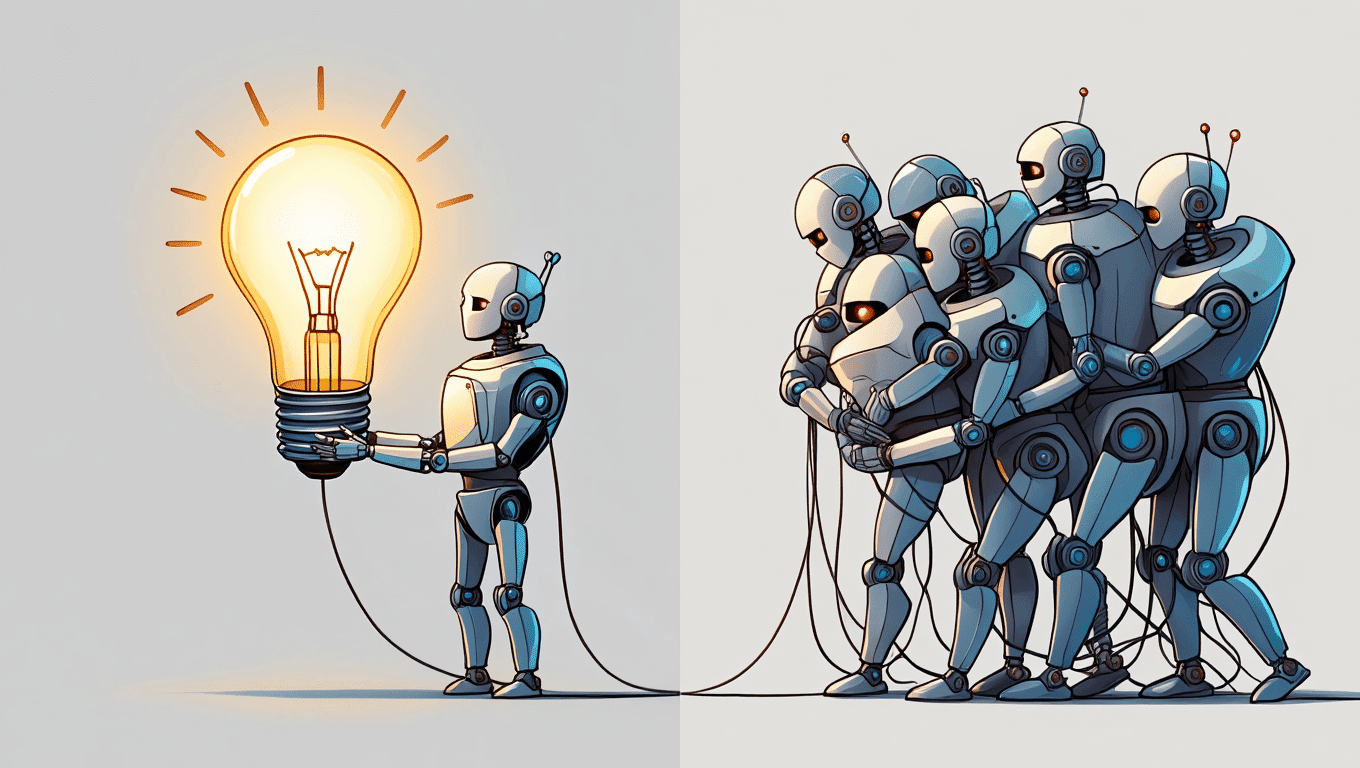
Companies and customers are being pushed toward sophisticated multi-agent workflows by the agentic hype, but this research may indicate that more isn't always better. A well-designed single agent may perform better than a complex system at a fraction of the cost for many enterprise tasks that call for step-by-step reasoning.
Your one-stop shop for automation insights and news on artificial intelligence is EngineAi.
Did you like this article? Check out more of our knowledgeable resources:
📰 In-depth analysis and up-to-date AI news .
🤝 Visit to learn about our goal and knowledgeable staff.
📬 Use this link to share your project or schedule a free consultation.
Watch this space for weekly updates on digital transformation, process automation, and machine learning. Let us assist you in bringing the future into your company right now.
Did you like this article? Check out more of our knowledgeable resources:
📰 In-depth analysis and up-to-date AI news .
🤝 Visit to learn about our goal and knowledgeable staff.
📬 Use this link to share your project or schedule a free consultation.
Watch this space for weekly updates on digital transformation, process automation, and machine learning. Let us assist you in bringing the future into your company right now.