The Floodgates Open: How Alibaba's Qwen3 Suite is Reshaping the Global AI Race
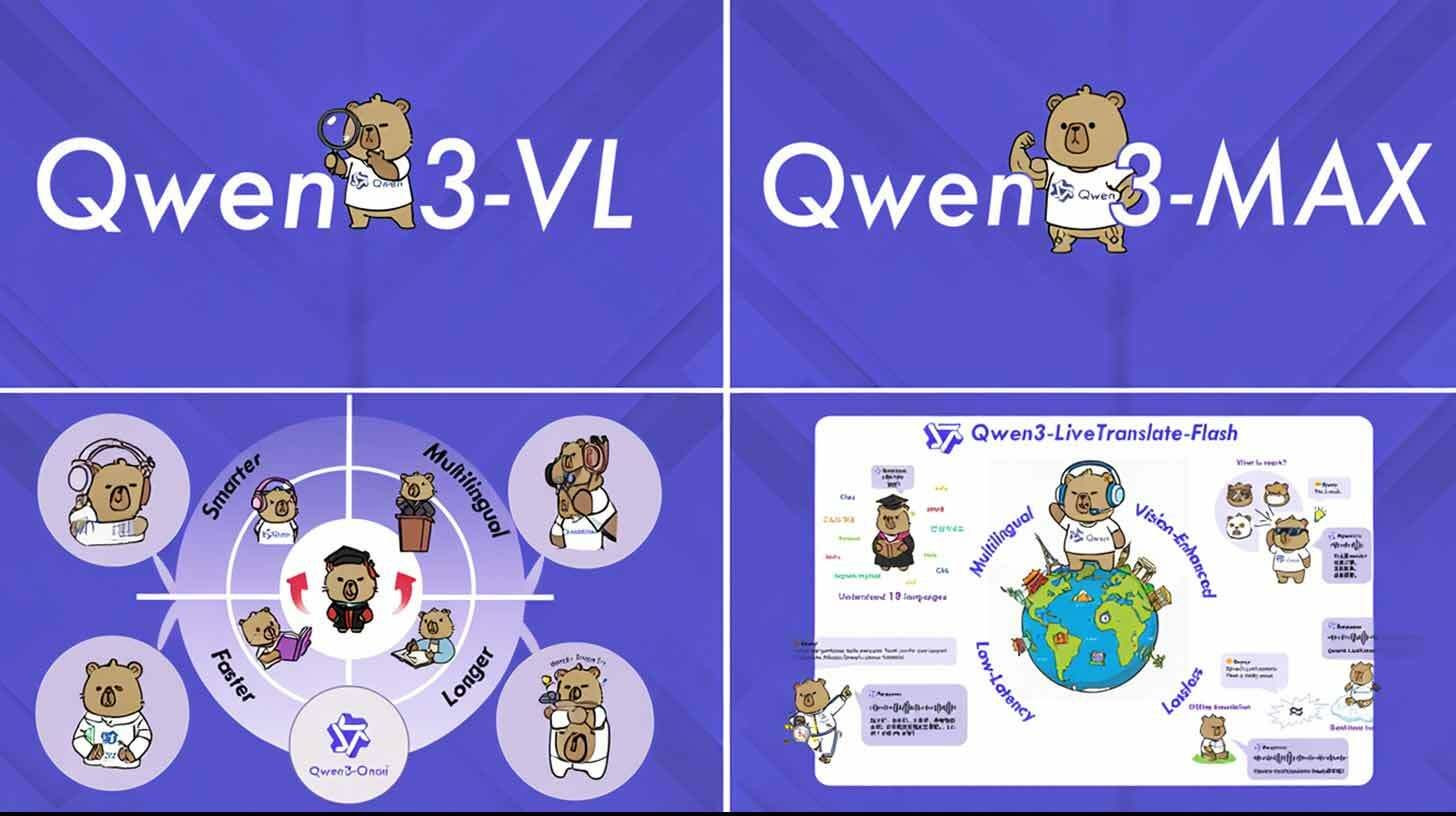
In the high-stakes competition for artificial intelligence supremacy, timing is strategy. While Western labs like OpenAI, Anthropic, and Google have cultivated an aura of deliberate, measured releases—each announcement a carefully staged event—Chinese tech giants are playing a different game. This week, Alibaba unveiled six new Qwen3 models spanning text, vision, audio, and safety, flooding the market with near-frontier capabilities at a pace that feels less like a product launch and more like a strategic offensive. At the center of this arsenal is Qwen-Max, a 1-trillion-parameter model that signals a bold claim: Chinese AI is no longer catching up—it is competing at the edge. For an industry conditioned to expect scarcity, this abundance is disorienting. For the global AI landscape, it is transformative.
The flagship of the Qwen3 suite, Qwen-Max, represents a significant leap in capability. With near-frontier performance in coding and agentic tasks, it is designed for complex, multi-step workflows that require planning, tool use, and contextual reasoning. While its "Heavy" variant scores flawlessly on numerical reasoning benchmarks—a testament to its precision in mathematical and logical domains—Max is optimized for versatility. It can orchestrate autonomous agents, debug intricate codebases, and navigate ambiguous instructions with a fluency that rivals the best Western models. This is not just a model; it is a platform for building the next generation of AI applications, from enterprise automation to scientific discovery.
But Qwen-Max is only one piece of a broader ecosystem. Qwen-Omni extends the suite's reach into multimodal intelligence, offering speech interpretation in 19 languages and generation in 10. More impressively, it can analyze text, graphics, audio, and video in a unified framework, enabling use cases like real-time multilingual video summarization, cross-modal search, and accessible content creation. For global enterprises, this means deploying a single model that understands and generates content across languages and media—a significant reduction in complexity and cost.
On the visual front, Qwen-VL has earned distinction as the best non-reasoning, open-source visual model, outperforming leading closed models on multiple benchmarks. This is a strategic win for the open-source community: by releasing a high-performance vision model under permissive terms, Alibaba is empowering researchers and developers worldwide to build upon its foundation. The implications are profound. Open-source models accelerate innovation by lowering barriers to entry, fostering collaboration, and preventing vendor lock-in. Qwen-VL's performance suggests that openness and excellence are not mutually exclusive—a message that could reshape how the industry thinks about model distribution.
Safety and specialization round out the suite. Alibaba introduced Guard models for content moderation, designed to detect and mitigate harmful outputs across languages and contexts. Improved Coder variations offer enhanced performance for software development tasks, while LiveTranslate-Flash enables real-time interpretation with low latency—critical for live events, customer support, and cross-border collaboration. Together, these models form a comprehensive toolkit: not just a collection of capabilities, but an integrated stack for building responsible, multilingual, multimodal AI applications.
The pace of this release is as significant as the capabilities themselves. Western AI development has been characterized by long development cycles, extensive safety reviews, and carefully orchestrated announcements. Alibaba's approach is the opposite: rapid iteration, broad specialization, and market saturation. This "flood the zone" strategy serves multiple purposes. It pressures competitors to accelerate their own roadmaps, captures developer mindshare by offering diverse tools for diverse needs, and demonstrates technological parity—or superiority—in key domains. For Alibaba, this is not just about models; it is about market positioning in a global race where perception can be as important as performance.
The claim that Qwen3 represents the closest a Chinese lab has come to the frontier since DeepSeek's R1 is noteworthy. It acknowledges the progress of peers while asserting leadership. More importantly, it signals confidence: Chinese AI research is no longer defined by imitation, but by innovation. The Qwen3 suite reflects a maturation of capabilities—from raw performance to practical utility, from single-modality to cross-modal understanding, from research prototypes to production-ready tools. This is the hallmark of an ecosystem that has moved beyond experimentation to execution.
For developers and enterprises, the implications are immediate. The availability of high-performance, specialized models at scale lowers the barrier to deploying advanced AI. A startup can now access coding assistance, vision analysis, and multilingual support without negotiating with multiple vendors or waiting for Western APIs to expand coverage. An enterprise can build a customer service bot that understands voice, image, and text in dozens of languages, with built-in safety moderation—all from a single provider. This consolidation of capability simplifies architecture, reduces integration overhead, and accelerates time-to-value.
Yet, the rapid proliferation of models also raises questions about sustainability and focus. In the rush to release, are corners being cut on safety evaluation, bias auditing, or long-term maintenance? How do users navigate a landscape where new models appear weekly, each with incremental improvements? Alibaba's strategy assumes that abundance creates opportunity—that developers will gravitate toward the tools that best serve their needs, and that competition will drive quality upward. This is a bet on market dynamics over centralized curation, and it reflects a broader philosophical divergence between Eastern and Western approaches to AI development.
The geopolitical dimension cannot be ignored. As AI becomes a cornerstone of economic and strategic power, the divergence in release strategies reflects deeper differences in governance, innovation culture, and risk tolerance. Western labs, operating under intense regulatory scrutiny and public scrutiny, prioritize caution and transparency. Chinese labs, facing different incentives and constraints, prioritize speed and scale. Neither approach is inherently superior; both carry trade-offs. The global AI community will benefit from observing both, learning from their successes and failures, and adapting best practices across borders.
Looking ahead, the Qwen3 suite hints at a future where AI capabilities are modular, interoperable, and accessible. Instead of monolithic models that attempt to do everything, we may see ecosystems of specialized models that collaborate to solve complex problems. Alibaba's multi-model strategy is a blueprint for that future: text, vision, audio, and safety as composable components, orchestrated by developers to meet specific needs. This modularity could accelerate innovation by allowing teams to mix and match the best tools for each task, rather than being locked into a single vendor's stack.
For the broader industry, Alibaba's announcement is a wake-up call. The AI race is not a sprint with a single finish line; it is a marathon with multiple checkpoints, and momentum can shift quickly. Companies that assume their lead is secure risk being overtaken by competitors who iterate faster, specialize deeper, and distribute more broadly. The lesson is not to copy Alibaba's strategy, but to recognize that agility, specialization, and openness are becoming competitive advantages.
The age of AI scarcity is ending. In its place rises a world of abundance—where powerful models are accessible, diverse, and rapidly evolving. Alibaba's Qwen3 suite is both a symptom and a catalyst of this shift. It demonstrates that frontier capabilities are no longer the exclusive domain of a few Western labs, and that innovation can flourish in multiple ecosystems simultaneously.
For developers, the message is empowering: the tools you need are available now. For enterprises, it is strategic: diversifying your AI stack could future-proof your investments. For the global community, it is a reminder: the future of AI will be shaped not by a single vision, but by many.
The floodgates have opened. The question is no longer who leads, but how we navigate the deluge—together.
Your one-stop shop for automation insights and news on artificial intelligence is EngineAi.
Did you like this article? Check out more of our knowledgeable resources:
Watch this space for weekly updates on digital transformation, process automation, and machine learning. Let us assist you in bringing the future into your company right now