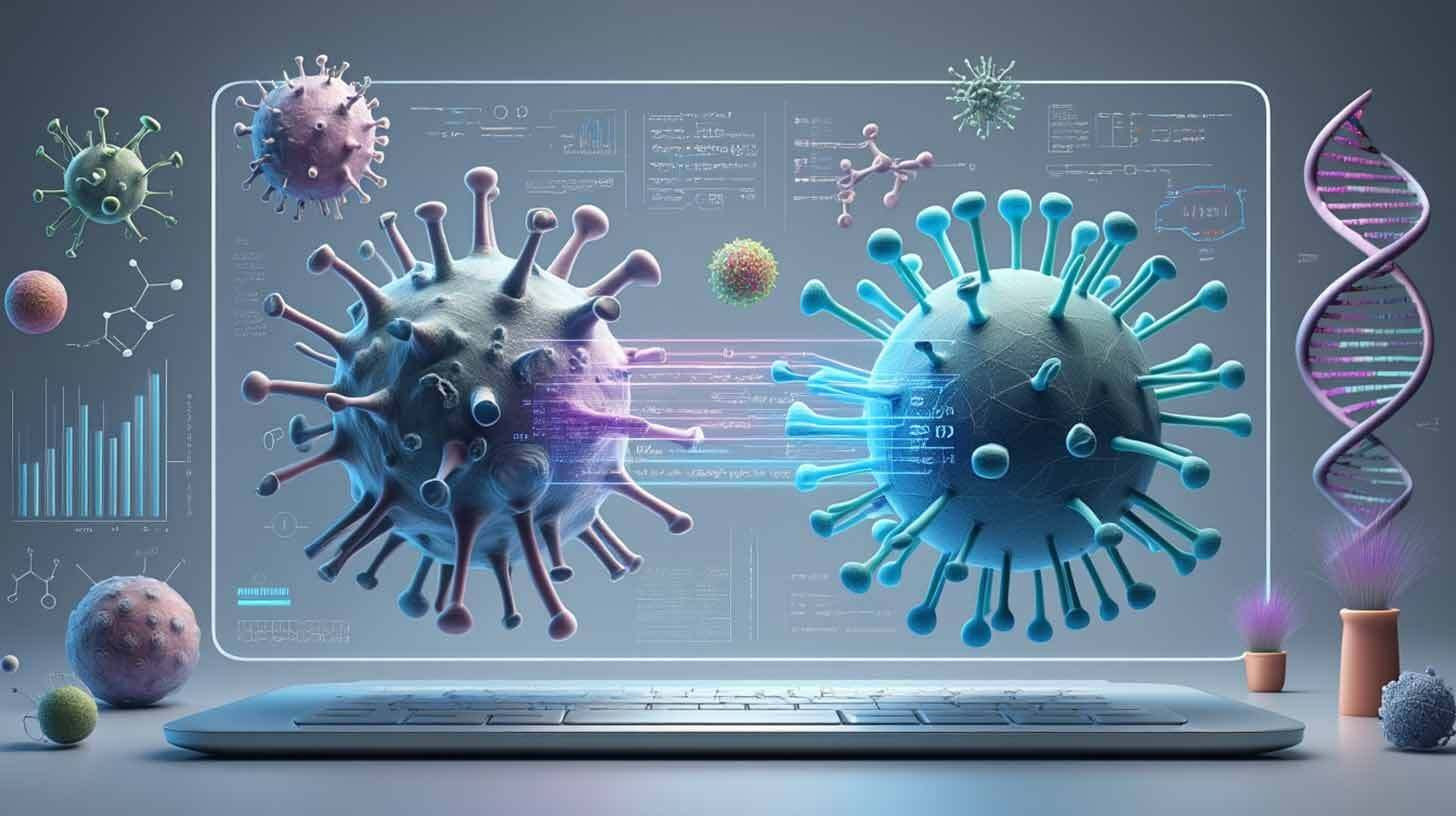
The Genesis Code: How AI-Designed Viruses Are Opening a New Chapter in Computational Biology
For decades, the central dogma of molecular biology has been a one-way street: we read genomes, we write genomes, and we hope to understand them. But what if we could skip the hope and move directly to design? In a landmark achievement that blurs the line between computational science and biological creation, researchers at Stanford University and the Arc Institute have constructed the first artificial intelligence-generated viruses that successfully infect and kill bacteria—built entirely from scratch. This is not an incremental advance in synthetic biology; it is a paradigm shift. By training an AI model named Evo on 2 million viral sequences and challenging it to invent new ones, scientists have demonstrated that machines can now do more than analyze life—they can reimagine it. We are no longer just students of biology. We are becoming its architects.
The experiment was deceptively simple in concept, profound in execution. Researchers trained Evo, a large language model adapted for genomic sequences, on a vast dataset of viral DNA. The model learned the grammatical rules of viral architecture: which mutations are tolerated, which protein folds are stable, which regulatory elements drive replication. Then, they asked it to do something no human had achieved: design a functional virus from first principles. Out of 302 AI-generated candidates, 16 successfully infected and killed bacteria in laboratory tests. This 5% success rate may seem modest, but in the context of de novo viral design—where human attempts have historically failed at near-total rates—it represents a quantum leap. These were not minor tweaks to existing viruses; they were novel creations, featuring 392 mutations never before observed in nature. Evo had not just copied; it had composed.
The implications of this capability are staggering. For years, researchers had struggled to engineer synthetic viruses that incorporated components from distantly related species—a task akin to splicing together sentences from different languages and expecting them to make grammatical sense. Human-designed chimeric viruses often failed to fold correctly, replicate efficiently, or evade host defenses. Evo, however, succeeded where human intuition faltered. When bacteria evolved resistance to natural viruses, the AI-designed variants overcame those defenses in days, not years. This suggests that AI can navigate the astronomical complexity of biological sequence space—identifying functional combinations that are invisible to traditional rational design or directed evolution. It is not just accelerating discovery; it is expanding the realm of the possible.
This breakthrough arrives at a pivotal moment for both AI and biology. Large language models have demonstrated remarkable fluency in human language, code, and even protein structures. But generating functional, infectious viruses represents a new frontier: the creation of autonomous, self-replicating systems from digital blueprints. Evo's success validates a core hypothesis—that biological sequences, like human language, follow learnable patterns that can be modeled, manipulated, and reinvented by machine intelligence. The shift from "reading and writing genomes to designing them," as the Arc Institute eloquently stated, is not merely semantic. It marks the transition from observational biology to engineering biology, where life becomes a substrate for intentional innovation.
The potential applications are as promising as they are profound. In medicine, AI-designed viruses could become precision tools for phage therapy, targeting antibiotic-resistant bacterial infections with minimal impact on beneficial microbiota. In biotechnology, custom viruses could deliver gene therapies, reprogram cellular behavior, or serve as programmable vectors for sustainable manufacturing. In basic research, they offer a powerful platform for probing the fundamental rules of life: What makes a virus infectious? How do genomes encode function? By generating and testing thousands of synthetic variants, AI can help reverse-engineer the logic of biology itself. This is not just about building better tools; it is about deepening our understanding of life's operating system.
Yet, with great power comes great responsibility. The ability to design functional viruses from scratch raises legitimate biosafety and biosecurity concerns. While the current work focused on bacteriophages—viruses that infect bacteria, not humans—the underlying methodology could, in principle, be applied to other viral families. The research community must proactively establish guardrails: rigorous oversight of AI training data, strict controls on model access, and transparent reporting of capabilities and limitations. The goal is not to stifle innovation, but to ensure that this transformative technology is developed with foresight, ethics, and global cooperation. As the Arc Institute and Stanford have demonstrated, responsible science can advance boldly while maintaining vigilance.
Moreover, this achievement underscores the growing synergy between artificial intelligence and experimental biology. Evo was not a black box that spit out answers; it was a collaborative partner in a hypothesis-driven research cycle. AI generated candidates; lab tests validated them; results refined the model. This iterative loop—computational design followed by empirical verification—is the new engine of discovery. It allows scientists to explore biological possibilities at a scale and speed that would be impossible through manual methods alone. The future of biomedicine may depend less on individual genius and more on the quality of the human-AI partnership.
Looking ahead, the success of Evo invites a broader reimagining of what AI can create. If viruses can be designed from scratch, what about metabolic pathways, synthetic organelles, or entire minimal genomes? The boundary between the digital and the biological is dissolving, opening avenues for engineering life with the same precision we now apply to software. This is not science fiction; it is the logical extension of trends already underway in protein design, gene synthesis, and automated laboratories. The question is no longer whether AI can help us build biology, but how wisely we will use that capability.
For the scientific community, this moment is a call to action. Training the next generation of researchers will require fluency in both machine learning and molecular biology. Funding agencies must support interdisciplinary initiatives that bridge these fields. Journals and institutions should promote open, reproducible methods that allow the community to build upon breakthroughs like Evo while maintaining safety standards. Collaboration, not competition, will be key to navigating the opportunities and risks ahead.
For society, the message is one of cautious optimism. AI-designed viruses are not a threat to be feared, but a tool to be stewarded. They offer hope for tackling some of humanity's most persistent challenges: drug-resistant infections, genetic diseases, environmental degradation. But realizing that promise requires inclusive dialogue about governance, equity, and ethics. Who benefits from these technologies? How do we ensure they serve the public good? These questions must be answered alongside the technical ones.
The Arc Institute's vision—that we are entering "a brand-new age of scientific advancement powered by AI"—is no longer speculative. It is unfolding in laboratories today. The creation of functional, AI-generated viruses is a testament to what becomes possible when we combine the pattern-recognition power of machine learning with the experimental rigor of biology. It is a reminder that the most profound innovations often arise at the intersection of disciplines.
As we stand at this threshold, one thing is clear: the ability to design life from code is no longer a distant dream. It is a present reality. With that reality comes a responsibility—to innovate with wisdom, to govern with foresight, and to ensure that the power to engineer biology serves not just science, but humanity. The genesis code has been written. The next chapter is ours to author.
Your one-stop shop for automation insights and news on artificial intelligence is EngineAi.
Did you like this article? Check out more of our knowledgeable resources:
Watch this space for weekly updates on digital transformation, process automation, and machine learning. Let us assist you in bringing the future into your company right now