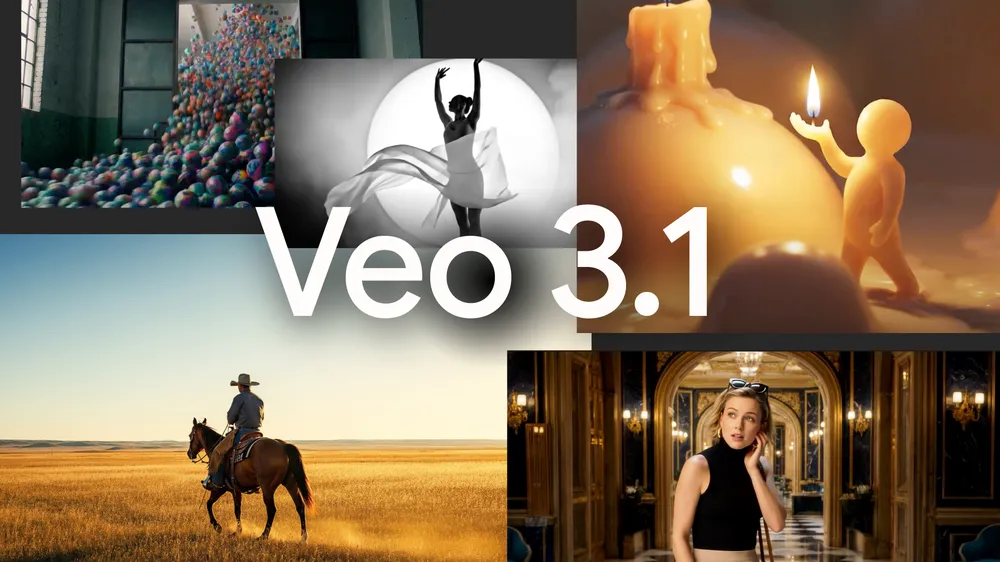
Veo 3.1 and advanced capabilities in Flow – EngineAI

Veo 3.1 and advanced capabilities in Flow

Veo 3.1 and advanced capabilities in Flow

Google Flow Unleashes Veo 3.1: The AI Filmmaking Revolution Gets Audio and Precision Editing

Five months after its debut, Google's Flow—an AI-powered filmmaking platform built on the Veo model—has quietly become one of the most prolific creative engines on the internet. With 275 million videos already generated, Flow is no longer an experiment; it is a studio. Today, Google is upgrading that studio with Veo 3.1, a model that adds rich generative audio, surgical editing tools, and cinematic realism that can stretch a single thought into a sixty-second seamless shot.

From Silent Clips to Living Scenes

Until now, Flow’s universe has been visually dazzling but audibly empty. Veo 3.1 ends the silence. Every core feature—Ingredients to Video, Frames to Video, and Extend—now ships with synchronized, scene-aware sound. A desert sunset will hiss with wind; a neon alley will echo with distant sirens. The audio is not layered on top; it is generated from the same latent space that dreams up the pixels, so footfalls match the gravel, and dialogue lip-syncs without human intervention.

The upgrade arrives first in “Ingredients to Video,” Flow’s multi-reference tool. Feed the model a handful of stills—say, a cyber-punk heroine, a rainy Shibuya crossing, and a 1980s color-grade—and the system will weave them into a moving tableau complete with ambient raindrops, splashing puddles, and the muffled throb of underground bass. Directors who once had to hunt for royalty-free loops can now whistle the mood they want and let the algorithm compose the rest.

Start- and End-Frame Storytelling

“Frames to Video” graduates from clever interpolation to full narrative choreography. Supply only a first and last frame—perhaps a closed bakery at dawn, then the same storefront swarmed by festival-goers at dusk—and Flow will hallucinate the entire day in between, camera move included. The addition of audio means the quiet morning gives way to chatter, clinking bottles, and a busker’s guitar that swells exactly as the sun flares. Because the model understands physics and perspective, balloons wobble, shadows pivot, and reflections in the window hold steady across the cut.

The One-Minute Single Take

“Extend” tackles the holy grail of micro-filmmaking: the invisible cut. Each new generation seeds itself from the final second of the previous clip, allowing creators to daisy-chain shots into a continuous, minute-long camera move. Imagine a drone that crests a hill, dives through a cottage window, glides past a simmering pot, and exits the back door into a twilight meadow—all without a single visible splice. Veo 3.1’s depth estimation keeps parallax consistent, while the new audio engine cross-fades ambience so smoothly that even waveform analysis struggles to spot the seams.

Pixel-Perfect Editing Arrives

Great films are rewritten, not just shot. Google is therefore grafting Photoshop-style dexterity onto Flow’s timeline. “Insert” lets users paint new objects into any frame with a text prompt. Type “a translucent jellyfish floating above the sidewalk” and the creature appears, its tentacles catching the sodium streetlight, shadow cast correctly across wet asphalt. The model relights the scene automatically, so the jellyfish’s bioluminescence tints passing umbrellas without looking like a sticker slapped on in post.

Coming soon, “Remove” will perform the opposite trick: marquee an unwanted boom mic, an extra passer-by, or an entire car, and Flow will inpaint the background as if the element never existed. Because Veo 3.1 reasons in 3-D, it can reconstruct occluded architecture or foliage instead of smearing neighboring pixels, a common artifact in classical inpainting.

State-of-the-Art, Benchmarked

Google DeepMind’s internal evals place Veo 3.1 at the top of publicly reported metrics for prompt adherence, motion fidelity, and audiovisual sync. Human raters prefer its outputs over those of Veo 3 by a double-digit margin, especially on complex prompts like “slow-motion close-up of a match-head igniting, sparks swirling into the shape of a phoenix.” The new model also halves the hallucination rate on human faces, a notorious sore spot for generative video.

For developers, the same checkpoint is available through the Gemini API and Vertex AI, priced per-second of generated footage. Enterprise customers gain granular safety filters, 4-K upscaling, and indemnification clauses—signals that Google sees real commercial productions in the pipeline.

Early Users and the First Viral Moments

Beta testers have already pushed the platform into unexpected genres. A Korean indie band storyboarded an entire music video by feeding the model Polaroids shot in their rehearsal space; Flow animated the stills into a continuous tracking shot that ends with the drummer literally dissolving into cymbal splash. An NFT artist looped a 45-second Extend sequence of a blooming mechanical rose, then sold it as a 1-of-1 generative piece for 12 ETH. Even traditional agencies are experimenting: a Parisian perfume house is testing fragrance ads where the bottle shatters in slow motion, each shard reflecting a different memory—impossible to shoot practically, trivial for Flow.

The Fine Print: Experimental but Accelerating

Google labels every new feature “experimental,” and the caveats show. Audio occasionally drifts out of sync when characters speak on-camera, and Extend can lose narrative coherence after 50 seconds of chained generations. Nighttime footage still carries a faint watermark grain unless users opt for the paid tier. Yet the iteration cadence is blistering: updates arrive weekly, trained on an ever-growing lake of licensed cinematic content and user opt-ins.

Privacy guardrails remain tight. Uploaded reference images are encrypted at rest and auto-deleted after 30 days; the model refuses to generate recognizable people unless the user provides explicit written consent. Deepfake detection metadata is baked into every frame, a move aimed at pre-empting regulatory scrutiny.

Toward a One-Person Studio

The bigger picture is less about any single feature than about collapsing the distance between imagination and audience. A teenager on a phone can now scout virtual locations, cast synthetic actors, compose score, and final-edit a short film before the school bus arrives. Hollywood pipelines—storyboard, pre-vis, location shoot, ADR, color grade—compress into a single chat window.

Critics worry this flood of AI content will drown human craftsmanship, but early data hints at the opposite: Flow users watch 40 % more behind-the-scenes tutorials on traditional cinematography than before, suggesting that lowering the floor also raises the ceiling. When tools handle the grunt work, creators obsess over lighting motivation, color symbolism, and rhythmic editing—craft issues that algorithms still delegate back to humans.

How to Start Creating

The update rolls out today at flow.google. Existing projects automatically inherit Veo 3.1 when users hit “remix,” while new prompts default to the latest model. Free-tier users receive 60 seconds of watermarked 720p generation per month; the 20 per second for 720p, dropping with volume commitments.

Google’s roadmap hints at collaborative timelines, real-time multi-user editing, and eventually text-to-audio-to-video in one prompt: type “a noir detective whistles while chasing a suspect through 1940s Chicago” and receive a fully mixed scene. Until then, Veo 3.1 feels like the moment silent film learned to talk—only this time, every screen in the world is a potential theater, and every viewer can also be the director.

← Back to all articles

Explore More AI Resources

📚 AI Glossary

🏆 Best AI Tools

⚡ AI Comparisons

📘 AI Guides

What is Artificial Intelligence?

Artificial intelligence represents one of the most significant technological advances in human history, fundamentally changing how we interact with computers and digital systems. At its core, AI enables machines to perform tasks that historically required human intelligence, including visual perception, speech recognition, decision-making, and language translation. The field has evolved rapidly from narrow AI systems designed for specific tasks to increasingly sophisticated models capable of generalized reasoning.

Machine learning, a subset of AI, allows systems to learn and improve from experience without being explicitly programmed. Deep learning, in turn, uses neural networks with many layers to process complex data and recognize intricate patterns. These technologies power everything from the recommendation engines that suggest your next movie to the autonomous vehicles that may soon drive our roads. Understanding the fundamentals of AI helps business leaders, developers, and consumers alike navigate an increasingly AI-powered world.

The impact of AI extends across every industry and sector of the economy. Healthcare organizations use AI for diagnostic imaging analysis and drug discovery. Financial institutions deploy AI for fraud detection and risk assessment. Manufacturers implement AI for predictive maintenance and quality control. Retailers leverage AI for inventory management and personalized marketing. These applications demonstrate how AI creates value by automating routine tasks, extracting insights from vast data sets, and enabling new capabilities that were previously impossible.

Applications of AI Across Industries

The practical applications of AI technology span an extraordinarily wide range, touching virtually every aspect of modern life. In healthcare, AI systems analyze medical images to detect cancers earlier and more accurately than human radiologists in some studies. AI-powered drug discovery platforms can simulate molecular interactions and predict which compounds might treat diseases, potentially accelerating the development of new medications by years. Surgical robots assisted by AI enable minimally invasive procedures with greater precision than traditional techniques.

In finance, AI algorithms process millions of transactions per second to identify fraudulent activity in real time. Trading systems use AI to analyze market conditions and execute trades at speeds and scales impossible for human traders. Credit scoring models leverage AI to evaluate borrower risk more accurately, expanding access to credit for underserved populations while maintaining lender profitability. Insurance companies use AI for claims processing and fraud detection, reducing costs and improving customer satisfaction.

Manufacturing and logistics companies use AI for predictive maintenance, identifying when machines are likely to fail before breakdowns occur, reducing downtime and repair costs. Supply chain optimization algorithms powered by AI consider thousands of variables to minimize inventory costs while ensuring product availability. Autonomous vehicles and drones promise to revolutionize transportation and delivery, with AI systems processing sensor data in real time to navigate safely through complex environments.

Getting Started with AI

Beginning your journey with AI does not require advanced degrees or massive technical expertise. Modern AI tools and platforms have made the technology increasingly accessible to users across skill levels. Start by exploring the fundamentals through resources like our comprehensive AI Glossary which explains key terms and concepts in accessible language. Build familiarity with common AI applications by experimenting with tools you already use, many of which incorporate AI features without requiring explicit AI expertise.

For organizations looking to adopt AI, the key is starting with clear problem identification. Successful AI initiatives begin by identifying specific business challenges where AI might add value, rather than implementing AI for its own sake. Common early applications include customer service chatbots, document processing automation, and data analysis tools. These provide measurable value while allowing teams to build AI capabilities and familiarity progressively.

Our AI Tools Directory provides comprehensive information on hundreds of AI-powered applications across categories including natural language processing, computer vision, predictive analytics, and process automation. Browse the directory to discover tools that match your specific needs, and read our detailed reviews and comparisons to inform your selection decisions. The rankings are based on extensive hands-on testing and evaluation by our expert team.

AI Resources and Learning

Staying current with AI developments requires ongoing learning and engagement with the field. Our AI Guides provide in-depth tutorials and explainers on topics from beginner fundamentals to advanced implementation techniques. Whether you are looking to understand how large language models work, learn best practices for prompt engineering, or implement AI automation in your organization, our guides offer practical, actionable guidance based on real-world experience.

The AI landscape evolves rapidly, with new models, tools, and techniques emerging continuously. Our editorial team monitors these developments to bring you timely coverage of significant advances and their practical implications. We provide context and analysis that helps you understand which developments genuinely matter versus passing hype. Subscribe to our newsletter for weekly summaries of the most important AI news and developments.

For those considering AI implementation, our comparisons section offers detailed evaluations of competing tools and approaches, helping you make informed decisions about which technologies suit your needs. Our rankings provide curated recommendations across all major AI categories, from best overall tools to specialized solutions for specific use cases. Each recommendation includes rationale and methodology so you understand exactly why we recommend what we recommend.

Explore Our AI Resources

From beginner guides to advanced tutorials, from tool comparisons to rankings, we provide the comprehensive AI resources you need to succeed.

Browse AI Tools AI Guides Best Rankings Comparisons AI Glossary

AI Technology and Industry Overview

The artificial intelligence industry has experienced remarkable growth and innovation in recent years, with new breakthroughs and capabilities emerging at an unprecedented pace. Large language models have revolutionized natural language processing, enabling applications from conversational AI to automated content generation. Computer vision systems can now recognize objects and scenes with accuracy rivaling or exceeding human performance in many domains. These advances have created new possibilities for businesses across every sector, from automating routine tasks to enabling entirely new products and services that were previously impossible.

Understanding the AI landscape requires familiarity with key concepts and terminology. Machine learning provides the foundation for most modern AI systems, enabling computers to learn patterns from data rather than following explicit programming. Deep learning uses neural networks with many layers to handle complex tasks like image recognition, speech processing, and language understanding. Large language models represent a particularly powerful class of deep learning systems trained on vast text corpora to understand and generate human language with remarkable fluency.

The practical applications of AI technology span virtually every industry and domain. In healthcare, AI assists with diagnostics, drug discovery, and personalized treatment recommendations. In finance, AI powers fraud detection, algorithmic trading, and risk assessment. In manufacturing, AI enables predictive maintenance and quality control. In retail, AI drives personalized recommendations and inventory optimization. These applications demonstrate how AI creates value by automating routine tasks, extracting insights from data, and enabling new capabilities.

Implementing AI in Your Organization

Successfully implementing AI requires more than just deploying technology. Organizations must develop clear strategies for identifying appropriate use cases, building data infrastructure, developing internal expertise, and managing change. The most successful AI implementations start with well-defined problems where AI can demonstrate clear value, then expand progressively as capabilities and confidence grow. This approach allows teams to build expertise gradually while generating measurable returns that justify continued investment in AI capabilities.

Building an AI-ready organization requires attention to data quality, infrastructure, and talent. AI systems depend on data, and organizations must have processes for collecting, cleaning, and maintaining high-quality data to train and operate effective AI models. Infrastructure considerations include computing resources, data storage, and integration with existing systems. Talent requirements range from specialized ML engineers and data scientists to product managers and business leaders who can identify AI opportunities and translate them into business requirements.

Change management represents a critical but often overlooked component of AI implementation. Employees may view AI as a threat to their jobs, requiring careful communication about how AI will augment rather than replace human workers. Successful organizations invest in training programs that help employees work effectively alongside AI systems, developing new skills for leveraging AI tools in their daily work. This human-centered approach to AI adoption leads to better outcomes than treating AI as a purely technical implementation.

Evaluating AI Tools and Vendors

The AI tools market has exploded with options ranging from general-purpose platforms to specialized solutions for specific industries and use cases. Evaluating these options requires understanding your specific requirements, use cases, and constraints. General-purpose AI platforms offer flexibility but may require more customization to achieve optimal results for specific applications. Specialized solutions may offer turnkey functionality but could create vendor lock-in or limitations for future needs.

Our comprehensive AI Tools Directory provides detailed information on hundreds of AI tools and platforms. We evaluate each tool across dimensions including capability, ease of use, pricing, and support. Our rankings provide curated recommendations based on extensive testing and analysis. We also offer detailed comparisons that evaluate how competing tools stack up against each other across real-world use cases.

When evaluating AI vendors, consider factors beyond just technical capability. Data privacy and security policies determine how your data will be handled and stored. Pricing models vary significantly, from per-user subscriptions to consumption-based billing. Support and documentation quality affects how quickly your team can become productive with new tools. Integration capabilities determine how easily AI tools fit into existing workflows and systems.

AI Best Practices and Ethics

Responsible AI development and deployment requires attention to ethics, fairness, and potential societal impacts. AI systems can inadvertently perpetuate or amplify biases present in training data, leading to unfair outcomes for certain groups. Organizations must implement processes for auditing AI systems for bias and taking corrective action when problems are identified. Transparency about how AI systems make decisions helps build trust and enables accountability.

Data privacy represents another critical consideration for AI implementations. AI systems often require large amounts of data for training and operation, raising questions about what data is collected, how it is stored, and who has access. Organizations must implement appropriate data governance practices and ensure compliance with relevant regulations like GDPR and CCPA. When selecting AI vendors, carefully review their data handling practices and privacy policies.

Environmental considerations are increasingly important for AI deployments. Training large models can consume significant energy, raising sustainability concerns. Organizations should evaluate the environmental impact of their AI systems and consider strategies for minimizing energy consumption, such as using more efficient model architectures or leveraging cloud providers with strong sustainability commitments. These considerations should be part of comprehensive AI governance frameworks.

Explore Our AI Resources

From tool directories to best practices, from comparisons to tutorials, we provide comprehensive AI resources.

Browse AI Tools AI Guides Best Rankings Comparisons AI Glossary