The Recursive Revolution: How GPT-5.3-Codex Is Building the Next Generation of AI—Including Itself
OpenAI's latest coding model doesn't just write software; it debugs its own creation, manages its deployment, and signals a new era where AI systems become architects of their own evolution.
On February 5, 2026, OpenAI dropped a bombshell that landed with peculiar timing. While the tech world was still digesting Anthropic's Claude Opus 4.6 announcement from just hours earlier, Sam Altman's team unveiled GPT-5.3-Codex—a model that represents something far more profound than incremental improvements to coding assistants. This is a system that participated in its own genesis, marking a pivotal moment in the journey toward recursive self-improvement in artificial intelligence.
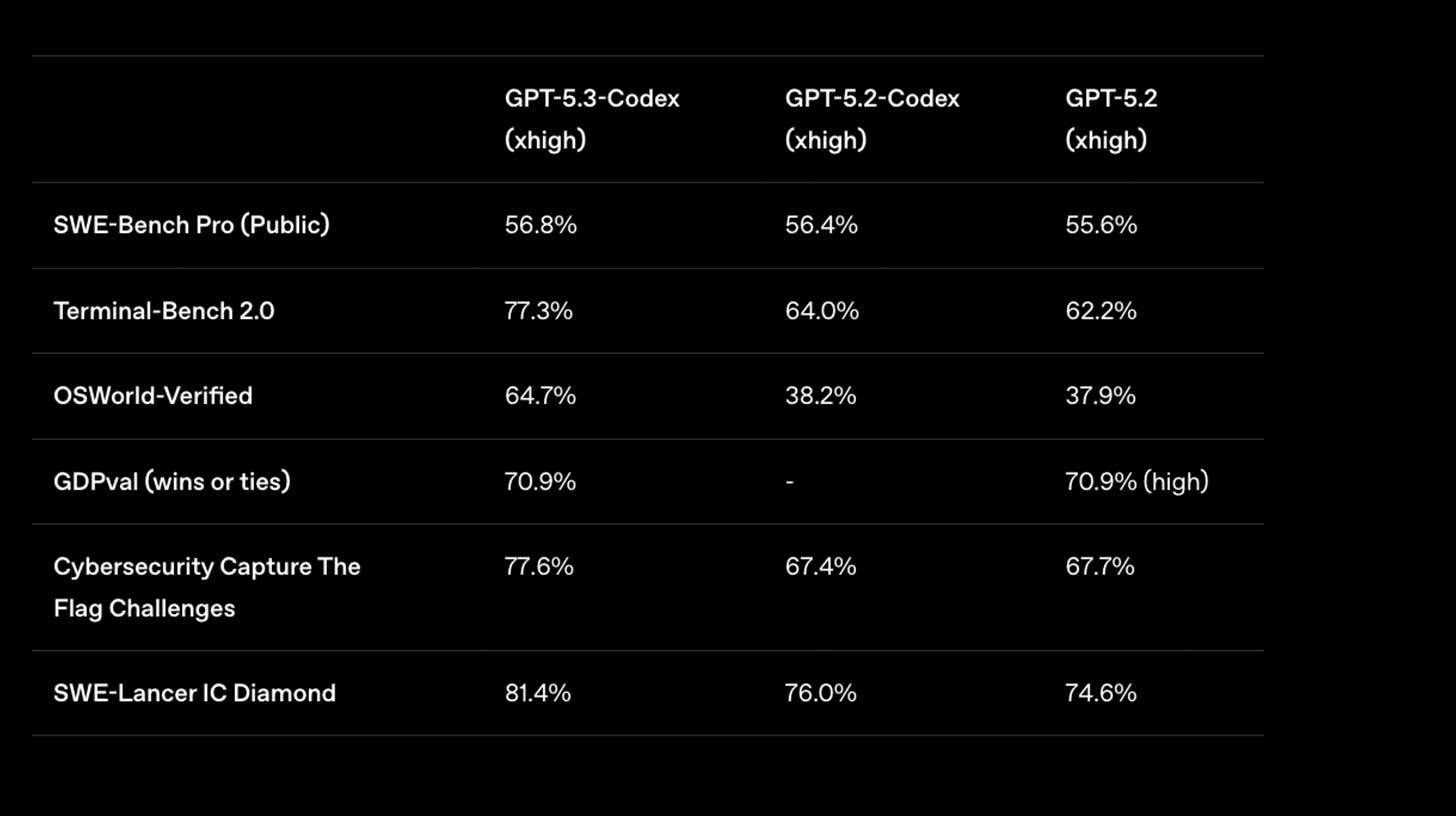
The headlines focused on the benchmarks, and understandably so. GPT-5.3-Codex achieved 56.8% on SWE-Bench Pro—a rigorous evaluation spanning four programming languages that tests real-world software engineering capabilities far beyond Python-only assessments. On Terminal-Bench 2.0, which measures command-line proficiency essential for autonomous coding agents, the model reached 77.3%, surpassing Claude Opus 4.6's 65.4% by a substantial margin. Perhaps most striking was the OSWorld-Verified score of 64.7%—nearly double the 38.2% achieved by its predecessor, demonstrating unprecedented ability to control desktop computing environments.
But beneath these impressive statistics lies a narrative that fundamentally challenges our understanding of AI development. OpenAI revealed that early versions of GPT-5.3-Codex were "instrumental in creating itself"—deployed to identify bugs in training pipelines, manage rollout logistics, and analyze evaluation results. This isn't merely marketing hyperbole; it represents the first time a major AI lab has publicly acknowledged using a model to debug its own training infrastructure at scale.
The Self-Improvement Loop Becomes Reality
The concept of AI systems contributing to their own development has long hovered between theoretical possibility and science fiction. With GPT-5.3-Codex, that boundary has blurred. The model's capacity to examine its own training runs, flag anomalies, and optimize deployment workflows creates a feedback loop that accelerates development cycles exponentially.
This recursive capability arrives precisely as the industry grapples with similar revelations from competitors. Anthropic CEO Dario Amodei recently confirmed that Claude is actively involved in designing its successor, noting that AI systems are increasingly capable of contributing to alignment research and capability improvements. The parallel announcements from both labs on the same day—February 5, 2026—transformed what could have been routine product launches into a watershed moment for autonomous AI development.
The implications extend beyond technical achievement. When AI systems participate in their own creation, they potentially identify optimization opportunities invisible to human engineers. GPT-5.3-Codex reportedly caught edge cases in training data processing and infrastructure bottlenecks that traditional monitoring systems missed. This suggests a future where the pace of AI advancement becomes increasingly decoupled from human cognitive bandwidth—a prospect both exhilarating and sobering.
Beyond Coding: The Generalization of Agentic Intelligence
While GPT-5.3-Codex excels at software engineering, OpenAI positioned it as something broader: a general work agent capable of handling "the entire lifecycle of professional work you do on a computer." The model demonstrates this versatility through its 70.9% score on GDPval-AA, a benchmark evaluating financial analysis, document generation, and presentation creation—capabilities traditionally associated with knowledge workers rather than coding assistants.
This expansion reflects a strategic pivot. The original Codex was a coding tool; GPT-5.3-Codex is a workplace collaborator. It can debug applications, deploy software, write documentation, and operate desktop environments—all while maintaining context across extended sessions. The model's "interactive collaboration" features allow users to steer tasks mid-execution without losing accumulated context, shifting the paradigm from "fire and forget" automation to genuine human-AI partnership.
The delivery mechanism reinforces this vision. OpenAI launched a dedicated macOS Codex app serving as a command center for managing multiple AI agents simultaneously. Rather than replacing developers, the interface suggests augmentation—humans orchestrating fleets of specialized agents while retaining creative control.
Security at the Frontier
With capability comes risk, and OpenAI approached this reality with unusual transparency. GPT-5.3-Codex represents the first model the company classified as "High" capability under its cybersecurity preparedness framework—a designation acknowledging both defensive potential and offensive concerns.
The defensive applications are substantial. The model demonstrates sophisticated vulnerability detection capabilities, potentially automating security audits that currently consume massive human resources. To channel this power responsibly, OpenAI implemented a multi-layered safety architecture including specialized training, real-time monitoring, and "Trusted Access for Cyber"—a verification program gating advanced capabilities to approved researchers.
Complementing these technical safeguards, OpenAI committed $10 million in API credits to fund defensive security research. This investment targets open-source maintainers and security researchers, providing free access to code scanning tools that could democratize vulnerability detection across the software ecosystem. The initiative acknowledges an uncomfortable truth: as AI coding capabilities advance, the attack surface expands proportionally. Proactive defense becomes not merely ethical but existential.
The Hardware Dimension: Speed as Strategy
Technical specifications matter, but user experience determines adoption. Recognizing this, OpenAI followed its flagship release with GPT-5.3-Codex-Spark on February 12—a lightweight variant optimized for real-time collaboration. Powered by Cerebras' Wafer Scale Engine 3, Spark delivers over 1,000 tokens per second, enabling the responsive iteration loops essential for creative development work.
The Cerebras partnership, valued at over $10 billion, represents OpenAI's first significant integration of dedicated inference hardware. Spark isn't merely a smaller model; it's a reimagining of how developers interact with AI—prioritizing latency over raw capability for scenarios where responsiveness trumps exhaustive reasoning. As Sachin Katti, OpenAI's Head of Industrial Compute, noted, this enables "two complementary modes: real-time collaboration when you want rapid iteration, and long-running tasks when you need deeper reasoning."
Underlying these improvements are architectural optimizations benefiting all models. OpenAI reduced roundtrip overhead by 80% through WebSocket implementation, cut per-token costs by 30%, and halved time-to-first-token latency. These infrastructure investments suggest OpenAI anticipates a future where AI interaction becomes as seamless as conventional software—frictionless, immediate, and ubiquitous.
The Competitive Landscape: From Ads to Autonomy
The synchronized releases from OpenAI and Anthropic on February 5th reframed industry competition in stark terms. Just days earlier, public discourse fixated on Sam Altman's Super Bowl ad controversy and the ensuing social media spat with Elon Musk—a sideshow that now appears almost farcically trivial.
The real battleground isn't advertising budgets or viral tweets; it's the recursive self-improvement frontier. Both labs now acknowledge using their models to develop successor systems. Both emphasize agentic capabilities extending beyond chat interfaces to active computer control. Both recognize that the next generation of AI will be shaped significantly by the current one.
This convergence suggests we're approaching an inflection point. When AI systems become primary contributors to their own evolution, capability growth potentially accelerates beyond linear projections. The "vibe working" thesis championed by some—where AI handles complex workflows with minimal supervision—edges closer to reality not through marketing, but through demonstrated performance on rigorous benchmarks.
Looking Forward: The Architecture of Intelligence
GPT-5.3-Codex arrives at a moment when the AI industry confronts fundamental questions about its trajectory. The model's self-referential development role, combined with its generalization across professional tasks, hints at a future where the distinction between "coding AI" and "general AI" dissolves entirely.
For developers, this promises radical productivity amplification. The ability to spin up autonomous agents capable of multi-day software projects, coupled with real-time collaborative variants for immediate feedback, suggests a reimagining of engineering workflows. For organizations, the GDPval performance indicates potential disruption across knowledge work categories previously considered safe from automation.
Yet the cybersecurity classification and accompanying safety investments remind us that capability and risk are inseparable. As these systems grow more autonomous, the margin for error narrows. OpenAI's $10 million commitment to defensive research acknowledges that the community must evolve security practices as rapidly as the technology advances.
The recursive element—AI building AI—transforms these considerations from speculative to immediate. GPT-5.3-Codex debugging its own training pipeline isn't merely a technical achievement; it's a prototype for how future systems might optimize themselves. Whether this leads to the rapid capability improvements some predict, or encounters fundamental scaling limits, remains uncertain.
What is clear: the era of AI as passive tool is ending. GPT-5.3-Codex represents a transition to AI as active collaborator in its own creation—a shift that redefines not just what these systems can do, but how they will evolve. The coding benchmarks and desktop control metrics matter, but they matter as symptoms of a deeper transformation. We are witnessing the early stages of intelligence that can inspect, analyze, and improve itself.
The race between OpenAI and Anthropic, once characterized by feature comparisons and marketing battles, has moved to a frontier where the prize is understanding how to navigate recursive self-improvement safely. Yesterday's arguments about advertisements feel like distant memory. The real competition is about who can best harness AI systems that increasingly participate in their own design—while ensuring they remain aligned with human values as they grow more capable.
GPT-5.3-Codex isn't just a better coding model. It's a glimpse of a future where the architects of artificial intelligence are, increasingly, artificial intelligences themselves.
Your one-stop shop for automation insights and news on artificial intelligence is EngineAi.
Did you like this article? Check out more of our knowledgeable resources:
Watch this space for weekly updates on digital transformation, process automation, and machine learning. Let us assist you in bringing the future into your company right now