Moonshot AI’s Kimi K2.6 closes open-source gap – EngineAI

Moonshot AI’s Kimi K2.6 closes open-source gap

Moonshot AI’s Kimi K2.6 closes open-source gap

Two weeks ago, Anthropic CEO Dario Amodei made a characteristically confident prediction. Speaking at a closed-door AI summit in London, he told attendees that open-source models and Chinese AI labs were “roughly 6 to 12 months behind” the frontier capabilities of closed, Western models like Claude Opus 4.6, GPT-5.4, and Gemini 3.1 Pro. The gap, he suggested, was real, structural, and unlikely to close quickly.


He may have been wrong by about 14 days.


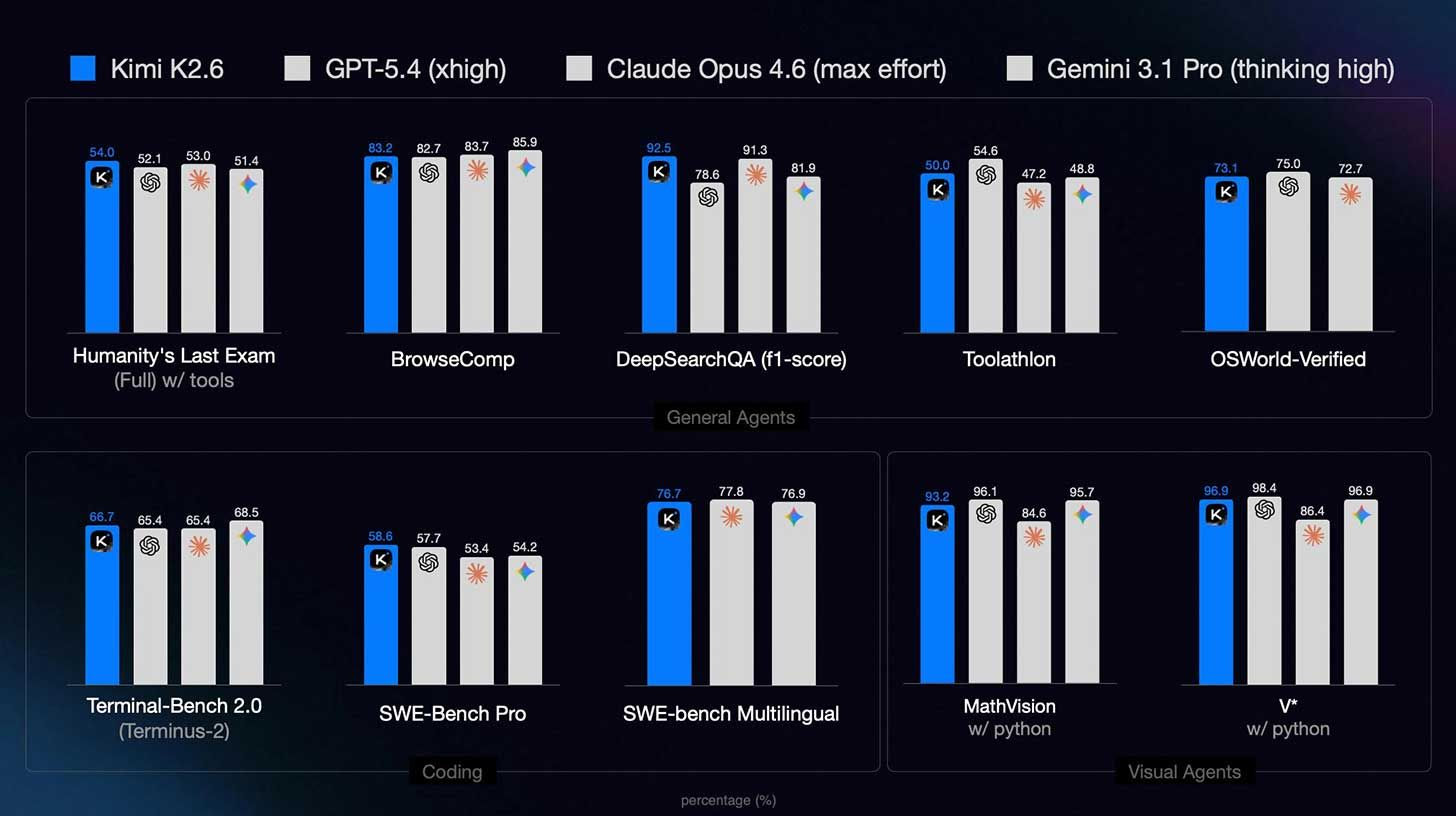
Today, Moonshot AI – the Chinese startup behind the popular Kimi assistant – open-sourced K2.6 , a new agentic coding model that, according to a comprehensive benchmark suite published by the company, either nears or outright outperforms the very frontier models Amodei cited. On Humanity’s Last Exam (HLE) with tools, a grueling reasoning benchmark designed to stump even the best models, K2.6 scores 54.0% – beating GPT-5.4 (52.1%), Opus 4.6 (53.0%), and Gemini 3.1 Pro (51.4%). On SWE-Bench Pro, the gold standard for real-world coding ability, K2.6 scores 58.6% , surpassing Opus 4.6 (53.4%) and Gemini 3.1 Pro (54.2%), while narrowly edging GPT-5.4 (57.7%).


The results are not a clean sweep – the Western models still lead on some benchmarks, particularly pure reasoning without tools – but the overall picture is unmistakable. A Chinese, open-source model is trading blows with the most advanced closed models from OpenAI, Anthropic, and Google. And in the categories that matter most for autonomous agents – long-horizon execution, tool use, and agent swarms – K2.6 is not just competitive. It is, in some dimensions, superior.


But the benchmarks, however impressive, are not the story. The story is what K2.6 does. The model can work continuously for 12+ hours across 4,000+ tool calls, refactoring an 8-year-old codebase or optimizing a niche-language inference engine from scratch. It can spin up 300 parallel sub-agents as a swarm – triple the capacity of its predecessor, K2.5. Always-on agents like OpenClaw and Hermes are already running on K2.6, with one internal Moonshot agent operating autonomously for five days straight, handling monitoring, incident response, and system operations without human intervention.


“This is not a model that answers questions,” said Dr. Elena Vasquez, an AI analyst who has tested K2.6 extensively. “This is a model that works. It takes a task and just … keeps going. For hours. For days. That is a fundamentally different capability than what most frontier models offer. They’re brilliant for 30 seconds. K2.6 is reliable for 30 hours.”


For developers frustrated by usage limits, rate throttling, and the unpredictable costs of closed APIs, K2.6 arrives as a powerful, cost-effective, and open alternative. And for the open-source community, it is a statement: the gap is closing. Faster than anyone predicted.


Part I: The Benchmark Sweep – By the Numbers

Moonshot AI has published an extraordinarily detailed benchmark suite for K2.6, comparing it against GPT-5.4 (with xhigh reasoning effort), Claude Opus 4.6 (max effort), and Gemini 3.1 Pro (high thinking level), as well as its own predecessor, K2.5. The results are spread across four categories: Agentic, Coding, Reasoning & Knowledge, and Vision.


Agentic Benchmarks (Tool Use & Autonomous Action)

This is where K2.6 shines brightest. On HLE-Full with tools – a version of Humanity's Last Exam that allows models to use search, code execution, and browsing – K2.6 scores 54.0%, beating every competitor. On DeepSearchQA (F1-score), K2.6 achieves 92.5%, far outpacing GPT-5.4 (78.6%) and Gemini 3.1 Pro (81.9%), while narrowly edging Opus 4.6 (91.3%). On accuracy, the gap is even wider: K2.6 at 83.0% vs. GPT-5.4 at 63.7%.


On Toolathlon, a benchmark for multi-step tool use, K2.6 scores 50.0%, ahead of Opus 4.6 (47.2%) and Gemini (48.8%), though behind GPT-5.4 (54.6%). On MCPMark, a test of Model Context Protocol integration, K2.6 ties Gemini (55.9%) and surpasses Opus (56.7%? Actually K2.6 matches Opus's 56.7? The table shows Opus 56.7*, K2.6 55.9 – a narrow gap).


Perhaps most significantly, on Claw Eval (pass^3) – a measure of reliable autonomous execution – K2.6 scores 62.3%, beating GPT-5.4 (60.3%) and Gemini (57.8%), though still behind Opus 4.6 (70.4%). But on the pass@3 metric (attempts three times), K2.6 is competitive at 80.9%.


Coding Benchmarks

On SWE-Bench Pro, K2.6 achieves 58.6%, surpassing Opus (53.4%), Gemini (54.2%), and GPT-5.4 (57.7%). On Terminal-Bench 2.0, a test of command-line and DevOps tasks, K2.6 scores 66.7%, ahead of GPT-5.4 (65.4%) and Opus (65.4%), though behind Gemini (68.5%). On SWE-Bench Multilingual, K2.6 scores 76.7%, effectively tied with Opus (77.8%) and Gemini (76.9%).


On LiveCodeBench (v6), a test of real-time coding, K2.6 reaches 89.6% – slightly ahead of Opus (88.8%) but behind Gemini (91.7%).


Reasoning & Knowledge (Without Tools)

Here, the Western models maintain a lead. On HLE-Full (no tools), K2.6 scores 34.7%, behind GPT-5.4 (39.8%), Opus (40.0%), and Gemini (44.4%). On GPQA-Diamond, a graduate-level reasoning test, K2.6 scores 90.5%, behind Gemini (94.3%) and GPT-5.4 (92.8%), but ahead of Opus (91.3%? Actually Opus 91.3, so K2.6 is slightly behind). On AIME 2026, a math competition, K2.6 scores 96.4%, competitive but behind GPT-5.4 (99.2%).


Vision Benchmarks

K2.6 is multimodal, and it performs respectably. On MMMU-Pro, it scores 79.4%, behind Gemini (83.0%) and GPT-5.4 (81.2%), but ahead of Opus (73.9%). With Python tool use, scores improve across the board, but the Western models maintain a slight edge.


“The pattern is clear,” said Vasquez. “When you give K2.6 tools – when you let it search, execute code, and iterate – it is world-class. When you force it to reason purely from its parameters, it is still good, but not quite at the frontier. That suggests Moonshot has optimized heavily for agentic capabilities. And that is exactly the right bet for the market.”


Part II: Long-Horizon Coding – 12 Hours, 4,000 Tool Calls

The benchmark numbers are impressive, but they do not capture what makes K2.6 truly different. For that, you have to look at the long-horizon demonstrations Moonshot has released.


In one internal test, K2.6 was tasked with downloading and deploying the Qwen3.5-0.8B model locally on a Mac – but with a twist: it had to implement and optimize the model inference in Zig, a niche systems programming language with very little example code or documentation.


K2.6 worked for 12 hours straight, making over 4,000 tool calls across 14 iterations. It researched Zig’s syntax, wrote inference code, ran benchmarks, identified bottlenecks, rewrote critical sections, and iterated again. By the end of the process, it had improved throughput from approximately 15 tokens per second to 193 tokens per second – a 1,200% improvement – ultimately achieving speeds 20% faster than LM Studio, a popular optimized inference tool.


“That is not code generation,” said Marcus Wei, an AI engineer who reviewed the test log. “That is software engineering. The model didn’t just write a function. It optimized a system. It learned a niche language. It benchmarked. It iterated. That is a level of autonomy I have not seen from any other model.”


In another test, K2.6 was asked to overhaul exchange-core, an 8-year-old open-source financial matching engine. The model analyzed CPU and allocation flame graphs, identified hidden bottlenecks, and reconfigured the core thread topology (from 4ME+2RE to 2ME+1RE) – a bold architectural change. Over 13 hours, it initiated over 1,000 tool calls and modified more than 4,000 lines of code. The result: a 185% leap in medium throughput (from 0.43 to 1.24 MT/s) and a 133% gain in peak performance (from 1.23 to 2.86 MT/s).


“What impressed me most was the surgical precision,” said a beta tester from Augment Code, quoted in Moonshot’s announcement. “When an initial path is blocked, K2.6 is strong at pivoting intelligently – following existing architectural patterns, finding hidden related changes, and keeping fixes scoped to the real problem.”


These long-horizon capabilities are not academic. They are directly applicable to the kind of autonomous agents that are increasingly being deployed in enterprise environments: agents that monitor systems, respond to incidents, refactor legacy codebases, and optimize performance – without human oversight.


Part III: Agent Swarms – Scaling Out, Not Just Up

One of K2.6’s most distinctive features is its agent swarm capability. Unlike traditional models that process tasks sequentially, K2.6 can dynamically decompose a complex task into heterogeneous subtasks and spin up parallel sub-agents to execute them simultaneously.


K2.6’s swarm architecture scales to 300 sub-agents executing across 4,000 coordinated steps simultaneously – triple the capacity of K2.5 (100 sub-agents, 1,500 steps). This parallelization dramatically reduces end-to-end latency for complex tasks.


In practice, this means K2.6 can:


Perform broad search and deep research simultaneously, combining complementary skills.


Analyze large-scale documents while generating long-form writing in parallel.


Generate multi-format content (documents, websites, slides, spreadsheets) in a single autonomous run.


The swarm can also turn any high-quality file – PDFs, spreadsheets, slides, Word documents – into Skills, capturing the document’s structural and stylistic DNA. Once a skill is created, K2.6 can reproduce the same quality and format in future tasks, creating a library of reusable workflows.


“The swarm capability is where K2.6 really separates from the pack,” said Dr. Alex Chen, an AI researcher focused on multi-agent systems. “Most models are single-threaded. They do one thing at a time. K2.6 can coordinate an army of sub-agents. That is not an incremental improvement. That is a different paradigm.”


Moonshot has also introduced Claw Groups, a research preview that extends the swarm architecture to heterogeneous agents running on different devices, different models, and different toolkits. A Claw Group can include agents running on local laptops, mobile devices, or cloud instances, each with its own specialized skills and memory contexts. K2.6 serves as the adaptive coordinator, dynamically matching tasks to agents based on skill profiles, detecting failures, and reassigning tasks as needed.


In an almost self-referential twist, Moonshot has been dogfooding Claw Groups to run its own agent marketing team – specialized agents like Demo Makers, Benchmark Makers, Social Media Agents, and Video Makers working together to produce launch campaigns.


“We’re moving beyond simply asking AI a question or assigning AI a task,” the company writes. “We’re entering a phase where human and AI collaborate as genuine partners – combining strengths to solve problems collectively.”


Part IV: Proactive Agents – Five Days of Autonomy

The ultimate expression of K2.6’s capabilities is the proactive agent – an AI that runs continuously, managing tasks without being prompted. Moonshot’s internal RL infrastructure team used a K2.6-backed agent that operated autonomously for five days straight, handling:


Monitoring: Watching system metrics and logs.


Incident response: Detecting anomalies and taking corrective action.


System operations: Managing ongoing tasks and workflows.


The agent’s worklog, anonymized and shared by Moonshot, shows a persistent context spanning days, multi-threaded task handling, and full-cycle execution from alert to resolution. This is not a chatbot that answers when called. It is a digital employee that never sleeps.


Always-on agents like OpenClaw and Hermes – open-source projects for autonomous computer use – are already running on K2.6. According to early testers, the model delivers “more precise API interpretation, stabler long-running performance, and enhanced safety awareness during extended research tasks.”


Moonshot has quantified these gains with an internal Claw Bench evaluation suite, covering five domains: Coding Tasks, IM Ecosystem Integration, Information Research & Analysis, Scheduled Task Management, and Memory Utilization. Across all metrics, K2.6 significantly outperforms K2.5 in task completion rates and tool invocation accuracy – particularly in workflows requiring sustained autonomous operation without human oversight.


“For a no-code environment, AI has to handle every edge case,” said a tester from a low-code platform. “There’s no developer to step in when something doesn’t work as expected. K2.6 is noticeably more effective than K2.5 at navigating nuanced API behaviors and recovering when things break. It runs longer-horizon tasks before hitting a wall.”


Part V: The Open-Source Advantage – Cost, Control, and Customization

K2.6 is open-source – available via Kimi.com, the Kimi App, the API, and Kimi Code. The model weights are publicly accessible, and Moonshot has published detailed instructions for self-hosting.


The implications are significant. For developers frustrated by the usage limits, rate throttling, and unpredictable costs of closed APIs (OpenAI’s GPT-5.4 is expensive; Anthropic’s Opus 4.6 is even more so), K2.6 offers a powerful alternative. The cost per inference is a fraction of the closed models – Moonshot has not published exact pricing, but early estimates suggest K2.6 is 5-10x cheaper than GPT-5.4 for comparable performance.


“Given frustrations over usage rates and the rise of autonomous agents, K2.6 looks like a powerful, cost-effective new option for agentic workflows,” said Sarah Jenkins, an AI infrastructure strategist. “If you’re building an agent that makes thousands of tool calls per day, the cost difference between closed APIs and an open-source, self-hosted model is the difference between viable and impossible.”


The open-source nature also enables customization. Developers can fine-tune K2.6 for their specific domains, integrate it with internal tooling, and deploy it on their own infrastructure – with no data leaving their control. For enterprises with strict data residency or security requirements, this is non-negotiable.


“Closed models are great for prototyping,” said Chen. “But for production agents that handle sensitive data or run at scale, you need control. K2.6 gives you that control without sacrificing capability. That is a game-changer.”


Part VI: The China Factor – And the Amodei Prediction

Moonshot AI is a Chinese company. K2.6 was developed in Beijing, by a team that, until recently, was largely unknown outside of Asia. The model’s performance – particularly on agentic and coding tasks – is a direct challenge to the narrative that Chinese AI labs are irreversibly behind their Western counterparts.


Amodei’s “6 to 12 months” prediction, made just two weeks ago, now looks premature at best. On some benchmarks, K2.6 is not 6 months behind. It is ahead. On others, the gap is narrow enough that a single training run could flip the leaderboard.


“The open-source community has been saying for years that the gap is closing,” said Vasquez. “But this is the first time we have a model that is demonstrably competitive across the board – and open-source, and from China. That’s three disruptions in one.”


Of course, the geopolitical context cannot be ignored. K2.6’s release comes amid ongoing US export controls on advanced semiconductors to China. Moonshot AI has not disclosed what hardware was used to train K2.6, but the model’s existence – and its performance – suggests that Chinese labs have found ways to work around the restrictions, or that the restrictions are less effective than intended.


“The US thought that cutting off access to NVIDIA’s most advanced chips would slow Chinese AI development,” said Wei. “K2.6 is evidence that it didn’t. Not enough. The gap is closing. And it’s closing faster than anyone in Washington wants to admit.”


Conclusion: A New Baseline for Open Agentic AI

Kimi K2.6 is not the final word in open-source coding models. It is, however, a new baseline. For the first time, developers have access to a model that can reason, code, use tools, coordinate swarms, and run autonomously for days – at a fraction of the cost of closed alternatives, with full control over deployment and customization.


The benchmark wars will continue. GPT-5.5, Opus 4.7, and Gemini 3.2 are surely in development. But K2.6 has shifted the terms of debate. The question is no longer “can open-source models compete?” The question is “how long until open-source models lead?”


For Dario Amodei, the prediction of a 6-12 month gap was a statement of confidence. For Moonshot AI, it was a challenge. And with K2.6, they have answered.


The long-horizon agentic future is open-source. And it just arrived.


Your one-stop shop for automation insights and news on artificial intelligence is EngineAi.

Did you like this article? Check out more of our knowledgeable resources:

• 📰 In-depth analysis and up-to-date AI news


• 🤝 Visit to learn about our goal and knowledgeable staff


• 📬 Use this link to share your project or schedule a free consultation


Watch this space for weekly updates on digital transformation, process automation, and machine learning. Let us assist you in bringing the future into your company right now

← Back to all articles

Explore More AI Resources

📚 AI Glossary

🏆 Best AI Tools

⚡ AI Comparisons

📘 AI Guides

What is Artificial Intelligence?

Artificial intelligence represents one of the most significant technological advances in human history, fundamentally changing how we interact with computers and digital systems. At its core, AI enables machines to perform tasks that historically required human intelligence, including visual perception, speech recognition, decision-making, and language translation. The field has evolved rapidly from narrow AI systems designed for specific tasks to increasingly sophisticated models capable of generalized reasoning.

Machine learning, a subset of AI, allows systems to learn and improve from experience without being explicitly programmed. Deep learning, in turn, uses neural networks with many layers to process complex data and recognize intricate patterns. These technologies power everything from the recommendation engines that suggest your next movie to the autonomous vehicles that may soon drive our roads. Understanding the fundamentals of AI helps business leaders, developers, and consumers alike navigate an increasingly AI-powered world.

The impact of AI extends across every industry and sector of the economy. Healthcare organizations use AI for diagnostic imaging analysis and drug discovery. Financial institutions deploy AI for fraud detection and risk assessment. Manufacturers implement AI for predictive maintenance and quality control. Retailers leverage AI for inventory management and personalized marketing. These applications demonstrate how AI creates value by automating routine tasks, extracting insights from vast data sets, and enabling new capabilities that were previously impossible.

Applications of AI Across Industries

The practical applications of AI technology span an extraordinarily wide range, touching virtually every aspect of modern life. In healthcare, AI systems analyze medical images to detect cancers earlier and more accurately than human radiologists in some studies. AI-powered drug discovery platforms can simulate molecular interactions and predict which compounds might treat diseases, potentially accelerating the development of new medications by years. Surgical robots assisted by AI enable minimally invasive procedures with greater precision than traditional techniques.

In finance, AI algorithms process millions of transactions per second to identify fraudulent activity in real time. Trading systems use AI to analyze market conditions and execute trades at speeds and scales impossible for human traders. Credit scoring models leverage AI to evaluate borrower risk more accurately, expanding access to credit for underserved populations while maintaining lender profitability. Insurance companies use AI for claims processing and fraud detection, reducing costs and improving customer satisfaction.

Manufacturing and logistics companies use AI for predictive maintenance, identifying when machines are likely to fail before breakdowns occur, reducing downtime and repair costs. Supply chain optimization algorithms powered by AI consider thousands of variables to minimize inventory costs while ensuring product availability. Autonomous vehicles and drones promise to revolutionize transportation and delivery, with AI systems processing sensor data in real time to navigate safely through complex environments.

Getting Started with AI

Beginning your journey with AI does not require advanced degrees or massive technical expertise. Modern AI tools and platforms have made the technology increasingly accessible to users across skill levels. Start by exploring the fundamentals through resources like our comprehensive AI Glossary which explains key terms and concepts in accessible language. Build familiarity with common AI applications by experimenting with tools you already use, many of which incorporate AI features without requiring explicit AI expertise.

For organizations looking to adopt AI, the key is starting with clear problem identification. Successful AI initiatives begin by identifying specific business challenges where AI might add value, rather than implementing AI for its own sake. Common early applications include customer service chatbots, document processing automation, and data analysis tools. These provide measurable value while allowing teams to build AI capabilities and familiarity progressively.

Our AI Tools Directory provides comprehensive information on hundreds of AI-powered applications across categories including natural language processing, computer vision, predictive analytics, and process automation. Browse the directory to discover tools that match your specific needs, and read our detailed reviews and comparisons to inform your selection decisions. The rankings are based on extensive hands-on testing and evaluation by our expert team.

AI Resources and Learning

Staying current with AI developments requires ongoing learning and engagement with the field. Our AI Guides provide in-depth tutorials and explainers on topics from beginner fundamentals to advanced implementation techniques. Whether you are looking to understand how large language models work, learn best practices for prompt engineering, or implement AI automation in your organization, our guides offer practical, actionable guidance based on real-world experience.

The AI landscape evolves rapidly, with new models, tools, and techniques emerging continuously. Our editorial team monitors these developments to bring you timely coverage of significant advances and their practical implications. We provide context and analysis that helps you understand which developments genuinely matter versus passing hype. Subscribe to our newsletter for weekly summaries of the most important AI news and developments.

For those considering AI implementation, our comparisons section offers detailed evaluations of competing tools and approaches, helping you make informed decisions about which technologies suit your needs. Our rankings provide curated recommendations across all major AI categories, from best overall tools to specialized solutions for specific use cases. Each recommendation includes rationale and methodology so you understand exactly why we recommend what we recommend.

Explore Our AI Resources

From beginner guides to advanced tutorials, from tool comparisons to rankings, we provide the comprehensive AI resources you need to succeed.

Browse AI Tools AI Guides Best Rankings Comparisons AI Glossary

AI Technology and Industry Overview

The artificial intelligence industry has experienced remarkable growth and innovation in recent years, with new breakthroughs and capabilities emerging at an unprecedented pace. Large language models have revolutionized natural language processing, enabling applications from conversational AI to automated content generation. Computer vision systems can now recognize objects and scenes with accuracy rivaling or exceeding human performance in many domains. These advances have created new possibilities for businesses across every sector, from automating routine tasks to enabling entirely new products and services that were previously impossible.

Understanding the AI landscape requires familiarity with key concepts and terminology. Machine learning provides the foundation for most modern AI systems, enabling computers to learn patterns from data rather than following explicit programming. Deep learning uses neural networks with many layers to handle complex tasks like image recognition, speech processing, and language understanding. Large language models represent a particularly powerful class of deep learning systems trained on vast text corpora to understand and generate human language with remarkable fluency.

The practical applications of AI technology span virtually every industry and domain. In healthcare, AI assists with diagnostics, drug discovery, and personalized treatment recommendations. In finance, AI powers fraud detection, algorithmic trading, and risk assessment. In manufacturing, AI enables predictive maintenance and quality control. In retail, AI drives personalized recommendations and inventory optimization. These applications demonstrate how AI creates value by automating routine tasks, extracting insights from data, and enabling new capabilities.

Implementing AI in Your Organization

Successfully implementing AI requires more than just deploying technology. Organizations must develop clear strategies for identifying appropriate use cases, building data infrastructure, developing internal expertise, and managing change. The most successful AI implementations start with well-defined problems where AI can demonstrate clear value, then expand progressively as capabilities and confidence grow. This approach allows teams to build expertise gradually while generating measurable returns that justify continued investment in AI capabilities.

Building an AI-ready organization requires attention to data quality, infrastructure, and talent. AI systems depend on data, and organizations must have processes for collecting, cleaning, and maintaining high-quality data to train and operate effective AI models. Infrastructure considerations include computing resources, data storage, and integration with existing systems. Talent requirements range from specialized ML engineers and data scientists to product managers and business leaders who can identify AI opportunities and translate them into business requirements.

Change management represents a critical but often overlooked component of AI implementation. Employees may view AI as a threat to their jobs, requiring careful communication about how AI will augment rather than replace human workers. Successful organizations invest in training programs that help employees work effectively alongside AI systems, developing new skills for leveraging AI tools in their daily work. This human-centered approach to AI adoption leads to better outcomes than treating AI as a purely technical implementation.

Evaluating AI Tools and Vendors

The AI tools market has exploded with options ranging from general-purpose platforms to specialized solutions for specific industries and use cases. Evaluating these options requires understanding your specific requirements, use cases, and constraints. General-purpose AI platforms offer flexibility but may require more customization to achieve optimal results for specific applications. Specialized solutions may offer turnkey functionality but could create vendor lock-in or limitations for future needs.

Our comprehensive AI Tools Directory provides detailed information on hundreds of AI tools and platforms. We evaluate each tool across dimensions including capability, ease of use, pricing, and support. Our rankings provide curated recommendations based on extensive testing and analysis. We also offer detailed comparisons that evaluate how competing tools stack up against each other across real-world use cases.

When evaluating AI vendors, consider factors beyond just technical capability. Data privacy and security policies determine how your data will be handled and stored. Pricing models vary significantly, from per-user subscriptions to consumption-based billing. Support and documentation quality affects how quickly your team can become productive with new tools. Integration capabilities determine how easily AI tools fit into existing workflows and systems.

AI Best Practices and Ethics

Responsible AI development and deployment requires attention to ethics, fairness, and potential societal impacts. AI systems can inadvertently perpetuate or amplify biases present in training data, leading to unfair outcomes for certain groups. Organizations must implement processes for auditing AI systems for bias and taking corrective action when problems are identified. Transparency about how AI systems make decisions helps build trust and enables accountability.

Data privacy represents another critical consideration for AI implementations. AI systems often require large amounts of data for training and operation, raising questions about what data is collected, how it is stored, and who has access. Organizations must implement appropriate data governance practices and ensure compliance with relevant regulations like GDPR and CCPA. When selecting AI vendors, carefully review their data handling practices and privacy policies.

Environmental considerations are increasingly important for AI deployments. Training large models can consume significant energy, raising sustainability concerns. Organizations should evaluate the environmental impact of their AI systems and consider strategies for minimizing energy consumption, such as using more efficient model architectures or leveraging cloud providers with strong sustainability commitments. These considerations should be part of comprehensive AI governance frameworks.

Explore Our AI Resources

From tool directories to best practices, from comparisons to tutorials, we provide comprehensive AI resources.

Browse AI Tools AI Guides Best Rankings Comparisons AI Glossary