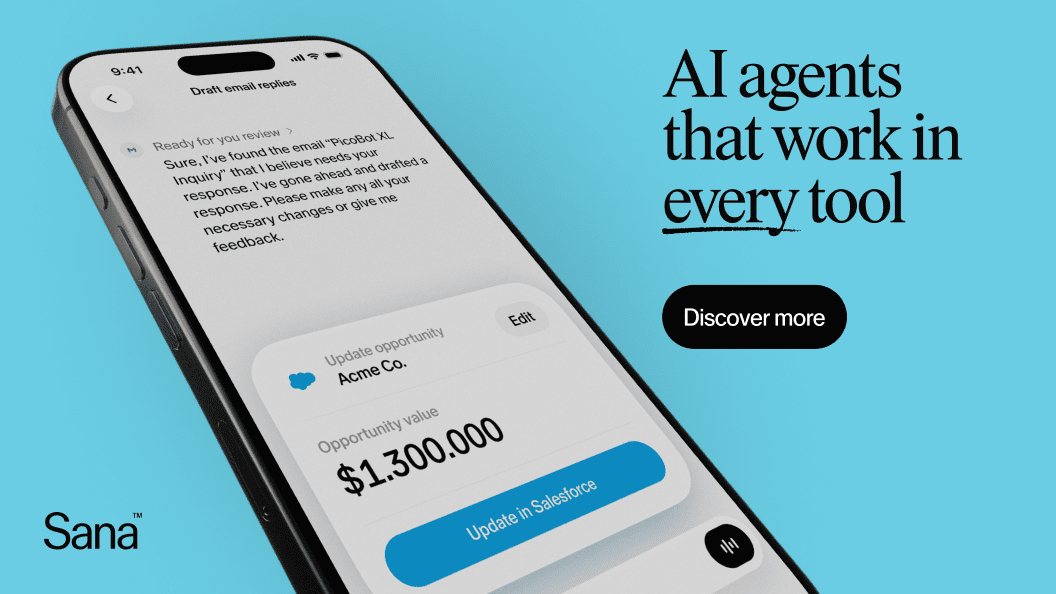
The End of Context Switching: How Sana's AI Agents Are Unifying the Fragmented Workplace
For the modern knowledge worker, the day is not a seamless flow of productivity—it is a relentless series of interruptions. Toggle between Gmail and Slack. Copy data from Salesforce into a spreadsheet. Search Google Drive for that one document. Switch to Teams for a meeting, then back to Outlook to reply to an email. This constant context switching is not just annoying; it is cognitively expensive, fragmenting focus and draining hours that could be spent on deep, meaningful work. The promise of AI has long been to automate the mundane, but most tools still operate in silos, requiring users to bridge the gaps themselves. Enter Sana, a platform built on a different premise: what if AI didn't just assist you in one app, but connected all your apps, turning fragmentation into flow? With AI agents that integrate with over 100 enterprise applications—from Gmail, Outlook, and Teams to Salesforce, Google Drive, and BigQuery—Sana is not just another productivity tool. It is the operating system for a unified, intelligent workplace.
The core innovation of Sana lies in its agentic architecture. Unlike traditional automation platforms that require rigid, pre-defined workflows, Sana's AI agents are dynamic, context-aware, and proactive. They don't just wait for commands; they understand intent, coordinate across systems, and execute multi-step tasks without human intervention. Imagine asking your AI to "prepare a summary of last week's customer feedback from Salesforce, cross-reference it with support tickets in Zendesk, and draft a report for the product team." In a conventional setup, this would require manual data extraction, spreadsheet manipulation, and document formatting. With Sana, the agent orchestrates the entire process: querying databases, synthesizing insights, and generating a polished deliverable—all while you focus on strategy, not logistics.
This is automation that thinks, not just acts.
The integration breadth is what makes this vision scalable. By connecting with more than 100 widely used applications, Sana meets teams where they already work. There is no need to migrate to a new platform or force adoption of unfamiliar tools. Instead, Sana's agents operate as a universal layer of intelligence, sitting atop existing workflows and enhancing them. For a sales team, this means AI can pull CRM data from Salesforce, enrich it with email history from Gmail, and surface actionable insights in Slack—all without a single manual export. For a research team, it means querying BigQuery for analytics, summarizing findings from Google Drive documents, and presenting results in a Teams channel, seamlessly. The result is not just efficiency; it is cohesion. Data and actions flow where they are needed, breaking down the silos that have long plagued enterprise software.
The productivity gains are profound, but the most transformative benefit may be cognitive. By eliminating the need to constantly switch contexts, Sana allows teams to remain focused on high-value work. Research suggests that it can take over 20 minutes to fully regain deep focus after an interruption. When AI handles the coordination, search, and summarization across apps, employees spend less time managing tools and more time creating, deciding, and innovating. This is not about working faster; it is about working smarter. Sana's agents act as force multipliers, amplifying human expertise by removing the friction that dulls it.
The economic implications are equally compelling. Sana claims that organizations can reduce operational costs by 10 to 20 times through intelligent automation. This is not hyperbole; it is the arithmetic of eliminated redundancy. When AI automates routine tasks—data entry, report generation, meeting scheduling, cross-referencing information—the hours saved compound across teams and departments. For a mid-sized company, this could mean reclaiming thousands of hours per year, reallocating talent from administrative overhead to strategic initiatives. Moreover, by reducing errors associated with manual processes, Sana improves decision quality and operational reliability. The ROI is not just in cost savings, but in accelerated execution and competitive agility.
But Sana's value extends beyond task automation. Its ability to search, summarize, and synthesize information across disparate sources turns data overload into clarity. In an era where information is abundant but insight is scarce, the capacity to instantly query all your company's knowledge—emails, documents, databases, chat logs—and receive a concise, accurate summary is transformative. This is particularly powerful for onboarding, decision-making, and innovation. New employees can get up to speed faster by asking AI to "explain our Q3 strategy based on all leadership communications." Executives can make informed choices by requesting "a risk assessment of our supply chain using data from ERP, logistics, and market reports." Sana becomes the institutional memory and analytical engine of the organization, always available, always contextual.
The platform's design also prioritizes security and governance—critical considerations for enterprise adoption. Integrations are managed through secure APIs, with granular access controls ensuring that AI agents only interact with data users are authorized to see. Audit trails provide transparency into agent actions, and compliance frameworks can be embedded into workflows. This is not a black box; it is a governed intelligence layer that respects organizational policies and regulatory requirements. For industries like finance, healthcare, or legal, where data privacy is paramount, this balance of power and control is essential.
Sana represents a broader shift in how we think about workplace technology. The future is not about more apps; it is about smarter connections. As AI becomes more capable, the value of any single tool diminishes relative to the value of integration. The winner will not be the platform with the most features, but the one that best unifies the ecosystem. Sana's agentic approach—dynamic, context-aware, and cross-platform—positions it at the forefront of this evolution. It acknowledges that work is not done in isolation; it is a network of interactions, data flows, and collaborative decisions. By making AI the connective tissue of that network, Sana enables a new paradigm: work that is fluid, intelligent, and human-centered.
For leaders navigating digital transformation, the message is clear: productivity is no longer about individual tools, but about systemic intelligence. Investing in a platform like Sana is not just an IT decision; it is a strategic imperative. It signals a commitment to empowering employees, optimizing operations, and staying agile in a rapidly changing market. The companies that thrive in the next decade will be those that leverage AI not as a novelty, but as infrastructure—woven into every workflow, amplifying every decision, connecting every dot.
The era of fragmented, interrupt-driven work is ending. In its place rises a vision of seamless, intelligent collaboration, where AI agents handle the complexity so humans can focus on creativity, strategy, and impact. Sana is not just a product; it is a blueprint for that future. By unifying apps, data, and actions through agentic AI, it offers a path to a workplace that is not only more efficient, but more humane. The question is no longer whether AI will transform work, but how quickly organizations can embrace the tools that make that transformation real.
The future of work is unified. The future of work is intelligent. And with Sana, that future is already here.
Your one-stop shop for automation insights and news on artificial intelligence is EngineAi.
Did you like this article? Check out more of our knowledgeable resources:
Watch this space for weekly updates on digital transformation, process automation, and machine learning. Let us assist you in bringing the future into your company right now