The Proactive Morning: How ChatGPT Pulse is Redefining the AI Assistant as a Personal Chief of Staff
For years, the promise of artificial intelligence has been reactive: you ask, it answers. You prompt, it generates. You command, it executes. But the next frontier of AI is not about waiting for instructions—it is about anticipating needs. This week, OpenAI took a significant step toward that future with the release of ChatGPT Pulse, a new preview feature available exclusively to Pro subscribers at $200 per month. Pulse proactively creates customized morning briefings while users sleep, synthesizing conversation history, user comments, and linked Gmail and Google Calendar data into five to ten curated cards delivered at dawn. This isn't just another notification feature; it is a fundamental reimagining of the AI assistant—from a tool you use to a partner that prepares for you. In an era where attention is the scarcest resource, Pulse offers something rare: clarity, curated before your day begins.
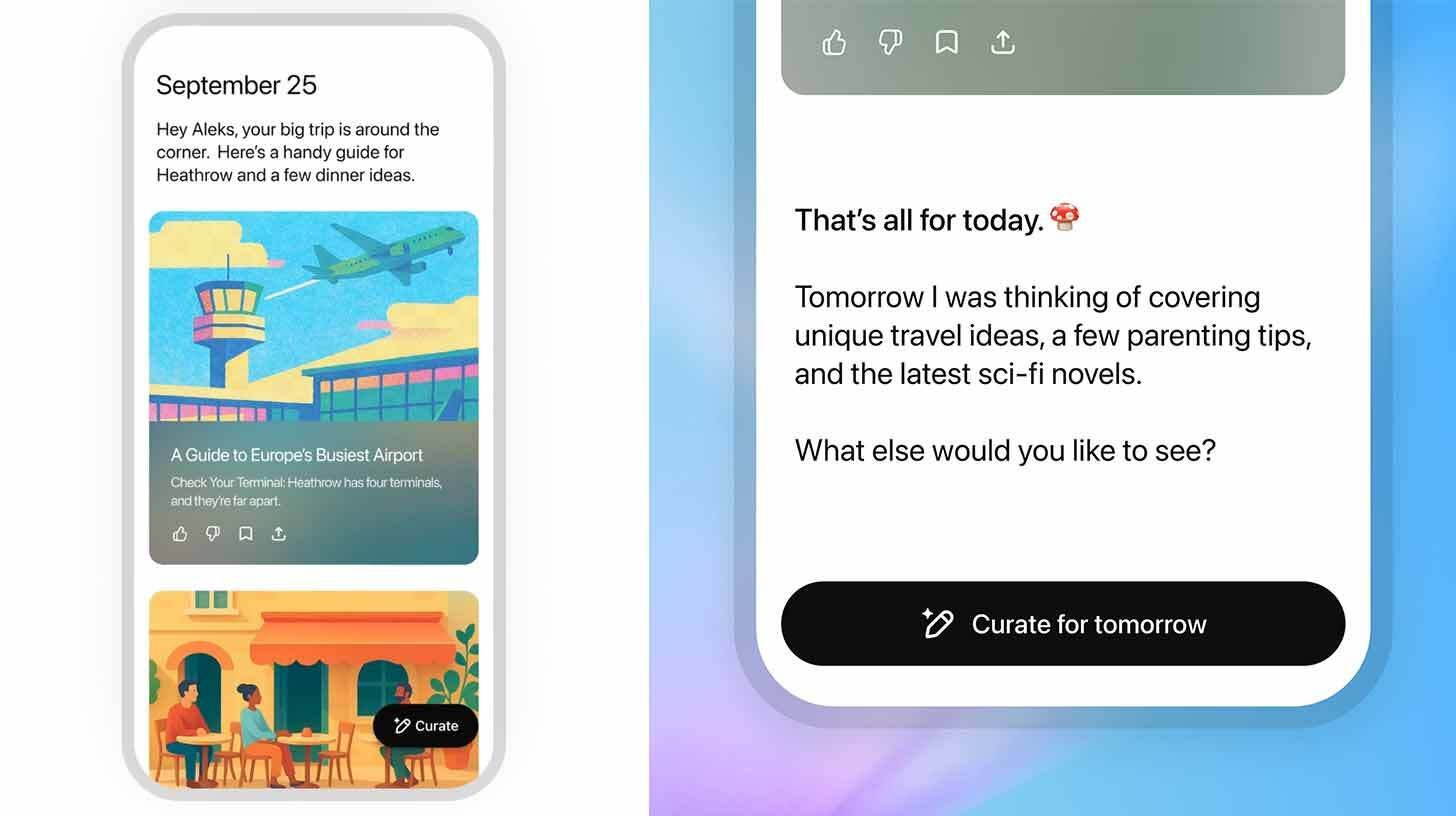
The mechanics of Pulse are elegantly designed to balance automation with control. Overnight, the feature analyzes your digital footprint—emails, calendar events, past conversations, and explicit preferences—to generate a personalized briefing. Each "card" might summarize an upcoming meeting with relevant context, highlight an unanswered email that requires attention, surface a news story aligned with your interests, or remind you of a deadline based on your project history. Users can influence future briefings through direct requests ("Include more tech news") or simple thumbs-up feedback, creating a reinforcement loop that refines the AI's understanding of what matters to you. Unless otherwise specified, updates refresh daily, ensuring the briefing evolves with your changing priorities. Crucially, Pulse is designed to halt after delivering its cards, displaying "that's it for today" to prevent engagement-driven scrolling. This intentional constraint reflects a mature design philosophy: the goal is utility, not addiction.
The strategic implications of this feature extend far beyond convenience. Pulse represents the convergence of several powerful trends in AI development: personalization, agentic behavior, and contextual awareness. By integrating productivity tools, news aggregation, data connectors, and life insights into a single morning roundup, OpenAI is positioning ChatGPT not just as a chatbot, but as a personal chief of staff—a proactive agent that manages information flow so you can focus on execution. For knowledge workers drowning in notifications, this is transformative. Instead of starting the day by triaging emails, scanning headlines, and reviewing calendars, you begin with a synthesized digest that highlights what truly matters. The cognitive load shifts from filtering to acting, from searching to deciding.
The Pro-tier exclusivity is a deliberate choice with broader strategic significance. OpenAI has signaled that Pulse is the first of several "compute-intensive" features that will be tested with the highest-paying subscribers before trickling down to Plus users. This tiered rollout serves multiple purposes: it validates demand for premium functionality, generates revenue to offset the substantial computational costs of proactive AI, and creates a feedback loop with power users who can provide nuanced input on feature refinement. For the industry, this model suggests a future where advanced AI capabilities are gated not just by access, but by willingness to pay for the infrastructure that enables them. The era of free, unlimited AI may be giving way to a more sustainable, value-based pricing structure.
Yet, the personalization that makes Pulse powerful also raises important questions about privacy and data governance. To generate a truly useful briefing, the feature requires access to sensitive information: your emails, your calendar, your conversation history. OpenAI has emphasized that users maintain control over what data is linked and can disconnect sources at any time. But the very act of aggregating these streams creates a detailed profile of your professional and personal life—a profile that, if compromised, could have significant consequences. Transparency about data usage, robust encryption, and clear opt-out mechanisms will be essential to maintaining trust.
Moreover, users must consider the trade-off: the more data Pulse accesses, the more valuable its insights become, but the greater the potential exposure. This is not a new dilemma in the digital age, but it is one that demands careful, ongoing negotiation.
The design decision to limit Pulse's output—to stop after "that's it for today"—is noteworthy in an industry often criticized for maximizing engagement at the expense of user well-being. By resisting the temptation to create an infinite scroll of AI-generated content, OpenAI is signaling a different value proposition: efficiency over addiction, curation over consumption. This aligns with a growing movement toward "calm technology," where digital tools respect human attention rather than exploiting it. For professionals seeking to reclaim focus in a distracted world, this philosophy could be a significant differentiator. Pulse isn't trying to keep you hooked; it is trying to set you free.
Looking ahead, Pulse hints at a broader trajectory for AI assistants. As models become more capable of understanding context, anticipating needs, and acting autonomously, the boundary between tool and teammate will blur. Future iterations might not just summarize your day—they might draft responses to routine emails, propose agenda items for meetings, or suggest optimal times for deep work based on your energy patterns. The agentic era is not about replacing human judgment; it is about amplifying it by handling the routine, the repetitive, and the administrative. Pulse is a first step toward that vision: a morning briefing that doesn't just inform, but empowers.
For enterprises, the implications are equally significant. If individual users benefit from proactive briefings, teams and organizations could leverage similar capabilities to align priorities, surface cross-functional dependencies, and reduce meeting overhead. Imagine a Pulse for your project team: overnight, it synthesizes updates from Slack, Jira, and email to produce a shared digest that highlights blockers, celebrates wins, and flags decisions requiring attention. This could transform asynchronous collaboration, making distributed teams more cohesive and efficient. OpenAI's consumer-facing feature may be the prototype for a new category of enterprise AI: the proactive coordinator.
The broader lesson is that the value of AI is shifting from raw capability to contextual relevance. A model that can answer any question is impressive; a model that knows which questions you should be asking is indispensable. Pulse embodies this shift by moving from generality to specificity, from reaction to anticipation. It acknowledges that in a world of information abundance, the scarce resource is not knowledge, but judgment—knowing what to focus on, when to act, and how to prioritize.
For Pro subscribers, Pulse offers an early glimpse of that future. For the rest of us, it offers a blueprint: the AI assistant of tomorrow will not wait for prompts; it will prepare the ground so your prompts matter more. The question is no longer whether AI can be proactive, but how we design proactivity that serves human goals without undermining human agency.
The age of reactive AI is ending. In its place rises a vision of anticipatory intelligence—where your assistant knows your schedule, understands your priorities, and prepares your day before you wake. ChatGPT Pulse is more than a feature; it is a statement about the future of human-AI collaboration. The morning briefing has been reinvented. The only thing left to do is start the day.
Your one-stop shop for automation insights and news on artificial intelligence is EngineAi.
Did you like this article? Check out more of our knowledgeable resources:
Watch this space for weekly updates on digital transformation, process automation, and machine learning. Let us assist you in bringing the future into your company right now