Instagram’s Aesthetic Is Dead, Says the Guy Who Built It
How Adam Mosseri’s year-end memo became the app’s own obituary for the perfect grid—and what comes next
How Adam Mosseri’s year-end memo became the app’s own obituary for the perfect grid—and what comes next
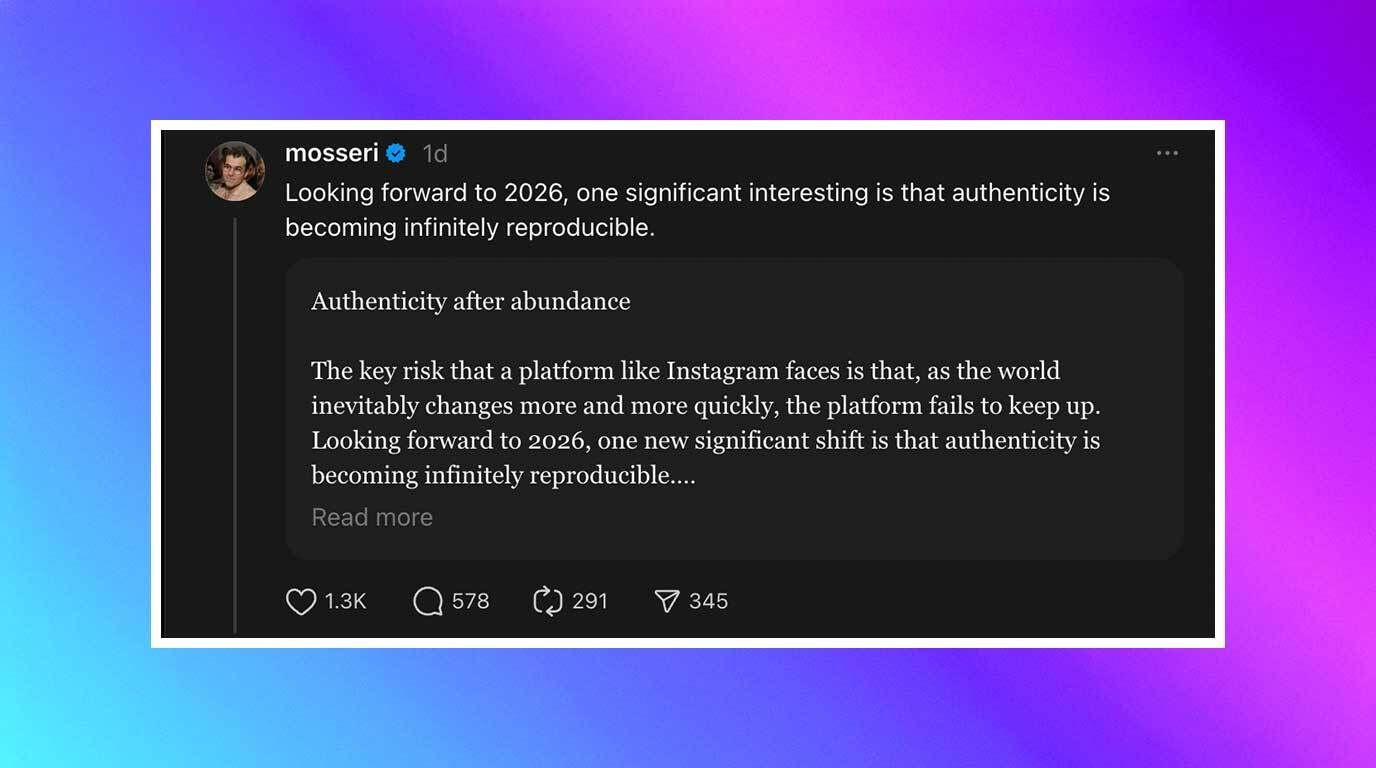
If you opened Instagram this week and felt the feed looked a little … desperate, you’re not imagining it. The Valencia-toned lattes, the color-coordinated sneaker shots, the influencer-pose that somehow made a Taco Bell look like Santorini—those images are vanishing faster than a Story at 24 hours. In a 2,500-word year-end essay posted to his personal account, Instagram head Adam Mosseri announced that the curated aesthetic his platform once fetishized is officially extinct. The culprit, he admits, is the very technology his parent company is racing to build: generative AI.
“Perfection used to signal effort,” Mosseri wrote. “Now it signals forgery.”
The memo, decorated with grainy, flash-lit candids of his kids and a dog that is definitely not groomed for social media, is the most candid admission yet from a Big Social CEO that the visual internet has entered its post-authenticity era. Below the post, top-liked comments range from celebratory (“Finally, the tyranny of the teal-orange feed is over”) to apocalyptic (“So we’re just surrendering to the bots?”). Either way, the message is the same: the Instagram that taught a billion people to style their brunch is gone, and it’s not coming back.
From Filter Culture to Filter Failure
Instagram’s origin story is inseparable from the rise of filter culture. When Kevin Systrom and Mike Krieger launched the app in 2010, the iPhone 3G’s 3-megapixel camera produced images that looked like washed-out security stills. Instagram’s one-tap filters—X-Pro II, Lo-Fi, Earlybird—hid the hardware’s flaws and gave everyday shots the nostalgic patina of film. By 2012, “shoot, filter, post” had become the universal grammar of social media. Brands spent millions perfecting a “grid aesthetic”; influencers planned feeds nine posts at a time; wedding photographers started listing “Instagram-worthy” as a deliverable.
Instagram’s origin story is inseparable from the rise of filter culture. When Kevin Systrom and Mike Krieger launched the app in 2010, the iPhone 3G’s 3-megapixel camera produced images that looked like washed-out security stills. Instagram’s one-tap filters—X-Pro II, Lo-Fi, Earlybird—hid the hardware’s flaws and gave everyday shots the nostalgic patina of film. By 2012, “shoot, filter, post” had become the universal grammar of social media. Brands spent millions perfecting a “grid aesthetic”; influencers planned feeds nine posts at a time; wedding photographers started listing “Instagram-worthy” as a deliverable.
The ascent of AI-generated imagery in 2023 cracked that mirror. Suddenly anyone could conjure a hyper-real Tuscan sunset without leaving a Brooklyn studio. At first the fakes were easy to spot—six-fingered hands, Morse-code teeth—but by mid-2024 the best Midjourney v7 outputs were indistinguishable from Hasselblad RAW files. Users who had spent years mastering Lightroom presets watched AI accounts rack up seven-figure followings by posting four “photos” a day of places that never existed. The signal-to-noise ratio flipped: perfection was no longer proof of skill; it was evidence of algorithmic sleight-of-hand.
Mosseri’s memo concedes the point. “We built Instagram to celebrate human creativity,” he writes. “When a machine can mimic that creativity pixel-for-pixel, the platform has to reinvent what it rewards.”
Gen Z Already Moved On
The reinvention is less a strategic choice than a rear-guard action. Internal data cited by Mosseri shows that users under 25 now post 64 % of their “sharing activity” inside private DMs rather than to the main feed. The preferred format is the raw, front-camera snapshot—what researchers call the “photo dump” or, more derisively, the “ugly pic.” These images are intentionally unflattering: red-eye, greasy hair, dirty mirrors, half-eaten burritos. Their value lies precisely in their refusal to be beautiful. In other words, the one thing an AI still struggles to fake is deliberate ugliness.
The reinvention is less a strategic choice than a rear-guard action. Internal data cited by Mosseri shows that users under 25 now post 64 % of their “sharing activity” inside private DMs rather than to the main feed. The preferred format is the raw, front-camera snapshot—what researchers call the “photo dump” or, more derisively, the “ugly pic.” These images are intentionally unflattering: red-eye, greasy hair, dirty mirrors, half-eaten burritos. Their value lies precisely in their refusal to be beautiful. In other words, the one thing an AI still struggles to fake is deliberate ugliness.
Mosseri calls this “proof-of-life” media. “A candid is hard because it requires being somewhere, with someone, at a specific moment,” he told staff in a December all-hands. “That friction is the new authenticity.”
The irony is rich: the generation that grew up watching influencers turn every coffee into content is now rejecting the performative polish that made Instagram a $50-billion-a-year business. But the shift is measurable. Time-spent in the DM tab has doubled since 2022, while feed-scrolling sessions have plateaued. Even ad dollars are following the migration; brands now seed “close-friends” lists with micro-influencers who post unboxing videos that disappear in 48 hours.
Can Crypto Save the Real?
Mosseri’s essay isn’t just a eulogy—it’s a product roadmap. The most concrete proposal is a call for camera manufacturers to embed cryptographic signatures at the moment of capture. Think of it as a blockchain birth certificate for every JPEG: a tamper-proof metadata string that records device serial number, timestamp, GPS coordinates, and a hash of the original sensor data. Instagram would display a check-mark badge—similar to the verified badge on accounts—on any image that arrives with a valid signature.
Mosseri’s essay isn’t just a eulogy—it’s a product roadmap. The most concrete proposal is a call for camera manufacturers to embed cryptographic signatures at the moment of capture. Think of it as a blockchain birth certificate for every JPEG: a tamper-proof metadata string that records device serial number, timestamp, GPS coordinates, and a hash of the original sensor data. Instagram would display a check-mark badge—similar to the verified badge on accounts—on any image that arrives with a valid signature.
Sony, Canon and Apple are already piloting versions of the technology under an open standard called C2PA (Coalition for Content Provenance and Authenticity). Nikon has promised firmware updates for its Z-series mirrorless line by summer. But the scheme faces headwinds. Privacy hawks warn that immutable metadata could dox protestors or abuse survivors. And crypto-bros smell a new NFT-style grift, whispering about “minting” every shutter click as an on-chain asset. Mosseri brushes the criticism aside. “We don’t need to solve every edge case,” he writes. “We need to give users a reason to trust something—anything—again.”
Labels, Context and the Arms Race
Beyond hardware authentication, Instagram will roll out three AI countermeasures in 2026:
Beyond hardware authentication, Instagram will roll out three AI countermeasures in 2026:
- Mandatory labeling. Any image whose metadata shows generative-AI derivation (via fields like “Generated by DALL-E”) will carry an irremovable on-image banner reading “AI-generated.” Attempts to crop or screenshot the label will trigger re-detection by parent company Meta’s in-house classifier.
- Provenance cards. Tapping the three-dot menu on any post will surface a “Why am I seeing this?” panel that lists account age, country of origin, and percentage of AI content posted in the last 30 days. The idea is to shift trust from the artifact to the actor—Mosseri’s line about “you’ll trust who posted it, not what it looks like.”
- Creator co-pilot. Rather than ban AI, Instagram will give human creators a dashboard of AI tools—voice cloning, scene extension, automatic captions—whose outputs are auto-labeled. The goal is to level the playing field so that flesh-and-blood influencers can post at machine speed without being mistaken for machines themselves.
Whether users will notice—or care—is another question. Early tests in Brazil showed a 12 % drop in engagement on posts carrying the AI badge. Meanwhile, Reddit forums dedicated to Stable Diffusion are already swapping tips on how to strip C2PA metadata with open-source scripts. The arms race is asymmetric: faking reality keeps getting easier, while proving reality still requires supply-chain coordination among chip fabs, camera makers and social platforms.
The Existential Part
Mosseri ends his essay on an almost philosophical note. “Instagram cannot be the museum of the future if every painting is a forgery,” he writes. “But it also can’t be a museum if no one wants to stand still long enough to look.” Translation: the app has to survive not only the death of its founding aesthetic, but also the migration of its core behavior—sharing pictures of your life—into private, ephemeral spaces where ads can’t follow.
Mosseri ends his essay on an almost philosophical note. “Instagram cannot be the museum of the future if every painting is a forgery,” he writes. “But it also can’t be a museum if no one wants to stand still long enough to look.” Translation: the app has to survive not only the death of its founding aesthetic, but also the migration of its core behavior—sharing pictures of your life—into private, ephemeral spaces where ads can’t follow.
The company’s answer, hinted at but not yet announced, is a pivot from “feed” to “context.” Imagine opening Instagram in 2027 and seeing not an endless scroll, but a map of where your friends are right now, overlaid with RAW, cryptographically signed photos they shot milliseconds ago. The interface would look more like Find My than Vogue. Monetization would shift from banner ads to real-world transactions—book this restaurant, split that Uber, join the flash-mob pop-up store. In that world, Instagram becomes not a gallery you visit, but a layer on reality you live inside.
Will it work? Ask the 18-year-old who hasn’t posted to her grid since 2023. She’s already sharing her life; she just isn’t sharing it with the algorithm. Mosseri’s memo is a bet that, with the right infrastructure, she might. If not, Instagram risks becoming the world’s most profitable archive of a moment no one wants to relive—an AI-generated mausoleum of perfect sunsets, forever untouched by human hands.
Your one-stop shop for automation insights and news on artificial intelligence is EngineAi.
Did you like this article? Check out more of our knowledgeable resources:
📰 In-depth analysis and up-to-date AI news .
🤝 Visit to learn about our goal and knowledgeable staff.
📬 Use this link to share your project or schedule a free consultation.
Watch this space for weekly updates on digital transformation, process automation, and machine learning. Let us assist you in bringing the future into your company right now.
Did you like this article? Check out more of our knowledgeable resources:
📰 In-depth analysis and up-to-date AI news .
🤝 Visit to learn about our goal and knowledgeable staff.
📬 Use this link to share your project or schedule a free consultation.
Watch this space for weekly updates on digital transformation, process automation, and machine learning. Let us assist you in bringing the future into your company right now.