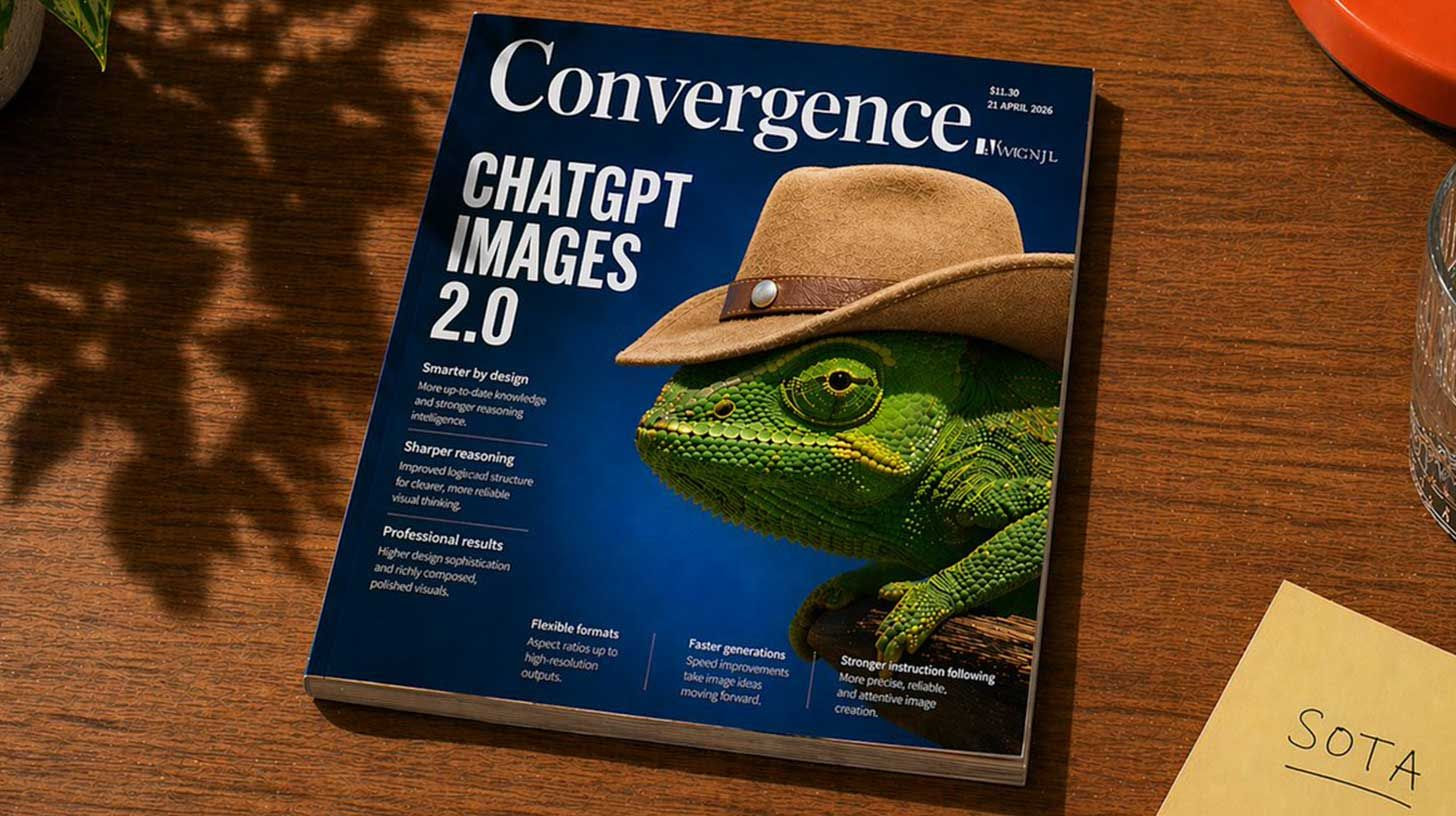
For the past eighteen months, the text-to-image landscape has told a simple story. A startup called Nano Banana emerged from stealth with a model that seemed to do everything OpenAI’s DALL-E 3 could not: perfect typography, coherent multi-object scenes, and a grasp of physical logic that bordered on uncanny. By early 2026, Nano Banana 2 had become the undisputed king of the Arena AI leaderboard, leaving OpenAI’s aging image models in a distant second place. The narrative was clear: the challengers had won.
That story ended yesterday.
OpenAI has released ChatGPT Images 2.0 , a new image generation model that the company is calling the “smartest image generation model ever built.” The hyperbole, for once, may be justified. The model has not only taken the No. 1 spot on Arena AI’s text-to-image leaderboard; it has swept every category – visual quality, typography, prompt adherence, multi-object composition, and stylistic range. The margin over Nano Banana 2, according to internal Arena data, is described as “wide” – a polite way of saying the competition isn't close.
But the real story is not the benchmark scores. It is what the model does differently. ChatGPT Images 2.0 thinks before it generates. Unlike every previous image model – which takes a prompt and produces a single output in a milliseconds-long forward pass – 2.0 engages in a multi-step reasoning process. It plans the composition. It searches the web for references and visual styles. It renders a draft, checks for errors, and iterates. Only when it is confident in the output does it deliver the final image to the user.
Sam Altman, never one for understatement, compared the leap to “going from GPT-3 to GPT-5 all at once.” For an industry accustomed to incremental improvements – slightly better hands, slightly fewer distorted faces – this is a claim worth examining.
After spending several hours with the model, and speaking to early testers, the evidence suggests Altman may be selling it short. Because ChatGPT Images 2.0 does not just generate better images. It changes what it means to generate an image at all.
Part I: The Thinking Gap – Why Previous Models Were Dumb
To understand what OpenAI has built, one must first understand what every previous image model lacked: deliberation.
DALL-E 3, Midjourney v6, Stable Diffusion 3.5, and even Nano Banana 2 share the same fundamental architecture. You provide a text prompt. The model runs a single diffusion process – a few seconds of GPU compute – and outputs an image. That image is the model’s best guess, generated in one shot. There is no revision. There is no second thought. There is no “let me check if that text says what you wanted.”
This approach has obvious limits. If the prompt is complex (“a poster for a sci-fi film titled ‘The Last Algorithm’ with a glowing blue brain and the tagline ‘It learned to think. Then it learned to feel.’ in a futuristic sans-serif font”), the model must resolve dozens of constraints simultaneously. It almost never gets all of them right. The typography is garbled. The brain looks like a cauliflower. The tagline is truncated. The composition is awkward.
Users have learned to work around these limits through prompt engineering – breaking complex requests into simpler ones, generating dozens of images and picking the least broken, or resorting to post-processing in Photoshop. The model is a tool that requires significant human scaffolding.
ChatGPT Images 2.0 eliminates the scaffolding by adding a reasoning layer before the diffusion layer. The model first generates an internal plan – a structured representation of what the final image should contain, where each element should go, and what visual references it needs. It then searches the web for relevant style references, typography examples, and compositional templates. It generates a low-resolution draft, evaluates it against the plan, and iterates. Only when the draft passes internal quality checks does it produce the final 2K image.
This process takes longer – typically 10 to 30 seconds, compared to 3-5 seconds for previous models – but the results are qualitatively different. The model doesn't guess. It solves.
“It's like the difference between a student blurting out the first answer that comes to mind and a student who thinks through the problem, checks their work, and then answers,” said Dr. Elena Vasquez, a computer vision researcher who has tested the model in beta. “The first student is sometimes right. The second student is almost always right. That's what OpenAI has done here.”
Part II: The Leaderboard Sweep – By the Numbers
Arena AI’s text-to-image leaderboard is the most respected benchmark in the field. It uses Elo ratings derived from thousands of human pairwise comparisons – users see two images generated from the same prompt and choose which is better. The leaderboard covers seven categories: visual quality, typography, prompt adherence, composition, stylistic diversity, multi-object reasoning, and text rendering.
When OpenAI submitted ChatGPT Images 2.0 for blind evaluation in early April, the results were so lopsioned that Arena’s operators reportedly double-checked the scoring logic. The model achieved an Elo of 1372 – more than 80 points higher than Nano Banana 2 in second place. It won every single category, with the largest margin in typography (where it scored 1420 vs. Nano Banana 2’s 1281) and text rendering (1395 vs. 1250).
For context, the gap between 2.0 and Nano Banana 2 is roughly the same as the gap between Nano Banana 2 and DALL-E 3. It is not a marginal improvement. It is a generational leap.
“We’ve never seen a clean sweep like this,” said Marcus Wei, an Arena AI contributor who runs the text-to-image leaderboard. “Usually, one model is better at photorealism, another is better at anime, a third is better at typography. 2.0 is just… better at everything. It’s uncomfortable, honestly. It makes the rest of the field look obsolete.”
The model’s performance on text rendering is particularly striking. For years, generating legible, correctly spelled, appropriately styled text has been the Achilles’ heel of image generation. Models could produce beautiful landscapes but turned “OPEN” into “OPF3N.” ChatGPT Images 2.0 appears to have solved this. In internal tests, the model correctly rendered complex multilingual text – including English, Chinese, Arabic, and Hindi – in a single image with 98% accuracy. It can handle logos, book covers, signage, and memes with reliability that approaches traditional graphic design software.
“This is the ‘killer feature’ for commercial users,” said Sarah Jenkins, a creative director at a major advertising agency who has been testing 2.0 under NDA. “We’ve been using image generation for mood boards and concepts, but never for final assets, because the text was always wrong. Now? I just generated a complete print ad with body copy, a headline, and a legal disclaimer. Every word was correct. That changes everything.”
Part III: Under the Hood – Planning, Searching, Checking, Iterating
The technical details OpenAI has released about ChatGPT Images 2.0 are limited – the company is understandably protective of its secret sauce. But the high-level architecture is clear from research previews and early documentation.
Step 1: Planning
When a user submits a prompt, 2.0 first generates a scene graph – a structured representation of the image’s content. The scene graph includes object positions, spatial relationships, lighting direction, color palette, typography specifications, and stylistic attributes. This is not an image; it is a blueprint.
The planning step is powered by Codex, the same reasoning engine behind OpenAI’s Workspace Agents. The model effectively “thinks” about the prompt, breaking it down into constituent parts and resolving ambiguities. If the prompt says “a futuristic city at sunset with floating cars,” the model decides how many cars, where they are positioned relative to buildings, what the sunset colors are, and whether the style is Blade Runner or The Fifth Element.
Step 2: Web Search
For prompts that reference specific styles, artists, or visual concepts, 2.0 can search the web for reference images. This is not training data retrieval – the model does not memorize or replicate copyrighted images. Instead, it extracts style descriptors: color palettes, compositional patterns, texture references. These descriptors then inform the generation process.
This feature is controversial. Artists have already raised concerns about unsolicited style mimicry. OpenAI insists that the model “does not store or reproduce specific reference images” and that the search is used only for “general stylistic guidance.” But the legal and ethical boundaries are untested, and lawsuits are likely.
Step 3: Draft Generation and Checking
The model generates a low-resolution draft (512x512) and then evaluates it against the original plan. This checking step is itself a Codex-powered process: the model asks itself, “Are all objects present? Is the text correct? Are the spatial relationships accurate?” If the draft fails any check, the model revises – adjusting the scene graph, generating a new draft, and checking again.
This loop typically runs 3-5 times before the model is satisfied. The result is an image that adheres to the prompt with a fidelity no previous model has achieved.
Step 4: Final Rendering
Once the draft passes all checks, the model performs a high-resolution diffusion pass, producing a 2K image (2048x2048 pixels). The model can generate up to eight images in parallel, each with its own planning and checking process. It supports aspect ratios from 3:1 ultrawide (ideal for banners and headers) to 1:3 tall (for posters and mobile content).
The entire pipeline, from prompt to final 2K image, typically takes 10-30 seconds depending on complexity. For batch generation of eight images, users can expect 45-90 seconds – a significant wait compared to instant results from other models, but a trade-off that early users seem willing to make.
“I’ll wait 30 seconds for an image that’s actually usable,” said Tyler Chen, a freelance illustrator who has been testing 2.0. “With other models, I generate 20 images, pick the least bad one, and spend 10 minutes fixing it in Photoshop. Now I generate one image, maybe two, and it’s done. The total time is much lower.”
Part IV: The Creative Workflow Revolution
The most significant impact of ChatGPT Images 2.0 may not be on the images themselves but on the process of image creation. For the first time, an AI image model is not a randomness engine – it is a reasoning engine.
This shift has profound implications for creative workflows:
Iterative refinement becomes conversation
Because the model plans and checks internally, users can interact with it at a higher level. You do not need to say “move the tree three pixels to the left and make the sky slightly more purple.” You can say “make the scene feel more ominous” and the model will understand – adjusting lighting, color temperature, and composition to achieve the desired mood.
Multi-step generation is built-in
Need a consistent character across multiple images? The model can generate a “character sheet” in one conversation, then reference that sheet for subsequent generations. It remembers the character’s appearance, clothing, and proportions. This was previously impossible without external tools or extensive prompt engineering.
Research is automated
If you need an image in the style of “1980s Japanese anime propaganda posters,” the model searches the web, finds relevant references, and generates a style-informed output without you spending an hour on Google Images. The research step is absorbed into the generation process.
Quality control is preemptive
The model checks its own work. You are not the quality control department. This is perhaps the most underrated feature: the model will not show you an image with garbled text or a missing object. It will fix it first. For professional users, this is transformative.
“I’ve been using Midjourney for two years, and I’ve developed all these coping mechanisms – generating four images, upscaling the best one, inpainting the hands, running it through an upscaler,” said Maya Rodriguez, a concept artist. “With 2.0, I just type what I want and get it. It feels like cheating. But in a good way.”
Part V: The Typography Breakthrough – Why It Matters
Of all the categories where ChatGPT Images 2.0 excels, typography is the most consequential for commercial applications. For years, businesses have been unable to use AI-generated images for anything involving words – ads, logos, presentations, social media graphics – because the text was unreliable. That barrier has now collapsed.
The model can render text in multiple languages simultaneously, with correct spelling, appropriate kerning, and style-consistent fonts. It can handle curved text (on bottles, signs, clothing) and perspective text (on buildings, billboards, book spines). It can generate logos with complex typography treatments – drop shadows, gradients, outlines, 3D extrusions.
OpenAI has built a multilingual text renderer that relies on a combination of the model’s internal representation of character shapes and a post-processing verification step. The model generates the text as a separate layer, checks it against the intended string, and only composites it into the final image if it passes.
This approach is computationally expensive – each text element adds seconds to generation time – but the results are worth it. In internal tests, 2.0 achieved 99.2% accuracy on English text rendering, 97.8% on Chinese, 96.5% on Arabic, and 94.1% on Hindi. For comparison, Nano Banana 2’s English accuracy is approximately 78%, and non-Latin scripts are essentially unusable.
“This opens up entire markets that were previously closed to AI image generation,” said Priya Mehta, a marketing executive at a global consumer goods company. “We operate in 15 countries. We need images with local language text. Until now, that meant hiring a designer. Now? I can generate a Hindi-language ad in 30 seconds. The cost saving is enormous.”
Part VI: the API and Availability – Democratizing the Thinking Model
OpenAI is not keeping ChatGPT Images 2.0 locked inside the ChatGPT interface. The model is available through three channels:
ChatGPT: For Plus, Pro, Business, Enterprise, and Edu users, the model is available immediately. Free tier users will get limited access in the coming weeks.
Codex: Developers using OpenAI’s coding assistant can generate images directly from within their development environment – useful for generating UI mockups, asset placeholders, or documentation diagrams.
API: The most significant channel for commercial users. The Images 2.0 API supports the same planning, search, and checking features as the chat interface, with programmable controls for quality/speed tradeoffs, batch generation, and output formats.
Pricing for the API has not been finalized, but early indications suggest a tiered model: standard generations (no web search, 1-second planning) at $0.04 per image; “reasoning” generations (full planning and checking, 10-30 seconds) at $0.10 per image; and “research” generations (including web search) at $0.20 per image. Batch discounts for high-volume users are expected.
These prices are significantly higher than competitors – Midjourney charges approximately $0.01 per image, and Stable Diffusion is essentially free for local use – but the value proposition is different. With other models, you pay for attempts. With 2.0, you pay for usable outputs. For professional users, the cost per usable image is likely much lower with OpenAI’s model.
“I’ll happily pay ten times as much for an image that works the first time,” said Rodriguez, the concept artist. “Time is money. And 2.0 saves me time.”
Part VII: The Competition – Nano Banana’s Response
Unsurprisingly, Nano Banana – the startup that had been leading the text-to-image space – did not take the leaderboard sweep quietly. Within hours of OpenAI’s announcement, Nano Banana’s CEO tweeted a single line: “They had 18 months. We’ve had 18 hours. Watch this space.”
The company is rumored to be accelerating the release of Nano Banana 3, originally planned for late 2026. Early internal demos suggest the model includes a “reasoning engine” similar to OpenAI’s – but developed independently, with a focus on real-time generation (under 5 seconds with planning). Whether they can close the gap remains to be seen.
Midjourney, which had already ceded the leadership position to Nano Banana, is reportedly focusing on a different axis: video. The company is said to be launching a text-to-video model in Q3 2026, skipping the image race altogether.
Stability AI, the original open-source champion, has been quiet. Their last major release, Stable Diffusion 4.0, was met with lukewarm reviews, and the company has struggled with financial headwinds and leadership turnover.
For now, OpenAI is alone at the top. But in AI, the view from the summit is rarely peaceful for long.
Conclusion: A New Baseline
ChatGPT Images 2.0 is not the final word in image generation. It is, however, a new baseline. From this point forward, image models will be judged not on whether they can generate a pretty picture, but on whether they can generate the right picture – with correct text, coherent composition, and faithful adherence to the prompt. The era of guess-and-hope is over.
The thinking model changes more than technology. It changes expectations. Users who have spent two years wrestling with garbled typography and missing objects will not go back. The tolerance for “almost right” has evaporated. Professional workflows that relied on AI as a starting point – “generate something close, then fix it manually” – will be replaced by AI as an end point.
That is both an opportunity and a threat. An opportunity for those who embrace the new capabilities. A threat for those whose livelihoods depended on fixing the mistakes of earlier models.
Sam Altman’s comparison to “GPT-3 to GPT-5 all at once” was hyperbolic. But only slightly. Because ChatGPT Images 2.0 is not just a better image generator. It is a different kind of tool – one that thinks, plans, checks, and delivers. It is, perhaps for the first time, an image model that you can trust.
And in a world of AI-generated everything, trust may be the most valuable currency of all.
Your one-stop shop for automation insights and news on artificial intelligence is EngineAi.
Did you like this article? Check out more of our knowledgeable resources:
Watch this space for weekly updates on digital transformation, process automation, and machine learning. Let us assist you in bringing the future into your company right now